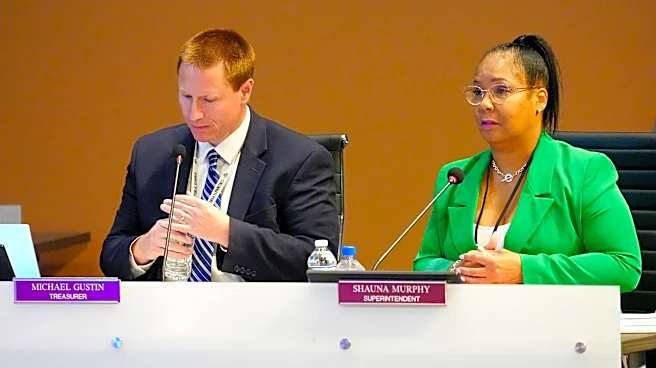








Cincinnati Public Schools' Superintendent Shauna Murphy saw a decline in her overall score from the Board of Education in its annual evaluation, dropping to 3.3. on a scale of 1 to 5, down from the 4.6 she earned last year.
The school board used the recently released school report card data from the Ohio Department of Education and Workforce to determine whether Murphy improved student outcomes on a list of predetermined goals. Of those markers, Murphy fell short on meeting targets for third grade reading proficiency, algebra I proficiency and closing reading gaps between economically disadvantaged and non-disadvantaged students.
Those student performance goals account for 60% of Murphy's final evaluation score. The other parts are made up by
her ability to meet superintendent standards and her preparation and participation in a midpoint check-in with the board.
In public comment, Cincinnati Federation of Teachers President Julie Sellers praised Murphy's ability to lead during a particularly turbulent time for the district, as it navigates a multimillion-dollar deficit andshrinking state funds.
"I sincerely hope the board is considering the extraordinary circumstances under which (Murphy) has been asked to lead Cincinnati Public Schools," Sellers said referring to the board's evaluation.
Murphy, a longtime CPS staffer, was unexpectedly tapped to assume the role in a November 2024 board vote. She replaced Iranetta Wright, who resigned in spring 2024 after six unions that contract with the district voted no confidence in her.

Despite the dip in Murphy's evaluation, the district as a whole saw major gains in its most recent state report card, earning its first-ever 3-star score, up from the 2.5-star score it's earned the last two years.
Breaking down Shauna Murphy's 2025-26 evaluation:
The majority of the superintendent's evaluation, which can be viewed in full here, is determined by whether the five student performance goals below were met, per data from the 2025-26 school year.
- Increasing third grade reading proficiency from 55.7% to 59.7% by September 2026 (Actual = 58.9%).
- Raising algebra I proficiency for first-time test-takers from 47.1% to 51.1% by September 2026 (Actual = 48.9%).
- Closing the sixth grade reading gap between economically disadvantaged and non-disadvantaged students from 50.7% to 47.7% by September 2026 (Actual = 48.5%).
- Add two new industry-recognized credential options valued at 7 points or higher by September 2026 (Actual = six credentials).
- Creating a new three-year Strategic and Financial Plan by Aug. 3, 2026 (Plan was formally proposed at the Sept. 14, 2026 meeting).
These five goals were finalized by the board in a vote at Murphy's last evaluation, in October 2025.
The last two pieces of the superintendent's evaluation are a board survey of Murphy's ability to meet Ohio's five superintendent standards and Murphy's preparation for and participation in a midpoint check-in with the board. The survey accounts for 30% of the overall score and the check-in accounts for 10%.
CPS superintendent evaluation has changed in recent years
The method with which the board evaluates the CPS superintendent has varied over the years, and there's no one way districts in the region do it.
There's no legal requirement to use any one kind of process, Teri Morgan, senior deputy director of board and management services at the Ohio School Boards Association, previously told The Enquirer.
The highest-ranking official at CPS used to be evaluated on about 20 different state standards such as strategic visioning, talent development and community-building. Starting with Wright, Murphy's predecessor, the board introduced performance objectives, using student performance data to evaluate the superintendent's leadership.
Last year marked the first time the board used a policy to formalize when and how the superintendent is evaluated on those performance objectives.
Board approves 4 of 5 new goals for 2026-27 school year
In a unanimous vote at its Oct. 12 meeting, the board approved the following four markers that Murphy will be evaluated against for the current school year:
- Increasing third grade reading proficiency from 58.9% to 62% by September 2027.
- Increasing the College, Career, Workforce and Military Readiness measure of the state report card from 64.7% to 81.5% by September 2027.
- Reducing the district's chronic absenteeism rate from 46.2% to 43.5% by September 2027.
- Increasing the number of the district's schools that meet or exceed state standards, or earn 3 or more stars on state report cards, from 30 to 38 schools.
The board did not approve its fifth goal and instead tabled it to a future vote to figure out its wording. That goal involved increasing the share of teachers with full credentials in schools that are currently not meeting state standards in the education department's report cards.
This article originally appeared on Cincinnati Enquirer: Cincinnati schools' superintendent gets lower score from school board