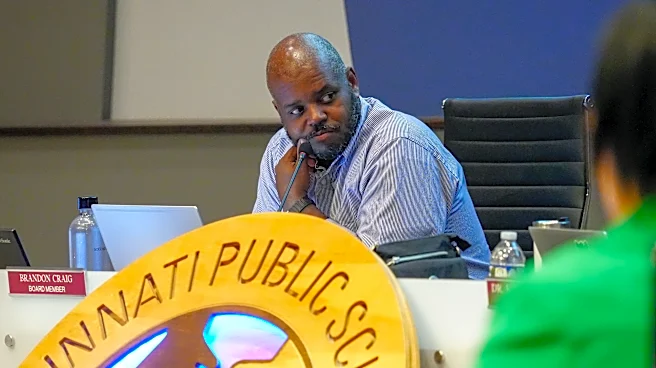







Cincinnati Public Schools' decision to seek an earned income tax for the first time has quickly drawn opposition from both political parties in Hamilton County.
Republican Party Chairman Josh Gerth called the school board's levy vote "offensive" in a statement shared on July 28, one day after the board voted 5-2 to put the tax on the November ballot.
At a separate meeting on July 28, the executive committee of the Hamilton County Democratic Party voted to urge Cincinnati schools not to put an earnings tax on the ballot.
That puts the school board in an awkward position: all seven of the school board members are Democrats, though the position is officially nonpartisan.
At a rate of 0.75%, the proposed earned income tax would amount to $750 annually
for someone with a yearly income of $100,000. And for a salary of $54,500 – the average earned income for those living in the district – the tax would amount to $408 annually, or $15.72 per paycheck.
What Republicans said about the CPS tax
Republican Party Chairman Josh Gerth called the school board's levy vote "offensive" in a statement shared on July 28.
"There are a lot of problems in the city's schools - the size of their budget is certainly not one of them," Gerth wrote. "This proposal is irresponsible, reckless, and the Hamilton County Republican Party stands ready to oppose this levy this November."
Gerth added that the region's largest district is failing to educate its kids, alluding to CPS's latest, 2.5-star report card wherein it fell short of the state's 3-star overall performance goal and the slight rise in its chronic absenteeism rates.
What Democrats said about the tax
The Democratic party's executive committee voted 50-23 to urge the school board to rethink the levy, party chair Alex Linser told The Enquirer. The committee is made up of Hamilton County elected officials, party leadership, ward chairs and other members appointed by the chair.
Cincinnati Federation of Teachers President Julie Sellers, said no one from the school board consulted with county nor city officials like Mayor Aftab Pureval before the earned income tax vote was made.
The board should have opted for a property tax instead, Sellers previously said. An earnings tax shifts the tax burden away from commercial property owners and on to workers, "the employees who are making $15 an hour. Is that fair to working families?" she told The Enquirer.
The reconsideration vote was not an official endorsement position. Linser said the committee will vote on official endorsements after Aug. 5, the filing deadline for local ballot issues.
"Our membership is not in a position to support the tax, but everybody has an appreciation of the position the school board is in," Linser said, noting that schools see less money from the state government than they used to. "The bill is coming due for all of the bad policy-making decisions in Columbus."
Could Cincinnati Public Schools change its levy vote?
The school board is allowed to revise its earned income tax vote per the board's own parliamentary rules as long as they do so by the county's filing deadline of Aug. 5 at 4 p.m.
CPS's school board follows Robert's Rules of Order, which says one of the five board members who voted in support of the earned income tax must make the motion to reconsider.
The board could act at its standard business meeting scheduled for Monday, Aug. 3 at 5:30 p.m. An agenda has yet to be released for that meeting.
Why is Cincinnati Public Schools seeking an earned income tax?
Marking the first time CPS has proposed a new-money levy since 2016, the ask for taxpayer funds comes just weeks after the board voted to cut over 100 personnel to chip away at a $58.6 million deficit. Five furlough days for administrators and teachers totaling $7.5 million in savings were also approved.
School board and district officials say new revenue is imperative in avoiding even deeper reductions to operations and staff in the future.
CPS joins districts across the state cobbling together budgets in a turbulent funding landscape characterized by sweeping property tax reform, state funds that stray from the Fair School Funding Formula and shrinking enrollment thanks to private school vouchers.
The recently proposed tax on income would generate $74 million annually for CPS, with potential to increase up to $2 million annually as residents' wages grow, district Treasurer Mike Gustin said at Monday night's special meeting.
The district's latest move mimics a trend across the region, with urban districts resorting to income taxes given the property tax fatigue felt by some homeowners.
This article originally appeared on Cincinnati Enquirer: Democrats join GOP in asking Cincinnati schools to rethink levy