









When Cincinnati sold its railroad in 2024, the city promised some of that money to the historic College Hill Town Hall.
But the $5 million proposed for a Town Hall renovation in this northwest Cincinnati neighborhood never came.
Now, the final tenant is leaving, frustrated by the building's deterioration and lack of city follow-through. Mutual Dance Theatre and Arts Centers
will vacate the premises by year's end."Every time I come to the building, there's another giant problem," said Jeanne Mam-Luft, the dance group's executive director. "I can't do this anymore."
College Hill Town Hall has been down this road before, struggling to find willing tenants and needed dollars since at least the mid-1970s. Over time, the hulking 140-year-old structure
was rescued by College Hill's community council, a senior center, a theater group, the YMCA, the Masons, dances, lectures and even a ping-pong club.
With no one currently waiting in the wings to fill the space, the future of this Samuel Hannaford-designed landmark is unclear.
Leaking water, falling plaster and now, mold, too
Mam-Luft took to Facebook on Oct. 11 to post her decision.
She began using College Hill Town Hall around 2007, in space leased to Contemporary Dance Theater in 1999. Mutual Dance became the tenant in 2021 after it merged with Contemporary Dance.
"We've always faced a lot of issues," Mam-Luft said on the College Hill Neighbors' Facebook page.
In the last five years, those included leaking water, falling plaster, inefficient heating, vandalism and break-ins, she told The Enquirer. She stopped teaching children in the building, fearful of lead paint exposure. She stopped using the space in hot weather, since it lacked air conditioning.
She decided to depart after finding mold in the basement. "I just couldn't fight anymore," she said on Facebook.
At midweek, the building at Larch and Belmont avenues sat empty, save the giant mirrors in its three dance studios. Someone from a nearby church dropped in to see about taking some folding chairs. Students from neighboring Aiken New Tech High School smoked marijuana in the parking lot and congregated in a stairwell.
In the musty-smelling basement, the plastic baseboards were dotted with black mold.
Mutual Dance spent thousands while promised city funds, director says
Mam-Luft said the city told her the building would be boarded up when Mutual Dance is out.
City spokesperson Mollie Lair said the building would be "closed as the city considers next steps for the space" but not boarded up. "The city has no plans to tear it down," she said via email.
Lair also said Mutual Dance's lease made it responsible for upkeep and operations. The lease also made the dance company responsible for addressing mold, she said.
To that, Mam-Luft said her small nonprofit spent "thousands and thousands" to heat and maintain the building. As a small nonprofit, "we just don't have the money," she said.
She also said the city did not come through with two pledges to help.
The first was a verbal promise of $200,000, she said. She wanted to put those dollars toward air conditioning.
The second was $5 million from the Cincinnati Southern Railway Trust, listed in a 2023 city memo outlining proposed use of proceeds from selling the railway. College Hill Town Hall was one of nine projects that would share $49.6 million designated for public service projects, the memo from City Manager Sheryl Long said.

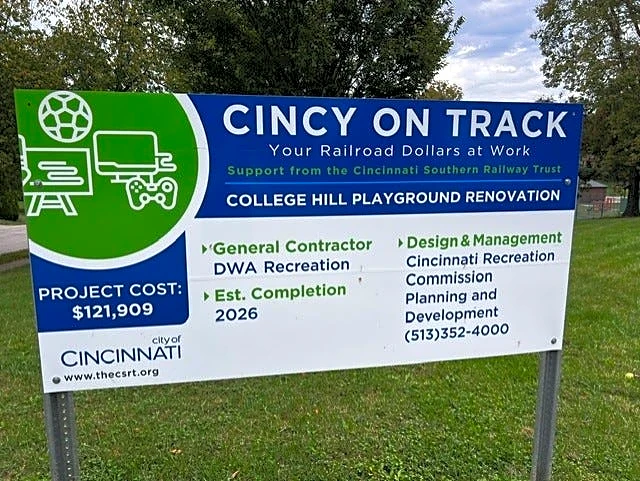
Playground facilities surrounding the Town Hall are getting $121,909 in railway money for renovations, according to an on-site sign and the Cincy on Track website.
Town Hall is not listed on any sign or site.
The city's department of public services requested money for the building during development of the 2026-27 capital budget, Lair said. It was not approved.
With spending of railway sale dollars just kicking off July 1, 2025, "many proposed projects ... have not yet been funded," she said.
Lair also said the city will complete an assessment of the building's condition by year's end as it seeks a new tenant. "We anticipate working with College Hill stakeholders on repurposing the building into a new use," she said.
As to $200,000 for College Hill Town Hall, Lair said the city has no record of that commitment.

Struggles for tenants and money date to at least mid-1970s
Famed Cincinnati architect Samuel Hannaford – credited with Cincinnati's Music Hall, City Hall and dozens of other notable Cincinnati buildings – designed College Hill Town Hall.
What was then the village of College Hill moved into the brick and stone structure in 1887, paying $6,000 for 5 acres of land and $15,000 for construction, a 1987 Cincinnati Post report said. The village police and fire departments used some of the 17 rooms, with a jail on the ground floor.
The city of Cincinnati took ownership in 1911, the year it annexed College Hill into the city.
Tenants came and went over the decades, leaving Town Hall vacant from time to time, news stories reported. In 1978, the building was boarded up, vandalized and likely to be demolished, the city said in its successful application to place the Town Hall on the National Register of Historic Places.
Then, as now, the building needed money.
"It's been a constant fund-raising effort," an officer of College Hill Forum, the neighborhood's community council, told the Post in 1987.

'Mad and sad' neighbors suggest who might help
As the city contemplates the future of College Hill Town Hall, neighbors just learned about its condition and funding woes from Mam-Luft's Facebook post.
"This makes me so mad and sad," one reader responded. "I fear what comes of the building," said another.
They suggested:
- Enlisting the College Hill Community Urban Redevelopment Corp. for help. That group's sole focus is the neighborhood business district, CEO Emmanuel Karikari told The Enquirer.
- Asking the College Hill Forum to intervene. Forum President David Borreson said the group "is definitely interested in being part of that conversation" and wants to protect the building from blight but isn't likely to buy it.
- Leaning on the building's place on the historic register for protection. That listing recognizes the building's significance but does not require the city to maintain, repair or even save it, according to the Ohio History Connection, the state's nonprofit historical society.
Mam-Luft's dance company, meanwhile, carries on in Hartwell, its second location since 2019.
She is disappointed the city did not treat her like a partner during the five years she lobbied for assistance. "This building needs so much help and work," she said. "We need entities in the city to work together and figure it out."
She departs in defeat.
"I feel horrible," she said. "I didn't want to do this. I didn't want to give up."
This article originally appeared on Cincinnati Enquirer: Railroad sale was set to save historic building, but money never came