





How do you want your eggs − scrambled, fried, or over easy?
For most of us, that has been about the only decision we were ever asked to make about an egg. Whether it came from a hen roaming a barnyard, confined to a hen house, or living in a cage rarely made it to the breakfast table.
Now several well-funded animal-rights groups want to change that. Backed in part bybillionaire philanthropy, they are pressuring Cincinnati-based Kroger to stop selling eggs from caged hens, effectively telling consumers that one of the cheapest sources of protein should no longer be available unless it meets their preferred animal-welfare standard.
This dispute is about much more than chickens.
It raises
a larger question: When advocacy groups want to change social policy, should they persuade consumers to change their behavior − or pressure corporations to take away choices consumers may still want?
Kroger's critics have a legitimate complaint

The campaign against Kroger is not a shoestring protest.
The Enquirer reported that Animal Equality received more than $2.2 million in May from Coefficient Giving specifically for "cage-free accountability." Cari Tuna and her husband, Facebook co-founder Dustin Moskovitz, founded Coefficient Giving. It also gave The Humane League, another organization protesting Kroger, $10 million in general support this year.
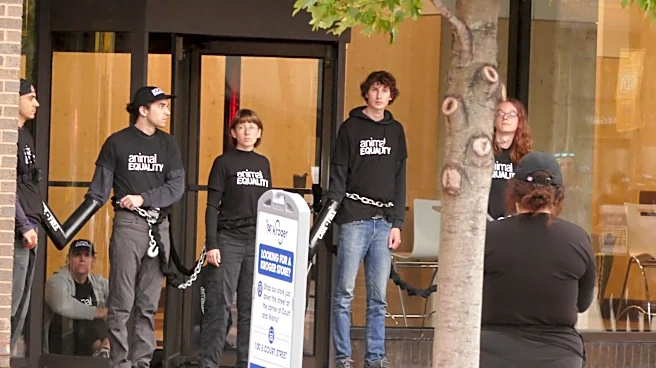
Animal Equality protesters have demonstrated outside Kroger headquarters throughout the summer. Nine activists were arrested Sept. 23 after chaining themselves to entrances at Kroger’s downtown headquarters.
There was something notable about those nine protesters: Not one was from Cincinnati. Not one was even from Ohio. They came from Texas, Massachusetts, Nevada, Virginia, Illinois, North Carolina, Florida and Pennsylvania.
That does not make their cause illegitimate. Americans are free to travel anywhere in the country to protest anything they choose.
But it does tell us something about what we are watching. This was not a spontaneous uprising of disgruntled Kroger shoppers from Hyde Park and Westwood. It was part of an organized national campaign designed to put sustained pressure on a Cincinnati corporation until it changes its policy.
But they do have a valid complaint.
In 2016, Kroger announced that it intended to transition to a 100% cage-free egg supply by 2025. It did not do it. Kroger now says it plans to reach about 70% cage-free by 2030.
If you make a public commitment, people are entitled to ask why you failed to keep it.
Cage-free comes with a cost
But Kroger also has an explanation that should not be brushed aside.
The company says cage-free eggs generally cost about 30% more to produce than conventional eggs. Kroger argues that eliminating the cheaper eggs would disproportionately affect lower-income shoppers who depend on eggs as an affordable source of protein.
Kroger says customer behavior has not matched the expectations behind its original pledge. In a previous animal-welfare update, the company said cage-free egg supply was exceeding customer demand despite its efforts to promote the more expensive eggs.
There is a fairly simple way to settle that disagreement.
Put both on the shelf and let customers decide
Put both kinds of eggs on the shelf. Explain how they are produced. Put the prices underneath them.
Then let the customer decide.
Those who believe keeping hens in cages is unacceptable can buy cage-free eggs. Kroger itself has promoted cage-free products and says it will continue expanding their availability.
Those who are counting every dollar in their grocery cart can buy the less expensive eggs.
The animal-welfare advocates would respond that this treats unnecessary animal suffering as merely another consumer preference. Their argument deserves to be heard. Conventional cages substantially restrict hens’ movement and natural behaviors, which is precisely why animal-welfare organizations have made eliminating them a priority. Coefficient Giving openly describes corporate pressure campaigns as a strategy for moving companies toward cage-free production.
But recognizing that concern does not answer the economic question.
It is much easier for a billionaire-backed philanthropic organization to decide that a 30% difference in production cost is acceptable than it is for a family standing in a Kroger aisle trying to stretch $100 into a week’s groceries.
Nor is “cage-free” synonymous with the pastoral picture consumers may imagine. It generally means hens are not confined in individual cages and can move within an indoor housing system. It does not necessarily mean chickens are wandering through green pastures.
That is an important improvement in freedom of movement. But it is not Old MacDonald’s farm.

Animal Equality and The Humane League have every right to protest Kroger. They have every right to tell us that cage-free eggs are better for chickens. They can ask Kroger to explain why it abandoned a promise it made 10 years ago.
And then they should try something more difficult.
Persuade us.
If enough Kroger customers agree with them and willingly pay more for cage-free eggs, conventional eggs will disappear because no one will be buying them.
That is consumer choice doing exactly what consumer choice is supposed to do.
The alternative is increasingly common: well-financed advocacy organizations target large corporations and persuade − or pressure − them to make social choices for millions of customers who were never part of the conversation.
Today, the argument happens to be about eggs.
The larger question is who gets to decide what remains on the shelf.

Dennis Doyle lives in Anderson Township and is a member of the Enquirer Board of Contributors.
This article originally appeared on Cincinnati Enquirer: Want Kroger to sell cage-free eggs? Convince its customers | Opinion