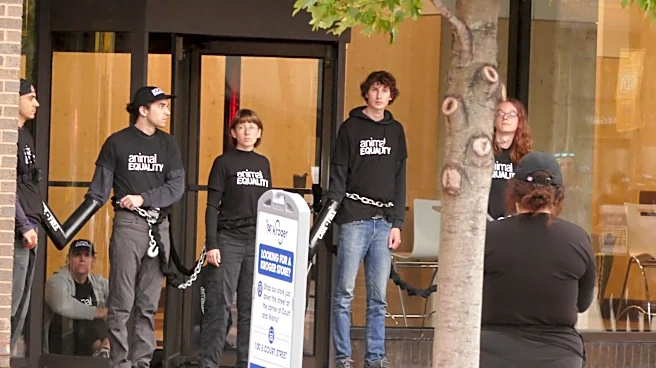

If you drive downtown or follow local news, you've likely seen the egg protests in front of Kroger, the Cincinnati-based supermarket giant.
Last week, nine out-of-town protesters were briefly jailedafter
blocking the entrance to the headquarters of the nation’s largest traditional grocer – some were even chained to the front door. So what’s their beef with Kroger’s eggs? Well, the grocer backed out on a 2016 promise to switch to selling only cage-free eggs by 2025. Four years ago, the company quietly scaled that goalback to 70% cage-free by 2030.
But it turns out Kroger isn't the only retailer to go back on the cage-free by 2025 promise. So did Walmart, Target and Aldi, which all made their pledges around the same time nine years ago.
The Sept. 23 arrests marked the most dramatic moment in a summer-long protest campaign outside Kroger headquarters over the company's cage-free egg policies. There was a brief toning-down of demonstrations after Downtown residents and shopkeepers began complaining about the noise.
"Until they take this issue seriously and sit down with us for a constructive conversation about its plans to end cages for hens, we will continue this campaign,” said Sharon Nunez, president of Los Angeles-based Animal Equality, in a statement after the arrests.
More protests by another animal rights group are also on the way.
Starting Sept. 28, Rockville, Maryland-basedthe Humane League, is also threatening to disrupt Kroger’s business. In an advisory, the group said it plans to protest outside a business conference held by Kroger merchandisers and supply clients at theNational Underground Railroad Freedom Centerat The Banks. Some protesters will don giant inflatable chicken costumes, while others will be dressed in “money” suits.
So what exactly are cage-free eggs, what is Kroger doing that’s drawn so much criticism, and why? And who are the groups behind the campaign? It turns out there's some big money and a Facebook connection.

What are cage-free eggs and who is selling them at their stores?
“Cage-free” is a grading by the U.S. Department of Agriculturefor eggs “laid by hens that are able to roam vertically and horizontally in indoor houses … in a manner that promotes bird welfare,” according to the regulator. The idea is the eggs are from chickens kept in more humane conditions.
Kroger and several other retailers already sell them. In 2024, 41% of all eggs sold by Kroger (by unit volume, not dollars) were cage-free. When the grocer first announced its plans to switch to all cage-free eggs, it touted its leadership in championing the product: “Kroger has been a leader in cage-free eggs for many years,” it proclaimed in 2016.
So how does Kroger stack up compared to others in the industry? Most major retailers disclose their cage-free efforts in annual sustainability reports.
Walmart, the world’s largest grocer,also promisted to go cage-free in 2016.
“While we did not meet our 2025 aspiration for cage-free eggs to represent 100% of shell egg sales … we work to increase customer adoption over time,” the Arkansas-based juggernaut said in its latest sustainability report.
And as for Aldi? It promised in 2016 and lapsed since. Mass discounter Target also missed its mark.
“We will not achieve our goal to transition to a 100% cage-free shell egg supply chain by 2025 due to industry-wide challenges. ... Despite this, ALDI remains committed to responsible sourcing and will continue to evolve our approach with the industry,” it said in a footnote in its 2024 sustainability report, which did not specify how much of its egg volume is cage-free. The report has not been updated.
Vincenzina Caputo, an agriculture economist with Michigan State University, said part of the problem with grocers trying to switch is the cost to vendors to overhaul production and hen housing. She estimated fewer than half of U.S. egg-laying hens were cage free.
"It illustrates the scale of the transition that remains across the industry," she said.

So how much of major retailers' eggs sold are cage-free compared to Kroger?
- Amazon’s subsidiary Whole Foods Marketonly sells cage-free eggs.
- Costconotched 84.7% of its egg sales as cage-free in the U.S.
- Albertsonsreported 75% of its eggs sold were cage-free.
- At Walmart's subsidiarySam’s Club, 67.0% of all shell eggs sold in the U.S. are cage-free.
- Ahold-Delhaize (which owns Food Lion, Stop & Shop, Hannaford and Giant Food) reported 53% of its eggs sold were cage-free.
- Target reports more than half its eggs by unit volume are cage-free.
- 41% of all eggs sold in 2024 by Kroger were cage-free.
- Publix reported cage-free egg items “only make up a little more than one-third of our volume.”
- At Walmart, 30.4% of shell eggs sold at U.S. stores are cage-free.
Kroger and other retailers have noted supply and other issues that slowed promised progress. One of the biggest was the runaway inflation and choppy economy of this decade.

Kroger considers eggs an ‘everyday essential’ that can sway consumers’ sense of affordability
As of August, the price of food at the grocery store has shot up more than 31% since March 2020 at the start of the COVID-19 pandemic – outpacing overall inflation that climbed 29% in the same period, according to data by the U.S. Bureau of Labor Statistics.
And the price of eggs has been among the most volatile in supermarket aisles: soaring from a U.S. average of $1.53 for a dozen large grade A eggs in March 2020 to as high as $6.23 in March 2025, before dropping back to $2.27 in August 2026, according to federal data.
Cage-free eggs cost more, which makes them a tougher sell to customers, retailers say. On Kroger’s website, a dozen Grade A large white eggs are priced at $1.49; a dozen large brown cage-free eggs go for between $3.99 and $4.99.
Eggs are a very sensitive item for Kroger too. Internally, the grocer’s merchandisers classify it among five items – out of thousands throughout its stores – as “everyday essentials.” Store officials consider eggs, along with milk, sugar, iceberg lettuce and bananas, as grocery items that shoppers watch particularly closely. If your eggs are considered too pricey, the thinking goes, then your store is considered too expensive.
"Keeping food affordable and delivering value for our customers, particularly as families face higher costs, remains a core priority," Kroger said after the arrests.
Glynn Tonsor, an agriculture economist with Kansas State University, said there's a disconnect between what shoppers support in principle and what they do when they open their wallets.
For his research, he surveys consumers on the most important factors that lead them to buy meats – and price is the third most important factor behind taste and freshness. Animal welfare ranks near the bottom (10th) among 12 factors influencing consumer choices.
"I think price is more important to consumers," he said. "(Cage-free) sounds good, but most consumers don't pull the trigger."

Who are these protest groups?
Of the nine protesters arrested during the disruption at Kroger headquarters, not one of them was from Ohio or Kentucky. Only one was from the Midwest (Chicago).
Animal Equality is a Los Angeles-based nonprofit founded in 2006 and bills itself as “one of the most effective advocates for farmed animals in the world,” according to its website. Last year, it generated $6 million in revenue, mostly from donations, according to its annual 990 financial disclosure form filed with theU.S. Internal Revenue Service.
The nonprofit has 26 employees and boasts nearly 14,000 volunteers. Its president, Sharon Nunez, is married to the organization’s executive vice president, Jose Valle, who both work full-time for the nonprofit; each makes more than $100,000, according to the filing. The nonprofit spent nearly $475,000 paying its officers and trustees and another $1.3 million to its staff. Last year, it spent $82,000 on professional fundraising fees and $2.5 million on “other expenses.”
In the disclosure, the nonprofit describes several campaigns against unnamed large corporations to switch to cage-free eggs, including retailers, restaurant chains and hotel operators.
On its website, Animal Equality touts that it got discounter Target in March to commit to 100% cage-free eggs by 2030 after missing its 2025 deadline. The group also claims it won more disclosure from grocer Ahold Delhaize on its shift to cage-free eggs by 2032.
A different group is behind the planned protests promising inflatable chicken costumes, called the Humane League, based out of Maryland. It has a larger paid staff and raised more money than Animal Equality, according to its financial disclosure. The nonprofit generated $22.1 million last year and has 112 staff as well as 232 volunteers.
“We exist to end the abuse of animals raised for food. This mission is executed by persuading companies and institutions to adopt animal welfare policies through negotiation and pressure campaigns,” the group said, describing its mission in the filing. Among the targets of its campaigns: sandwich-maker Subway; grocery giant Ahold-Delhaize; hotelier Best Western, restaurant chain Cheesecake Factory; and discounter Walmart.

Billionaires who care and the Facebook connection to the money funding the protest groups
While both groups are staging different protests on some of the same targets, they have something else in common: major financial backing by a San Francisco-based nonprofit Coefficient Giving that previously went by the name Open Philanthropy.
It was founded by its chair Cari Tuna, a former Wall Street Journalreporter, and her husband, Dustin Moskovitz, a billionaire cofounder of Facebook. In 2010, they became the youngest couple to signBill Gates’ and Warren Buffett's Giving Pledge, agreeing in their 20s to give away most of their billions in wealth via philanthropy.
Coefficient Giving officials did not reply to two emailed requests from The Enquirer to comment for this story.
Coefficient Giving’s filing states the organization’s simple mission as supporting “various charitable cause areas to help others and our world with the resources available.” Perhaps what makes the group’s filing stand out is the sheer size of its resources available: It generated nearly $101 million last year.
The nonprofit uses that money to fund various causes from air quality to combating lead exposure. One of its causes is also “farm animal welfare,” to improve the lives of farm animals.
According to the nonprofit’s website, it gave Animal Equality more than $2.2 million in May for its “cage-free accountability” work at about the time protests outside Kroger headquarters began this year. The group has also previously donated to Animal Equality, giving a total of $10.8 million between 2016 and 2021.
The nonprofit also gave a big donation to the Humane League in January: $10 million for “general support." Previously, it had donated $63.5 million to the group between 2015 and 2025.

This article originally appeared on Cincinnati Enquirer: Kroger egg protests, broken promises and ties to big Facebook money