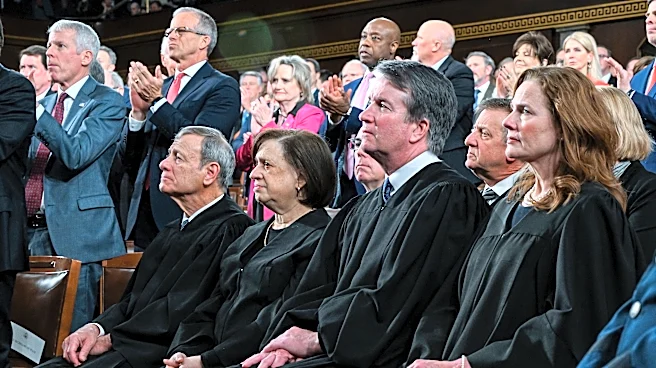










Judges are used to having the last word. Their credibility, inconveniently, is not theirs to decide.
According to a July Gallup poll, 33% of Americans approve of how the U.S. Supreme Court is doing its job. But approval is not the same as credibility.
As an Ohio Supreme Court justice, I have learned that credibility is essential to the institution. Judges should not worry about whether the public approves of a particular ruling. They should care deeply about whether the public trusts the courts to apply the law fairly and to recognize the limits of their power.
Courts are rarely far from the national spotlight. Gallup polling over the years suggests that Americans' views of the Supreme Court can shift sharply following controversial decisions.
That shouldn't alarm judges. Popularity is not our job.
Credibility is.
Judges should confront the unpleasant fact that their credibility no longer comes automatically with the robe. The judiciary must earn back its public credibility. A good place to start is in state courts.
Most justice happens in state courts
The National Center for State Courts reported that 70 million cases were filed in America's state courts in 2024. For most Americans, an encounter with the judiciary is likely to take place in a local courtroom. Those encounters involve divorce cases, criminal cases, landlord-tenant cases, and other everyday disputes.
Before joining the Ohio Supreme Court, I served as a trial court judge. I talked with people from all walks of life about their courthouse experiences. A common theme in their responses was convenient parking, passing through security, and, most importantly, whether the judge was fair. Judges and lawyers contemplate doctrine. Citizens wonder if the courthouse works. I don't want to leave the impression that this view is unsophisticated. Just the opposite. This is how most people see justice.
The robe doesn't confer wisdom

Judges should remember the robe doesn't confer wisdom. Judges have expertise in the law. Judges routinely must decide cases involving subjects in which they aren't experts. A robe no more makes a judge an expert in economics than a trip to the Ohio State Fair makes one an expert in sculpting the butter cow. Knowing the difference between interpreting the law and deciding what the law ought to be is where judicial humility begins.
Judges need to write shorter opinions in plain English. Brevity seems to be valued everywhere, except in judicial opinions. An opinion isn't written to demonstrate how much the judge knows. It's written to explain why the court ruled the way it did. If an opinion looks ready for a law school casebook, it probably isn't ready for anybody else.
Not every problem, however serious, is one judges can solve. Sometimes the law requires a court to say, "This isn't ours to decide," and leave the matter to the executive or legislative branches. Credibility is earned by recognizing the limits of judicial authority. That's not judicial weakness; it's knowing where judicial power ends. Not every problem needs a gavel.
Judicial restraint belongs neither to the left nor the right. Applied consistently, restraint leaves in place a policy a judge dislikes. Sometimes it prevents a judge from reaching an outcome the judge considers desirable. And, as it should, sometimes the law gets the last word.
Trust can't be ordered
People rarely go to court because they want to. Our system depends on even the loser believing the dispute was decided fairly. That may be the courthouse's most important verdict.
Politicians will criticize us. Advocacy groups will politicize us. Citizens may misunderstand us. We control none of that. Judges can control only how they do their jobs.
No court can order Americans to trust it. Apparently, some things are beyond the power of the robe.
Justice Megan E. Shanahan has served on the Supreme Court of Ohio since January 2025. She previously spent more than 12 years as a trial court judge in Hamilton County and began her legal career as a prosecutor in Butler and Hamilton counties.
This article originally appeared on Cincinnati Enquirer: Judges should worry less about approval than trust | Opinion