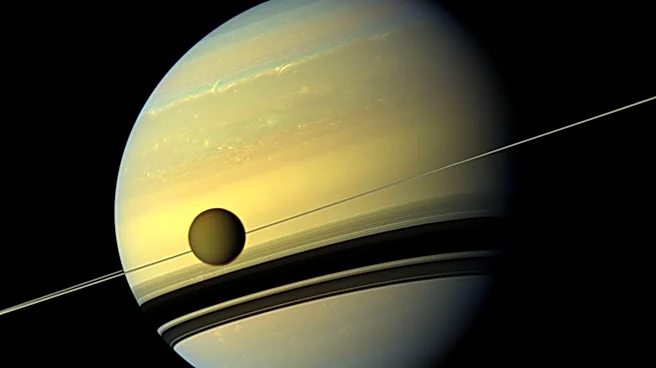







The ringed planet Saturn will soon make its closest approach to the Earth for the year. This event, called opposition, will happen on Oct. 4 when Saturn will be 784 million miles (1.26 billion kilometers) away.
Saturn looks like an ordinary, semi-bright, yellow star rising in the eastern sky after sunset. To the naked eye, it doesn’t stand out. But through a telescope Saturn comes alive with views of the rings that will take your breath away.
Let's get familiar with the stunning planet as it's time in the spotlight approaches.
Saturn's mysterious hexagon and decagon
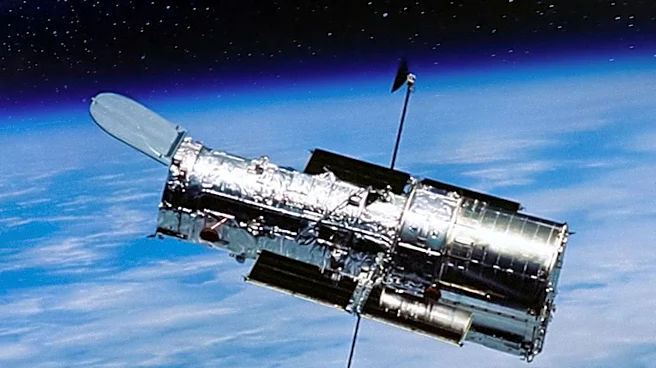
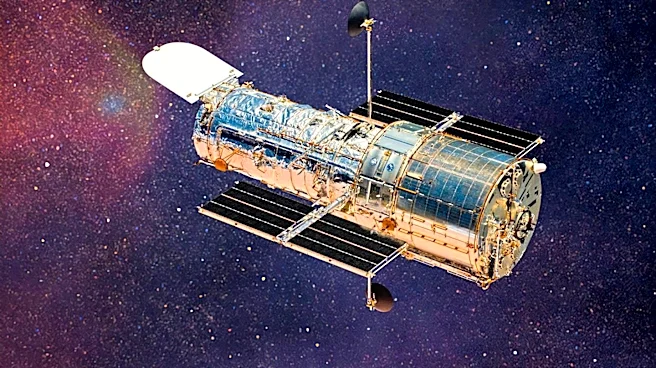
Although telescopes like Hubble and Webb can take detailed pictures of Saturn, most of our close-up images came from the Cassini Spacecraft which orbited Saturn from 2004-2017. Cassini documented changes in the planet’s atmosphere
during its stay and noted a mysterious hexagon-shaped storm on Saturn’s North Pole.
Since the end of the Cassini mission, the South Pole of Saturn is now tilted toward the sun and astronomers, using the Hubble Telescope, found a storm there too. But in this case, it is actually 10-sided. Saturn’s surface is made of hydrogen and helium gases in constant flux. This newly-found decagon will give scientists a lot to study in the next few years.
Saturn, the king of moons
Jupiter is the largest planet in the solar system, but Saturn leads in the moon count. And it’s not even close. Thanks to spacecraft and improved telescopes, astronomers have detected dozens of new moons around both planets. Jupiter has 115 moons and Saturn has 293. Many of the new moon discoveries are small – some are only a few miles wide.
Titan is the largest moon of Saturn and can even be spotted through a backyard telescope. A European Space Agency probe, Huygens, descended through the thick atmosphere and landed on Titan’s surface in 2005.
One of the most dynamic moons in orbit around Saturn is Enceladus. The Cassini mission witnessed geysers ejecting water vapor with enough force to leave the surface. As Enceladus circled Saturn, this material left behind a tracing of its orbit. Enceladus made its own ring!

The rings are back (well, they never left)
The most dramatic feature of Saturn must be the rings. There are hundreds of individual rings that circle the planet composed of individual pieces of rock and ice from shattered moons. Although the main rings span about 170,000 miles, in some places they are only 100 feet thick.
The rings are clearly visible through even a basic telescope. However, in the last two years, the rings have appeared “edge-on” meaning we can only see their skinniest parts. Saturn looked like a ball with a stick through it, or in some cases, the rings were completely invisible.
Well, good news: Naked Saturn (when the rings are not visible) is done. Over the next several years, Saturn will appear more tilted and expose the thicker parts of the rings to planet watchers. Get to a telescope this fall and see it for yourself.
Saturn season is open
Although Saturn is technically closest to Earth on Oct. 4, you can see it nightly through February 2027. On Sept. 26, the nearly full moon will be near Saturn with a repeat conjunction on Oct. 23 and 24.
But you must see Saturn through a telescope. Saturn appears to be a tiny ring world so perfect that you might swear someone put a sticker on the end of the telescope. But it is real and it is spectacular. Make a plan to see the ringed planet during Saturn season. The rings are open!
Dean Regas is an astronomy educator and author of seven books including "100 Things to See in the Night Sky" and "How to Teach Grown-Ups About Pluto." He can be reached at www.astrodean.com
Observe the Moon Night (and Saturn)
- What: View the moon through telescopes and see a special space-themed Omnimax movie introduced by astronomer Dean Regas.
- When: Friday, Sept. 18, 6:30-9 p.m.
- Where: Cincinnati Museum Center, 1301 Western Ave., Queensgate.
- Cost: Moon gazing is free. Tickets required for Omnimax film.
- More Information: astrodean.com/events.
This article originally appeared on Cincinnati Enquirer: Saturn makes closest approach to Earth. What to know for Saturn season