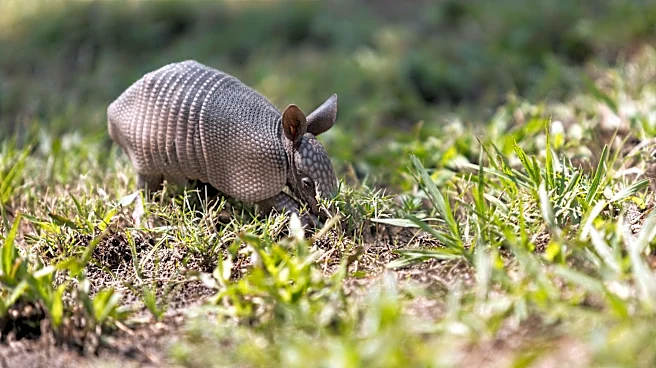







In what may be a historic discovery, researchers at Miami University in Oxford, Ohio, believe an armadillo found as roadkill in September 2026 near the Southwest Ohio city is the first natural occurrence of the animal in the state.
Dr. Tereza Jezkova, an associate professor of biology, said in a recent interview that climate change is likely allowing the animal more commonly associated with Texas and other southern states to expand its territory to the north.
However, winters in northern states like Ohio can still be harsh and potentially deadly to armadillos, Jezkova said.
"We do not yet know how well armadillos will survive Ohio winters," she said.
Another possibility is that armadillos are evolving ways to cope with colder climates, Jezkova said.
That's a question her lab would like to study.

Armadillo sightings in Ohio
While it isn't known for certain how the Oxford armadillo arrived in Ohio, natural dispersal is a likely explanation, Jezkova said. There are reliable records of armadillos in nearby areas of Indiana and Kentucky.
Since the Oxford armadillo discovery, she said several people have reported seeing armadillos nearby, especially around Trenton, near Middletown north of Cincinnati. But it isn't enough – yet – to establish that there is a breeding population in the state.
Prior to the latest find, there were two confirmed armadillo sightings in the state, according to the Ohio Department of Natural Resources. Both were found as roadkill in 2021.
The first was on May 11, 2021, in Richland County near Mansfield, at the state Route 13 and Interstate 71 northbound off ramp. The second was found on June 21, 2021, in Morrow County, on the exit ramp from I-71 to state Route 95. That's about 10 or so miles southwest from the first sighting.
"We suspect those animals were 'hitchhikers' that got onto a vehicle somewhere in armadillo range, and fell off in Ohio," Katie Dennison, ODNR wildlife biologist, told Axios Columbus.
Will armadillos survive Ohio winters?
Jezkova said armadillos use burrows for shelter. However, they do not hibernate and still need to forage for food.
"A mild winter may allow some to survive," she said. "Prolonged snow, ice, or freezing conditions make it harder for them to find food and increase the risk of mortality."
Miami University research into armadillos
Jezkova's research team has developed a proposal to study the physiological traits that might help armadillos survive colder winters. They are currently seeking funding for that work.
They plan to sequence the genome of the Oxford armadillo and compare with one from farther south. That will allow them to search for genetic bases of adaptation to cold, she said.
Earlier in 2026, Jezkova and other researchers published a study of the genetic structure and range expansion of the Mexican long-nosed armadillo.

Map shows Armadillo range in U.S.
Armadillos, the only mammal with a hard exterior shell, are native to South America.
According to the National Wildlife Federation, the armadillo is typically found in the southern United States, but their range has been expanding over the past 100 years. Some have been spotted as far north as Illinois and Nebraska, and they are also in Kentucky.
According to a 2025 study titled "Current distribution of the nine-banded armadillo (Dasypus novemcinctus) in the United States," from the U.S. Geological Survey, the armadillo was first documented in the United States in Texas in 1849.
Since then, its range has expanded to the north through Missouri and into southern Iowa, and to the northeast into Tennessee, Kentucky, North and South Carolina, Georgia as well as parts of Indiana and Illinois.
Are there armadillos in Kentucky?
Yes. Nine-banded armadillos have expanded in western and southern parts of Kentucky for 35–40 years, according to the Kentucky Department of Fish & Wildlife. They were first recorded in the Commonwealth in the mid-1980s, and one was discovered at the Bernheim Arboretum and Research Forest last year, around half an hour south of downtown Louisville.

Do armadillos carry diseases like leprosy? What diseases do they carry?
Yes. Nine-banded armadillos can carry leprosy, which can be transmitted to people, according to the Kentucky Department of Fish & Wildlife. Contact with armadillos should be kept to a minimum.
What do armadillos eat?
According to the University of Florida, armadillos typically eat adult insects and larvae.
Are armadillos dangerous? Why is the armadillo a pest?
According to the University of Florida, when looking for food, armadillos dig numerous holes in golf courses, lawns, flowerbeds, and gardens. The holes range in size from 1–3 inches deep and 3–5 inches wide.
They also burrow under driveways and patios, which can cause structural damage, and burrowing in pastures can pose a potential threat to livestock.
According to the Kentucky Department of Fish & Wildlife, armadillos aren't aggressive toward people or other wildlife but may bite or scratch if handled.
What states do armadillos live in?
Armadillos have been reported in states like Texas, Oklahoma, Kansas, Louisiana and Kentucky, according to the Texas Parks and Wildlife website.
This article originally appeared on Cincinnati Enquirer: Armadillos are settling in Ohio. Will they survive the winter?