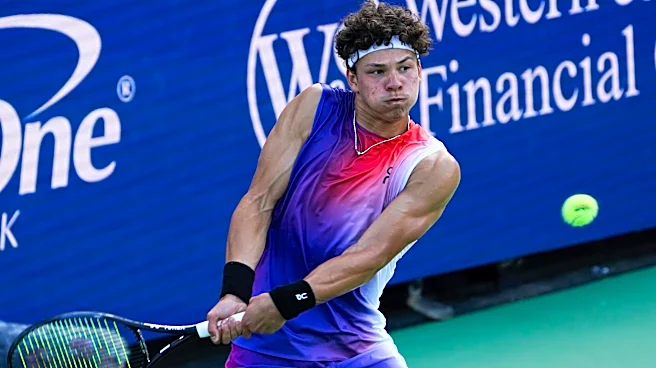






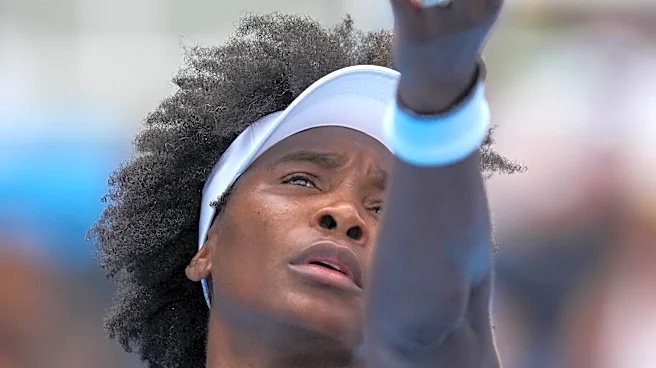

MASON ‒ With the crowd rallying behind him, American tennis player Michael Zheng pumped his fist in the air. After enduring two long late-night qualifying matches beforehand, Zheng saved his best for last against Hungary's Fábián Marozsán, beating him 3-6, 6-1, 7-6 (6) with a near-flawless tiebreak in the first round of the 2026 Cincinnati Open on Aug. 13
Zheng's win was his first-ever main draw win at an ATP 1000 event. It's another career milestone for college tennis's latest success story: the 22-year-old graduated from Columbia University in May, and spent the first five months of the 2026 season balancing the final year of his NCAA career with the start of his professional one.
"I think it's probably more freeing," Zheng said of his new life
without school in the backdrop. "I don't have to worry about going to classes the next day after a match like this or losing, and then thinking about doing an essay or studying for a test."
Don't be fooled by his words. Because Zheng still chose to spend four years in school, winning two NCAA singles titles for Columbia rather than heading straight to the pro circuit like many of his competitors do.
The same goes for several other emerging ATP and WTA players. At the recently-completed National Bank Open men's semifinals, all four participants (Ben Shelton, Learner Tien, Rafael Jodar, Brendan Nakashima) played college tennis. Three of the four Cincinnati natives at the Cincinnati Open (J.J. Wolf, Vignesh Gognineni, Peyton Stearns) also had NCAA careers.
But as college tennis alumni are having a moment during this North American hard court stretch, the actual NCAA sport in itself is in a different spot. During the 2025-26 college season, nine different Division I tennis programs were eliminated. The issue came to a head after Arkansas cut both its men's and women's teams, only reinstating them after supporters donated $5 million to the program.
Though many top American players skip the college route, the NCAA program cuts from this past spring still sent shockwaves throughout the professional tennis community, with names like Patrick McEnroe and Andy Roddickaddressing. In the wake of this, as well as the recent success of NCAA products, former college tennis players at the Cincinnati Open spoke about the importance of the sport during a critical juncture.
"Anytime someone asks me, I say that they should go to college," said Stearns, a Texas graduate. "The more people that are going to play college tennis, it helps those programs not get cut."
College tennis sees big presence at Cincinnati Open
Multiple pros explained in Mason how important college tennis was to their development on tour. Zheng, who lost in the 2022 Wimbledon juniors final before matriculating at Columbia, said it was a great pathway for players unwilling to grind on tour as a teenager.
"College tennis is just a great pathway for up-and-coming, aspiring juniors that aren't necessarily ready to take on the pro tour yet, or aren't having that rapid rise and need a place to develop physically and mentally and mature a bit," Zheng said.
Zheng's own career proves that point. While he played Challenger and ITF events sporadically while in school, he developed into a player consistently playing in Grand Slams and Masters 1000 events after graduating, rather than having to trudge through the lower ranks for a full year. The same goes for Shelton, who played three seasons for Florida before reaching the U.S. Open semifinals in his first full professional season.
Great Britain's Cameron Norrie, a Wimbledon semifinalist who played at TCU, contrasts the more laid-back nature of college with the grueling pro tour, where athletes are traveling constantly and often live paycheck-to-paycheck, which isn't much money below the top ranks. Emma Navarro, former UVA player and daughter of Cincinnati Open owner Ben Navarro, felt that experiencing school beyond tennis was formative for young adults.
"I think college is a great stepping stone, especially if you feel like you want a little bit more time before you go on your own and you want some of a more normal experience," Navarro said. "Those 18-22 years (of age) are when you can develop as a person and experience a life outside tennis."
But not only is college tennis an alternative for late-bloomers, but it's also producing legitimate up-and-coming talent. Jodar is arguably the biggest breakout story of 2026, escalating up to No. 11 at just age 19 after spending a season at UVA. Nakashima, who also played at UVA, reached his first-ever Masters 1000 final in Canada this past month. Gognineni made his Masters 1000 debut as a wild card at the Cincinnati Open after graduating from Yale in May.
The same can be said on the women's side. Indonesia's Janice Tjen, who rose to world No. 32 this year, graduated from Pepperdine in 2024. Navarro, 25, reached a career-high world No. 8 in 2024 two years after leaving Virginia in 2022.
"College tennis is a huge pathway for pro tennis now, and a lot of players are seeing that," Shelton said. "I think that soon we're going to have a lot of guys who play in college who are going to be in the top 10 as well."
Why are NCAA tennis programs being eliminated?
If several top pros all played college tennis, then why are Division I programs being cut? The answer can likely be traced back to the passing of the House v. NCAA settlement in July 2025, which allows colleges to pay their players using the revenue they generate from sports. In the wake of House, non-revenue sports (for most schools, sports that are not football and basketball) are at risk.
St. Louis, North Dakota and Arkansas had all cited the changing landscape of college athletics as a reason for their cuts this spring. During the 2024-25 school year, Arkansas reported its tennis teams made just $3,284 in operating revenue, while Razorback AD Hunter Yurachek said this spring that "a significant endowment" was needed from the outside in order for the program to sustain long-term.
An Intercollegiate Tennis Association letter from May, following the initial elimination of Arkansas's program, listed the success of former college tennis players in the pros as a reason to support the sport on an NCAA level. But when Shelton was asked in Mason whether his ATP success would encourage schools to invest in college tennis, he was skeptical.
"There are some programs that have kind of slipped at certain schools, which is sad to see. But I think that from a business perspective, for a lot of these colleges, tennis isn't a revenue-generating sport, and I think that's where some of these cuts come from," Shelton, who played against Arkansas while at Florida, said. "Obviously, Title IX and other reasons as well. At the end of the day, I think that's the way some colleges look at it."
Shelton also said that many college players are still being invested in, typically through the form of NIL (Name, Image, Likeness) money. It's also worth noting that top pro-producing programs like Virginia and Florida, which have won national championships, are in a different spot than those being cut.
Still, college tennis platforms at schools without as much championship history have benefited greatly from the history current pros have made. For example, Zheng was the first Columbia player to win an NCAA singles title since 1906 and led the school to its first-ever Elite Eight appearance. He wants his success to help further support for both players and programs across the country.
"If you ask Ben or any of the other guys, they would say college tennis has been instrumental in their growth and development, and it's been a part of their success on the pro tour as well," Zheng said. "I would hope to inspire college programs to keep going and juniors to use college as fabric."
A few current pros will not decide the future of college tennis. But at the Cincinnati Open, some of the world's best players made it clear how important they felt the pipeline was.
This article originally appeared on Cincinnati Enquirer: Cincinnati Open pros lobby to preserve college tennis programs