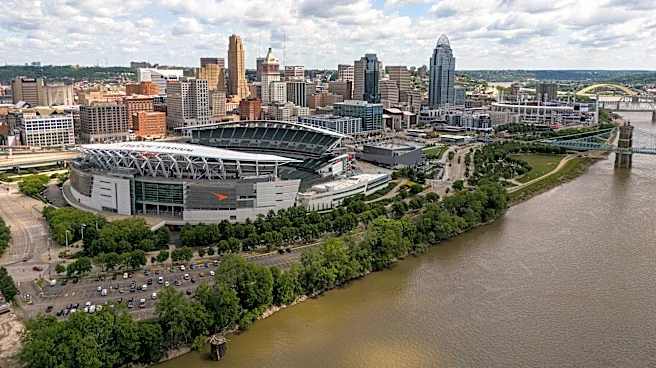









Greater Cincinnati is slowly growing, adding more people and jobs, but it's not building enough housing to keep up.
The Cincinnati Regional Chamber's 2026 State of the Region report outlines the metro area's economic strengths and weaknesses, revealing how we compare to peer cities and what we need to do to catch up.
"Cincinnati continues to grow, but at a measured pace," wrote the chamber's Emily Canan, director of the Center for Research and Data. "High-growth Sunbelt peers such as Nashville, Raleigh, and Tampa place pressure on our need to attract domestic residents, expand our housing supply, and leverage our regional specializations."
Here's what you need to know:
International immigrants made up 75% of new growth
While Greater Cincinnati has seen an increase in population over the last five
years, the majority of that growth has come from international immigrants.
The region added 47,500 new, foreign-born residents from 2020 to 2025, representing 75% of the area's total population growth, according to the report released on Oct. 15. Without this boost, the region's population would have been significantly smaller.
People who sought jobs in the region's computer systems design and related services industry made up nearly 29% − the highest of any sector − of H1B visa applications in 2025.
Slow growth hindered by more people moving away

The 15-county metro now has 2.31 million residents, up from 2.7% since 2020. But it only added 13,107 people between 2024 and 2025, which is lower than the previous year with over 20,000 new residents.
Hamilton County accounted for just 4% of the region's total population growth in that one-year period, adding 559 people, while Clermont County accounted for 20%, adding 2,663 people. Butler County, which has the second-largest population with 400,128 people, added 2,347 residents in one year.
Faster regional growth was hindered by what the report calls "negative domestic migration," meaning more people left the Cincinnati area in the last five years than moved here from another place in the United States.
Logistics in Northern Kentucky drives job growth
Transportation, logistics and warehousing employment is five times more concentrated in Boone County than it is nationally, according to the chamber's report.
The Northern Kentucky county, which includes the Cincinnati-Northern Kentucky International Airport, is responsible for driving nearly 30% of regional job growth since 2015, bringing over 26,000 jobs to the Cincinnati area. In Florence alone, 1,689 jobs were added between 2024 and 2025.
For comparison, Hamilton County grew by 1.4%, bringing in 7,600 jobs in a decade.
The region exported $38.85 billion in goods in 2024, making it the second-highest dollar amount out of Cincinnati's 20 peer regions − just behind Detroit. Transportation equipment accounted for over half the export dollars in 2024.
New housing still can't meet regional growth

The Enquirer consistently reports on Greater Cincinnati's housing shortage, but the chamber's report sharpens the problem: The region is adding people faster than it's adding places for them to live.
Since 2020, the region has added nearly 61,000 residents, but Cincinnati is still one of the slowest cities to approve new housing permits. In 2025, we permitted over 7,200 housing units, which is just 2.5% more than in 2024. Columbus saw a 13% increase in housing units, for comparison.
Rents increased in Cincinnati by 3.1% from 2025 to 2026, while home values rose 2.5%. The typical monthly rent was $1,580 as of May, according to the report. This is higher than Cincinnati's 20 other peer cities, including Indianapolis, Louisville and Columbus. Renters are also more severely cost burdened in Cincinnati than in other cities, meaning many people pay 50% or more of their household income on rent.
Other things to know from the State of the Region report:
- There was a 64% increase in Red Bike ridership in June 2026 compared to 10 years prior.
- Since 2010, Cincinnati has added 234 miles of bike and trail infrastructure.
- The Trust for Public Land ranks Cincinnati as having the fifth-highest ParkScore in the country, which measures access to greenspace per resident.
- The region had the fewest "good air quality days" in 2025 than any of our peer cities including Baltimore, Nashville, Pittsburgh, and Detroit.
- Greater Cincinnati has 31 times the concentration of flavoring syrup and concentrate manufacturing jobs compared to the nation overall.
- The region also has a high concentration of burial casket manufacturing.
This article originally appeared on Cincinnati Enquirer: International immigration key to region's growth, new report shows