






Vanessa Enoch hopes the fifth time is the charm.
The West Chester Democrat has run for Ohio’s 8th Congressional District seat four times. She has lost all four times to Republican Warren Davidson.
Usually, that sentence would be enough to end the discussion. But not this time.
Because while the candidates haven’t changed, the congressional district has. And Enoch believes the latest redrawing of Ohio’s political boundaries has given her something she has never really had before: a fighting chance.
"It’s absolutely winnable," Enoch said of her race against Davidson. "We have a district that leans very blue now, and we have a significant opportunity to flip the district.”
That might be an optimistic reading of the political landscape. Independent election
forecasters still favor Davidson. But dismissing Enoch simply because Davidson beat her four times before would miss what has happened underneath those losses.
Four losses, but a shrinking gap

Enoch has been chasing Davidson since 2018, when she received roughly a third of the vote and lost by more than 30 percentage points. Her worst showing came in 2020, when Davidson beat her by nearly 38 points.
Then something changed.
Enoch took 35.4% in 2022, cutting Davidson’s advantage to about 29 points. In 2024, she climbed to 37.2%, receiving more than 140,000 votes and trimming the margin to roughly 26 points.
Those are still decisive defeats. There is no point pretending otherwise. But there is also a pattern.
Davidson’s margin over Enoch has shrunk by more than 12 percentage points since 2020. Now the playing field itself has changed.
When Ohio’s congressional lines were redrawn for 2026, Republicans sought to make Democratic U.S. Rep. Greg Landsman’s 1st District more competitive. One consequence was moving additional Democratic-friendly Hamilton County territory into the neighboring 8th.
Hamilton County now represents a much more consequential piece of Enoch’s political puzzle. Communities such as Montgomery, Evendale, Deer Park, Mariemont, Silverton and Amberley are now in the 8th, along with Golf Manor and part of Indian Hill.
That matters because Enoch no longer has to find some magical formula for overcoming enormous Republican margins almost entirely through Butler County and rural western Ohio.
"I never run for the same district twice," Enoch said.
She has a point.
When she first ran in 2018, the district included Clark, Darke, Mercer, Miami and Butler counties. By 2020, Mercer was gone. By 2022, Clark was gone. In 2024, Preble County and portions of Hamilton County were added.
Now the lines have moved again.
Enoch says that when she first ran, the Republican advantage in the district was about 38 percentage points. She believes the new district has reduced the GOP’s structural advantage to about 8.
Independent handicappers aren’t nearly as bullish about her chances. Davidson remains favored to win. But favored isn’t the same thing as invulnerable.
And for the first time in five tries, Enoch believes she can see a path.
Enoch has a new problem: People have to know her

Redistricting can give you voters. It can’t introduce you to them. That’s Enoch’s biggest challenge.
I live and vote in Butler County. I’m used to seeing Vanessa Enoch’s name on my ballot. Many Hamilton County voters aren’t. Some voters who don’t closely follow redistricting could walk into a voting booth expecting to see Landsman’s name and instead discover they now live in Davidson’s district.
"People don’t know him just like they don’t know me," Enoch said, referring to the newly added parts of Hamilton County.
That’s why Enoch is attacking this race differently.
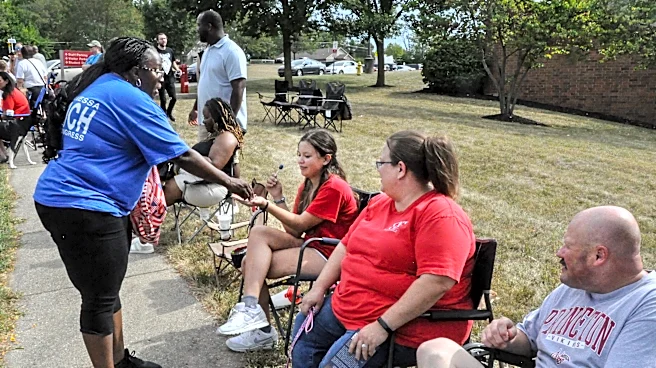
Her campaign is texting, phone banking and knocking on doors. She said she has scores of volunteers and more support from the Democratic parties in Butler and Hamilton counties than she’s had in previous campaigns, including help raising money.
She is also on the Hamilton County Democratic Party slate card, a potentially valuable advantage in a county where Democratic-endorsed candidates have performed exceptionally well in recent local elections. And her campaign is using voter data more aggressively to distinguish likely voters from people likely to stay home and to tailor its approach accordingly.
"Our targets are persuadable voters," Enoch said. "I want to make sure they know who I am, including independents."
The 56-year-old management technology consultant has a master’s degree in information technology and business and a doctorate in public policy. She also runs a nonprofit focused on workforce development. Enoch, whose husband died in 2009, has two adult daughters.
Politics wasn’t originally part of her plan.
Enoch said her interest was sparked years ago by a news story about male elected officials making decisions involving women’s health insurance coverage. She saw it as an example of why government needed people with different experiences and perspectives.
Then she came across another statistic that disturbed her: the extraordinary wealth of many members of Congress.
"It’s why nothing seems to ever change," she said. "When you’ve got millionaires and billionaires on both sides of the aisle, they don’t understand the struggles in our communities and households and the issues we face."
She initially wanted to help someone else get elected. Then she attended a Butler County Democratic Party meeting and explained why. Party leaders had another idea: Why don’t you run?
That began what has become an eight-year political marathon.
Enoch understood from the beginning that winning in such a Republican district was unlikely. She said part of the mission was building a Democratic voter base that eventually could make congressional and local races competitive.
Four elections later, she believes eventually has arrived.
This race will be about kitchen-table issues

Enoch knows Democrats alone can’t elect her. She needs independents. She needs disaffected Republicans. She needs Hamilton County voters who previously voted for Landsman. And she even needs to squeeze votes out of places where Democrats aren’t accustomed to finding many.
Her pitch begins with affordability.
"The number one thing I hear at doors is people are tremendously concerned with affordability and the data center boom. They are concerned about losing their health care and about air and water pollution with all the rollbacks on environmental protections. Costs are rising and wages are not and families are falling behind no matter how hard they work. It’s going to take a lot to fix what’s happening, but none of it will be fixed if my opponent wins. In fact, he will only double down on these failed policies.”
Enoch opposes the proliferation of data centers and criticizes Davidson’s positions on health care and federal safety-net programs. She also faults him for not challenging President Donald Trump more aggressively over federal spending she considers wasteful, including White House projects and events.
Enoch argues Davidson’s behavior this year is evidence that he recognizes the district is changing.
She says Davidson, who rarely had reason to treat her campaigns as serious threats in the past, is campaigning harder this time and has occasionally broken with Trump.
“He’s made a couple of symbolic votes, but they mean nothing when he’s voted against everything that would make things affordable for working families. He’s voted for big banks and big corporations and says nothing about where our money is being wasted. He’s stayed silent on the issues that matter most to families.”
That’s Enoch’s case against Davidson.
Davidson will have his own case to make to voters − including the most powerful argument any incumbent can make: Look at the scoreboard.
He has beaten Enoch four times. And not once has it been particularly close.
But Enoch isn’t conceding rural Ohio, either.
A Portsmouth native, she says she understands small-town communities and believes tariffs and other economic policies have created an opening among farmers who might never have considered voting for her before.
“They are losing their farmland and some feel like he no longer represents their interests,” she said. “Small farmers are suffering and he has not fought for them. They are more open to what I have to say.”
We’ll find out in November how open they really are.
Because Enoch still has an uphill climb. Davidson has incumbency, money, name recognition and the political DNA of a district Republicans have controlled for generations working in his favor. Election forecasters still see him as the favorite.
But maps matter. So do midterm political winds.
Candidates sometimes spend years losing until demographics, geography and political timing finally collide in their favor. Enoch has spent four elections trying to move a political mountain. This time, somebody moved part of the mountain for her.
Now she has to prove she can climb what’s left.

Opinion and Engagement Editor Kevin S. Aldridge can be reached at kaldridge@enquirer.com. On X: @kevaldrid.
This article originally appeared on Cincinnati Enquirer: Vanessa Enoch has lost to Warren Davidson 4 times. Could this time be different? | Opinion