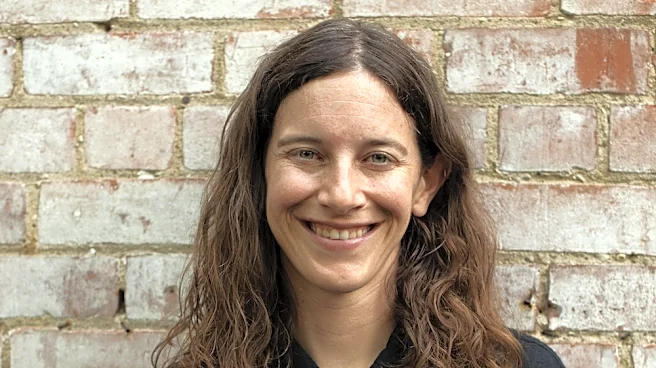






Van Sullivan grew up amid the extreme drought and raging wildfires of northern Colorado. They watched as the blaze crept closer and worried that neighbors would lose their land and farms to the impacts of a changing climate.
"I remember thinking, I want to understand that better, and I also want to create solutions," Sullivan said.
That passion didn't disappear after Sullivan moved to Goshen Township in Clermont County for high school, where extreme drought was replaced with record rainfall and poor air quality.
"That kind of unlocked a whole other layer," Sullivan said. "Like, my personal health can also be impacted by the environment, and so I just knew that that's what I wanted to dedicate my life to."
Since graduating from Oberlin College in 2011,
pursuing degrees in environmental studies and economics while dabbling in chemistry, Sullivan has worked for the U.S. Department of Energy and the city of Cincinnati. But they never forgot the first Green Umbrella event they attended on Sept. 1, 2016 − and their dream to work in the collaborative, community-focused space. In 2020, that dream came true, and six years later, Sullivan now will lead Green Umbrella, the nonprofit that coordinates and supports efforts to combat climate change across southwest Ohio, Northern Kentucky and eastern Indiana.
The Enquirer sat down with them to learn more about their goals for the role and what folks can do to take action now.
This interview has been edited for length and clarity.
Question: What are some of Cincinnati's biggest climate concerns, and what needs to happen?
Sullivan: I think one thing that's super real, and Green Umbrella did a report on this, is that the health impacts of climate change will be increasingly acute here, whether it's related to asthma or cardiovascular disease.
If we are experiencing more extreme heat, if we're experiencing more extreme rainfalls, we have to make sure that we have a built environment where we're not creating heat islands and dangerous conditions, especially for those who are more vulnerable.
We are going to be a region that will very likely be receiving folks who are fleeing even more extreme conditions. And so, it's not just about preparing the infrastructure and attending to the land. As folks migrate to this region, we also need to ensure that we can be welcoming and foster belonging and create healthy, equitable conditions for existing and newcoming residents.
The extreme weather will become not only more intense, but more frequent, and so we have to have these social connections and social systems to be prepared.
The status quo obviously isn't working. We're in a climate crisis, and so we need not only the projects, we need actual community programs, we need plans and we need policies that are committed to doing things differently.
What will Green Umbrella do to address climate impacts in Cincinnati? What challenges do you anticipate?
Sullivan: We are working with a collection of partners, including the city and the Southwest Ohio Air Quality Agency, to create a regional sustainability playbook. It's basically a big menu of options that are tailored to our conditions, specifically Greater Cincinnati. What are the strategies? What are the collaborative approaches that our communities can pick up and then take steps with?
What communities will soon have, by spring 2027, is an extremely robust playbook that has hundreds of strategies where they can identify, "Hey, we're ready to take next steps on training space" or "We're ready to pick next steps on renewable energy. How do I get started? What do I do?"
This will help guide them. And then what we do at Green Umbrella is we provide resources to connect them with, not just us, but other peer communities − partners that can help them deliver on their goals. We help educate them on the issues, we help equip them with tools, resources and connect them with funding. We don't just help with ideation and planning. We help with actually getting the work done.
At the end of the day, this work is about people. So much of our timeline is how do we mobilize and connect people, not only to each other, but with the solutions.
I feel excited for the challenge, but a very real challenge is that this work also requires resources, not just here but across the country. Environment work is not funded. And we don't have those structural commitments to really tackle the challenges that we have in front of us.
What are some simple, everyday ways that people can help the environment and live more sustainably?
Sullivan: There's so much that we can do.
Connecting to what you care about most first can really help you tap into that passion. And so, for me, growing up in rural America and being connected to food and land and animals, I make sure to support local farms, and I actually go around to different farms regularly to support their business, and then also enjoy what local growers are producing for a region.
If food is something you're passionate about, learn how to preserve food or to ferment it. There's so much food waste. You can compost, but there's also creative, fun steps of preserving and fermenting food.
If you are passionate about air quality or energy, become a bus user or a bike rider − using other forms of transit − because we are a pretty single occupancy vehicle dependent region. Just explore getting familiar with your public transit systems or getting comfortable with biking. As you build that comfortability, the world opens up to you.
I do think it is a form of climate action to get to know your neighbors. In times of disaster or extreme weather, like we had recently with the floods in July, knowing your neighbors − knowing you might need to be checked on − those are really important ways of building community resilience.
This article originally appeared on Cincinnati Enquirer: Q&A: Cincinnati climate collaborative's new leader calls for change