






Money is the only reason I care about this game.
I'm not spending a Wednesday evening in June watching Game 4 of the NBA Finals on the big screen TV in my friend's family room because I'm a fan of the New York Knicks or San Antonio Spurs. I didn’t grow up rooting for them. I don’t buy their jerseys. My attachment to the players is no stronger than it is to contestants on "Beat Bobby Flay."
I’m here because I placed my first-ever bet with an online sportsbook today: $10 on the Knicks to beat the point spread. And then, a few minutes ago, I did something profoundly stupid and placed another $10 bet on the Knicks to win, straight up, even though they were trailing by almost 20 points.
As halftime approaches, the Knicks are down 27. I sink into the couch,
muttering sarcastically.
“I’m not going to win a lot of money tonight.”
My friend’s 21-year-old son nods knowingly. He’s sitting next to me, scrolling through the sportsbook app on his phone.
“Yeah,” he says. “That happens most nights.”

I’ve never been much of a gambler. I play a friendly, low-stakes poker game a few times a year. I fill out a March Madness bracket and a fantasy football roster. Once, when I was a kid, I won a T-shirt for picking more NFL winners than my hometown newspaper’s sports columnist.
But today I opened accounts with FanDuel, the nation’s largest online sportsbook, and Kalshi, the largest prediction market. I put $200 into each.
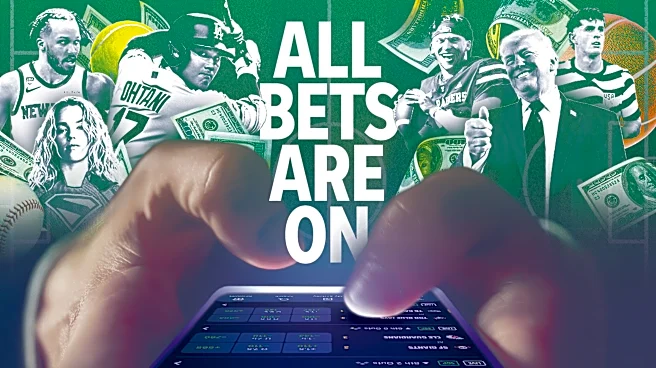
For the next two months, I’ll do what tens of millions of Americans do every day. I’ll bet on games, races, fights, celebrity weddings, the stock market, foreign affairs, reality TV, the potential existence of aliens and the random utterances of presidents and podcasters.
I’ll become part of an online gambling industry that last year totaled about $200 billion in wagers via sportsbooks and prediction markets – more than the gross domestic product of 155 countries.
My editor and I decided this would help me better understand how online gambling works, why people do it and how it affects lives. But what I really want to know is what it’s like to be part of a culture based solely on transactions, on wins and losses. Some might say that's a fair description of America, and they'd have a point, but if that's true, online gambling is America's new frontier.
The money, for me, is a way into that world. It’s not a huge sum. My company is reimbursing me and anything left goes to charity. But it’s enough to get me in the game.
I’m off to a lousy start. To win tonight, I’ll need the Knicks to pull off the greatest comeback in NBA Finals history. The TV announcers already are talking about the next game. Spike Lee looks despondent in his courtside seat.

But when the second half begins, the Knicks peck away at the lead. They cut it to 16. Then 10. Then to a single point. When OG Anunoby streaks to the basket to tip in the game winner for the Knicks, I’m on my feet, staring in amazement at the TV.
“This is unbelievable!” my friend says.
For a moment, watching the celebration, I feel like the sports fan I’ve always been, grateful to have witnessed such an incredible game. But then I check FanDuel and get a thrill that’s possible only because I’m now a gambler. It tells me I’m $45 richer.
I’m a winner, too.
When I arrive home a half hour later, my wife, who did not stay up for the game, lifts her head from her pillow and asks how my first day of betting went.
“Great,” I say, plugging my phone into a charger on the nightstand. “I think I might be good at gambling.”
Still half asleep, she squints at me, wrinkling her nose.
“Uh, oh,” she says.
'The less you bet, the more you lose'
A few days later, I'm huffing and puffing on the elliptical at the gym, trying to follow the guy on TV who's giving advice about betting on the World Cup.
As a newcomer to FanDuel, I get $50 a day in “bonus bets” for seven days. It’s a sweet deal, but there’s a catch. I must bet on something with my own money every day to get that day’s bonus money, and I must use the bonus within a week or I lose it.
I’m not a marketing whiz, but I think this means FanDuel wants me to dive into the gambling pool. And I’m willing. The problem, despite my Knicks’ luck the other night, is that I don’t know what I’m doing.
Fortunately, help is available from a thriving gambling ecosystem of podcasters, analysts and TV personalities, like the analyst talking on the TV in my gym. They all have their own schticks and slogans. My favorite so far: “The less you bet, the more you lose when you win.”
Their audience has grown exponentially since the U.S. Supreme Court lifted a federal ban on sports betting in 2018. Online gambling now is legal in 39 states, and more than 70 million Americanshave online accounts.
A generation ago, any connection to gambling could derail an athlete’s career and freak out team owners. Today, every major sports league maintains a sponsorship deal with at least one sports betting company. The NBA has two. The NFL has three.
Famous athletes make their own deals with sportsbooks, as do major media companies that cover sports, including ESPN, Fox, CBS, NBC and my own employer, USA TODAY Co.

As a lifelong sports fan, I knew gambling’s influence had grown. Now that I’m paying attention, I feel like I’ve swallowed the red pill in "The Matrix." I notice gambling references everywhere, from outfield walls to not-so-subtle plugs on sports podcasts.
When The Washington Post studied 50 hours of pro and college sports coverage earlier this year, it found a gambling reference occurred, on average, every four minutes.
As I labor through my workout, the guy on the gym's TV is talking about why Qatar’s odds against Switzerland are +1300 in the first round of the World Cup. I clearly have work to do.
Because I have no idea what that means.
You may lose, but the house never does
Under the theory that it takes a village to raise a gambler, I ask everyone I know who uses these apps to help me figure them out.
They talk me through straight bets (pick the winner) and parlays (combine multiple bets), over/under bets (guess the total points) and player props (predict if Shohei Ohtani homers tonight), and they explain that “plus” odds, like Qatar’s +1300, signify an underdog and a higher payout, while “minus” odds indicate a favorite and a lower payout.
One of the most important things I learn is that while I may lose those bets, sportsbooks and prediction markets never do.
Kalshi charges small fees that it collects regardless of the outcome, and FanDuel collects the “hold,” or the percentage it expects to keep from every wager. Sportsbooks carry some risk on any given bet, but over time, the hold gives them a strong statistical advantage.
The odds, as they say, are ever in their favor: FanDuel made $7 billion last year, a 60% increase over 2023, and Kalshi’s annualized earnings have reached $1.5 billion, five times more than its earnings last year.

When I text an old friend for advice on how to navigate this new world, he responds immediately. Online betting, he says, is “pretty stupid.”
He says he’s lost $350 over the past year. He’s always been careful with money, so this seems to stress him out. But he keeps doing it anyway, which makes me think it's about more than money. He likes the action.
I tell him I don’t see myself gambling when I’m done with this project.
“Just wait,” he says.
Gambling on a problem gambler
I spend my first gambling days in early June on the FanDuel app, but alerts from Kalshi keep popping up on my phone.
What will Trump say? What will JD Vance mention?
I’m curious. Prediction markets like Kalshi resemble stock markets, only instead of buying shares of Tesla, traders buy “yes” or “no” positions on real-world events, like whether the new “Supergirl” movie will get good reviews or Trump will say “Greenland” at his next rally.
The potential value of those bets, or trades, is set by the marketplace, which changes as traders buy and sell their positions.
The companies say this isn’t gambling. They don’t run casinos, they say, they operate markets that benefit society by allowing people to trade on their knowledge and beliefs, which, in turn, provide up-to-the-minute insight into our lives, culture and politics.
In the past two years, that insight predicted, among other things, Donald Trump’s return to the White House and Zohran Mamdani’s victory in the New York mayor’s race.
When I call Kalshi’s head of research, Nicole Kagan, she explains it this way: “We exist as a supplement to other information channels.”
I’m amazed when I open the app. People here are betting on who gets voted off “Love Island” with the same tech that runs the world’s financial markets. More than 8,000 trades are available on the site every day.

One immediately catches my eye: Will Brendan Sorsby, the former University of Cincinnati quarterback who admitted to gambling on sports, declare for the NFL’s supplemental draft or keep fighting to return to college football?
In other words, I can bet on the future of a young man with a gambling problem. This seems to me as morally suspect as it is ironic, but when I start to think about the Sorsby question as a gambler, I see an opportunity.
Almost 80% of Kalshi traders are betting against him entering the draft, which strikes me as high. Sorsby’s court fight against the NCAA feels like a long shot. I think they're wrong.
After typing $5 into the trade window, I hesitate. It feels different than my bets on FanDuel. More personal. I’m not gambling on Sorsby’s performance on the field. I’m gambling on how his life turns out.
Sorsby is 22, about the same age as my son. I ask myself if I’d do this if he were sitting in front of me, if I had to look him in the eye. He isn’t, though. I’m just a nameless, faceless trader making one of the hundreds of thousands of transactions that take place on this app every day.
I click “yes” and confirm the trade.
But I hate myself a little for doing it.
Fighting and making money at the White House
When I was a kid, a big fight meant Muhammad Ali and Joe Frazier at Madison Square Garden, or Sugar Ray Leonard and Thomas Hearns at Caesars Palace. Tonight, it means the Freedom 250 UFC fights on the White House lawn.
It’s June 14 and more than a dozen fighters are gathered in front of The People’s House to beat each other senseless.
I don’t understand UFC or its rules, which, to me, seem to be followed about as closely as I follow IKEA instructions. But I’m determined not to let my ignorance limit my ambition. I place bets on two underdogs and settle in for the night.
Gambling is a running theme. Ads for the Bet365 sportsbookair before the fights begin and the arena is adorned with logos for an online casino and the prediction markets Polymarket and Crypto.com.
The host of the festivities, President Donald Trump, has a partnership with Crypto.com through his social media company and made more than $1 billion from his own crypto business in his first year back in office. Trump’s inauguration committee accepted $1 million from sportsbooks, and his son, Donald Trump Jr., is an investor in Polymarket and an advisor to Kalshi.
A decade ago, these businesses would’ve been illegal in almost every state in the nation. Tonight, at the White House, they are guests of honor.

As I sit on my couch watching the first few fights, I feel like I’m the only person not making money. My underdog bets are aging as well as the bananas on my kitchen counter. I’m down $30 for the night.
Trump looks happy, though. One of the early winners, Bo Nickal, shakes his hand and gives the president a shout-out on live TV.
“It takes such a special person,” Nickal says, “to do something like this.”
Being right is (almost) as much fun as winning
The next evening, while doing the dishes in my kitchen, my phone pings. It’s a text from a friend who I’d told about my Sorsby wager.
“Winner, winner, chicken dinner.”
His next text is a link to a breaking news story about Sorsby deciding to turn pro. My hunch was right. My $5 bet just became $25.
I notice my fellow winners gloating in the comments on Kalshi. Some post screenshots of their trades, bragging about their bets on Sorsby’s misfortune. Many seem more excited about being right than about the money they won.
There is little sympathy for the man who made it possible.
“Sorsby,” one commenter says, “probably made a killing off this.”
LeBron and Cleveland: What could go wrong?
It’s early July and LeBron James is considering coming home to play for the Cleveland Cavaliers.
As a Cleveland sports fan, born and raised, I have a complicated relationship with LeBron, the native son, turned villain, turned basketball savior. When he won a championship for Cleveland in 2016, I took my son to the victory parade. It was amazing. I'd love for him to come back.
I open Kalshi and, sure enough, millions of dollars in trades already are being wagered on LeBron’s next team. The market is giving Cleveland a 30% chance to land him.
I put $5 on the Cavs. Ten minutes later, I throw in another $5.
It’s probably a mistake, but why not? LeBron posted a clip of himself on Instagram the other day, driving through Northeast Ohio. Surely, he wouldn’t tease us if he weren’t serious.
As I watch the odds move on Kalshi’s site, I’m struck by how weird it is to monetize a cultural moment like this. I’ve seen it with Taylor Swift’s wedding, Rotten Tomatoes scores and the price of a burrito at Taco Bell.
I can put a price on anything. My fan loyalty, my tastes in movies or music, my political preferences. Everything is a commodity.
Today, it’s my irrational desire for LeBron to come home. How much is that worth?
I put another $5 on Cleveland.

'They're trying to get you hooked'
Days later, my neck hurts when I get out of bed in the morning. I didn’t sleep well, and my left eye is twitching.
As a man who generously refers to himself as middle aged, I’m familiar with waking up with aches and pains I can’t explain. These days, though, I know the culprit. It’s all the time I’m spending on my phone, researching and placing bets.
Instead of reading a book last night, I spent an hour studying opinion polls for a Kalshi bet on Trump’s approval rating. I recently looked up stats for the quarterback of the Calgary Stampeders of the Canadian Football League. A few weeks ago, I left a Post-it note on my laptop that said, “Bet College World Series?”
I’m starting to worry about me.
Financially, I’m doing OK. I lose more than I win, but the bonus bet money and a few nice payouts have put me up about $100. Still, it's been hard to recapture the thrill of that early Knicks win. My daily routine of placing a half dozen or so wagers of $5 to $20 feels more like drudgery than fun.

I call Katrina Arroyo for some insight. She’s the manager of clinical programs at the Problem Gambling Network of Ohio.
She says my experience isn’t surprising. The apps I’m using are built to keep users like me engaged with rewards, alerts and odds that change with every basket, touchdown or strikeout. It’s like a live-action video game that can be played anytime, anywhere.
“They’re trying to get you hooked,” Arroyo says.
She’s seen it happen. Calls to Ohio’s gambling helpline jumped nearly 300% after the state legalized online sports betting in 2023.
I feel certain I don’t have a problem. I mean, sure, the company made me sign a waiver before starting this project. And it's true my wife has noted on several occasions that she did not sign that waiver and is prepared to seek legal representation if I empty our bank accounts.
But I believe I'm OK. I'm not chasing losses or throwing large sums into high-risk bets. Arroyo, though, cautions against overconfidence. She says her clients are intelligent, professional people who never anticipated their gambling would become a problem.
“I’m a rational person,” I say.
“Well,” she says, “so are all of my clients.”
Some sage advice: This is supposed to be fun
It’s July 13 and Major League Baseball’s Home Run Derby is on TV tonight. I might bet on it, but I don’t plan to watch.
I’ve been doing that a lot lately. Sometimes it’s because the games are on late, or not at all, and sometimes it’s because I care more about the bet than I do the game.
When I talk to Alan Feldmana few hours before the derby, he tells me that’s a mistake. Feldman is a former MGM Resorts executive and a distinguished fellow at the University of Nevada, Las Vegas. He’s worked in or around the gambling business for decades.
His take is that gambling is entertainment. If it’s not fun, if you don’t even care enough to watch the event, don’t bet on it.
“The vast majority, overwhelming majority, of people are betting on a team because they love one of the teams,” Feldman says.
I used to be like that, before I started betting. I enjoyed all kinds of sporting events, but I only cared, really cared, about my hometown teams. I believe Feldman when he tells me betting makes sports more fun for some people, but I’m starting to think I may not be one of those people.
After placing a $5 bet on the first round of the home run derby, I take Feldman’s advice. I log out of the FanDuel app, put down my phone and tune in for the show.

The derby turns into a barn burner. The first round goes down to the wire and the final ends with the Cardinals’ Jordan Walker hitting six straight homers to beat the Phillies’ Kyle Schwarber.
It’s great theater. When Walker’s mom and dad join him on the field to celebrate, they can’t stop smiling. His dad is wearing a jersey that says “Jordan’s Dad” on the back.
As a parent, I imagine all the Little League practices and games of catch in the backyard that got them here tonight.
“We’re so proud of him,” his dad says.
I’m so caught up in the moment I don’t realize until later that I forgot to bet on the final round.
So much time, so many apps
One of the first things I ask Sam is how many sportsbook apps he has on his phone.
“All of them,” he says.
We both laugh, but he’s not kidding. He has nine apps on his phone. It’s late July and I’ve been talking to gamblers for weeks. Sam, who is in his 30s and lives in Cincinnati, is one of the most prolific. He makes about $60,000 a year at his factory job and typically bets between $50 and $100 a day, though he’s placed single bets as high as $500.
“I break out in a cold sweat if I go over $10,” I tell him.
“I used to be that way,” he says.
He’s been betting on sports since before Ohio legalized it in 2023. Back then, he says, he’d drive to a strip mall parking lot just across Ohio’s border with Indiana, where sports gambling was legal and his GPS-monitored apps would function.
While there, he often saw other young men parked in their cars, staring at their phones. “It was pretty obvious what they were doing.”
When I ask why he gambles, he doesn’t hesitate. “It’s exciting,” he says. “Winning a bet is thrilling.”
Listening to Sam, I think I should be having more fun. I’ve had exciting moments, but preparing to gamble every day feels like doing my taxes. Sam is the opposite. He loves diving into statistics and hopping from app to app looking for the best odds and bonus money.

I ask if he worries about gambling too much. He says he doesn’t, but he knows people who do. Half of men ages 18 to 49 have a sportsbook app, and 10% of all men surveyed by the National Council on Problem Gambling last year reported gambling-related problems, twice the rate of women.
Most gambling sites, includingFanDuel and Kalshi, offer tools to head off trouble, such as budgeting features, voluntary account suspensions and programs that flag changes in behavior. Cory Fox, a FanDuel vice president, says the goal is to make the site “fun and social and entertaining.”
Sam says that’s his goal, too. He says he hasn’t added up the wins and losses from all those sportsbook apps, but he's confident he's doing OK financially.
“I know I’m up.”
There's always something to bet on, except Scooby Doo
I’m watching Scooby Doo with my 2-year-old granddaughter when I realize I haven’t placed a bet yet today. It’s early August and our daughter is visiting with her family, so I haven’t devoted as much time to gambling as I usually do.
Since I can’t bet on whether Scooby solves the mystery of the Spooky Space Kook (spoiler alert, he does), I’ll have to check later for a night baseball or WNBA game. I’m sure I’ll find something to wager on. There’s always something.
I’ve won 43% of my bets and, thanks to that early bonus bet money, I’m up about $60 overall. LeBron cost me a nice payout when he stiffed Cleveland a few weeks ago, but I’ve kept my head above water.
My two-month experiment ends in a few days, and I feel as if my brain has been rewired. I can’t read the news or watch a ball game without thinking about the betting possibilities.
When I started this journey, I wondered how I’d navigate a purely transactional world. Maybe most of life is that way now and online gambling is just an extension of it. But gambling, for me, encroached on parts of my life that had not, until recently, felt like transactions.
Before gambling, I cheered for sports teams because I used to sit in the stands with my dad watching those teams. I read a movie review because I looked forward to seeing the movie. I listened to what politicians said because I cared about my country. Adding a small financial stake to those moments didn't make me feel more connected to them. It turned them into products I could buy or sell, and I already have enough of those.
I don’t hate online gambling. I had some fun and I understand why people do it, but I’m looking forward to not doing it anymore.
My granddaughter is sucking her thumb and twirling her hair, a sure sign it’s time for bed. My bets today will have to wait a while longer.
Shoeless Joe and a long fly ball
Days after my last bet, I see an online link to highlights from the Field of Dreams game between the Philadelphia Phillies and Minnesota Twins.
It’s a cool event. I’ve always had a soft spot for the movie, which is about a man trying to make amends with his late father by building a baseball field in an Iowa corn field. If you haven’t seen it, trust me. It works.

For the game, Major League Baseball leans hard into the nostalgia that made the movie so popular. There's a hand-operated scoreboard. There's a wooden fence in the outfield. The players enter from the corn field, just like the players in the film, led by Shoeless Joe Jackson.
Jackson is a central figure in Field of Dreams. His career ended when he took bribe money from gamblers to throw the 1919 World Series between his Chicago White Sox and the Cincinnati Reds.
The first highlight videoI see from the game is a long home run. As I watch the ball sail into the corn field, I notice a sign on the outfield wall.
I zoom in and watch again.
The sign is an ad for FanDuel.
This article originally appeared on Cincinnati Enquirer: Online gambling is creating a new world. I lived in it for 2 months
Advertiser disclosure: USA TODAY may earn a commission when you sign up through links on this page. Commissions never influence our editorial coverage or rankings. Offers and odds were accurate at publication and are subject to change; terms apply — see the operator’s site. This is general information, not betting, legal or financial advice. To the fullest extent permitted by law, USA TODAY is not liable for losses arising from your use of it.
Must be 21+ (18+ where permitted). Sports betting and casino gaming are not legal everywhere; complying with the laws where you are located is your responsibility. Gamble only with funds you can afford to lose. Gambling problem? Help is available 24/7 — call or text 1-800-GAMBLER, or call the National Problem Gambling Helpline at 1-800-MY-RESET. State helplines and responsible gaming resources.