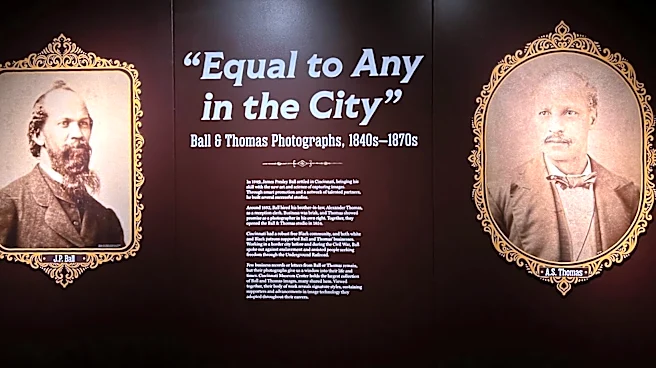





My history radar needs recalibrating, because I was late to learn about the J.P. Ball photography exhibit at the Cincinnati Museum Center. It has been up since July as part of the museum’s contribution to the America 250 celebration.
The good news is there are a few weeks left. “Equal to Any in the City”: Ball & Thomas Photographs, 1840s-1870s runs through Oct. 14, and it doesn’t require a separate museum ticket.
Ball was a pioneer photographer and Black entrepreneur who operated one of the finest studios and galleries in the nation in the pre-Civil War era.
James Presley Ball was born a free person of color in Virginia in 1825. After learning the daguerreotype process – an early type of photography – Ball settled in Cincinnati in 1849 and opened
his own daguerreotype studio.
Ball partnered with his brother-in-law, A.S. Thomas, to own several studios and galleries in Cincinnati, centered around Fourth Street.
The exhibit of photos by Ball and Thomas leads visitors through the early history of commercial photography, when sitters had to pose for 30 seconds to capture an image. The process evolved from daguerreotypes to cartes de visite to tintypes as photography became more accessible and affordable.
The Cincinnati Museum Center has the largest collection of Ball’s photos, including portraits of abolitionist Frederick Douglass and Civil War general William Haines Lytle. The photos are only a few inches in size and very delicate. Many required ornate cases to keep them from being scratched.

Ball was highly regarded for his quality portraits and the breadth of his sitters, from Queen Victoria and Charles Dickens to Civil War soldiers, businessmen, and women and children, Black and White.
Ball used his position to speak out against slavery as well. In 1855, he organized Black artists, including Robert S. Duncanson, to create a massive panorama on the history of the U.S., centering on the slave trade, which was exhibited in Cincinnati and Boston. The “mammoth pictorial” was 12 feet high and 1,800 feet long and was unspooled before an audience, accompanied by narration and sound effects.
Although the panorama has been lost, the fight for freedom and Ball’s role in our nation’s history are worth the spotlight.
This article originally appeared on Cincinnati Enquirer: Don't miss this rare exhibit showcasing pioneer Black photographers