








The sound of a classroom door slamming and the rigid feel of the ambulance stretcher on her back are the only things Sheri Wooldridge remembers about January 2024 – the month she was attacked by one of her students at Colerain High School.
She's pieced together other bits of information using what she's been told by her daughter, Erin Doherty, and news reports about that day. She's gathered that the 15-year-old Northwest Local student from one of her special education classes approached her, knocking over a desk in his path.
She faintly recalls reaching over to her classroom's intercom button to call for help.
Then, the student punched Wooldridge over a dozen times in the head, she learned, leaving her with a severe brain bleed. If the bleeding
had reached her brain stem, she says, "I would have been a vegetable."

The student fled through a side classroom door that leads outside – prompting the slam etched into Wooldridge's memory. Once she gained consciousness, she found herself hooked to hospital tubes at UC Medical Center's trauma center. She spent three weeks in the hospital before starting rehabilitation, relearning how to walk and talk.
Surgeons removed part of her skull to relieve pressure and later stapled it back together, Wooldridge learned months later from a prosecutor's remarks in Hamilton County Juvenile Court. The student was sentenced to six months in juvenile prison after pleading guilty to felonious assault.
Wooldridge, 63, never went back to her classroom. Supported by paid leave, she said she has "no desire" to ever return to teaching.
Wooldridge's story is emblematic of the teacher assaults dilemma – a trend that appears to be growing in Kentucky and Ohio public schools, prompting new legislation in both states.
When a teacher is assaulted, who should be held accountable? The administration tasked with supporting that teacher, the lawmakers who dictate the district's authority and the student at risk of losing their right to an education could all be players in the blame game.

Numbers show rise in teacher assaults, but that's not the full picture
Counts of violent behavior toward school employees in Ohio have nearly doubled since 2018, student discipline records submitted to the state as part of the Education Management Information System show. A similar pattern manifested in Kentucky, with cases jumping by the hundreds since pre-COVID-19 pandemic years.
But a lack of standard reporting requirements statewide and across districts paired with a culture of underreporting, teachers say, means the data may not paint an accurate picture.
In Ohio and Kentucky alone, how and where these assaults are tracked varies widely.
Kentucky's state education department tracks counts of "abuse of a teacher" – verbal, mental or physical abuse – in public schools. Kentucky's Center for School Safety compiles that data to identify trends in student behavior.
There's less infrastructure in Ohio that mandates and tracks reports of teacher assaults. Schools are required to report suspension, expulsion and other discipline records to the state, but federal student privacy laws often mean districts won't disclose details in those reports like whether a teacher was victimized.
In response to The Enquirer's requests for student behavior records involving assault of a teacher, Princeton City Schools, Northwest Local Schools and Mason City Schools all cited the Family Educational Rights and Privacy Act when refusing to provide or heavily redacting all documents.
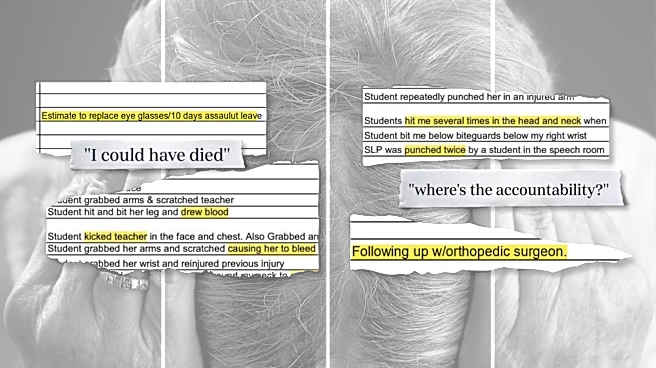
Cincinnati Public Schools provided the assault leave trackers that its teachers union has maintained for the past three years. Included in the 2025-26 tracker was a teacher requesting time off to consult an orthopedic surgeon after a wrist injury and another requesting 10 days off to replace their eye glasses after a student hit them in the face.
Forest Hills officials told The Enquirer the district had zero recorded incidents of school personnel being assaulted in the seven-year timeframe indicated in the request, 2018-19 to 2025-26 academic years. Oak Hills Local Schools said it had one teacher assault in that same timeframe.
Regardless, the records that districts maintain may be skewed. That's because of an underreporting culture wherein administrators and even school boards, Ohio and Kentucky teachers union officials say, discourage teachers from reporting assaults so as to not make the district look bad.
Underreporting, funding crises complicate the problem
In general, experts estimate student assaults on teachers have risen since the COVID-19 pandemic, attributing the lack of socialization and behavior instruction during remote learning as leading catalysts.
But some say the latest wave of anxiety about student behavior is a long time coming.
In a November 2025 policy meeting, Cincinnati Public Schools' teachers union representative Karen Imbus told school board members there needs to be a sense of urgency around what she believes is "the most serious issue this year."
Teachers are kicked, concussed, bruised across their face, Imbus said. The union "gets calls every day" about teachers being injured, she said.
Across the Ohio River in Kentucky, the problem persists.
Jessica Hiler, vice president of the Kentucky Education Association, said teacher assaults have been a problem for as long as she's been in education, which is 27 years.
In her time in classrooms, she's seen administrators downplay teachers' injuries because "it's the principals that usually have to answer for those numbers and ... take the heat for it," Hiler said.
Beyond potentially harming a district's reputation, investigations into student assaults against teachers can pose a logistical nightmare for staff, with teachers having to go on leave for months at a time, she said. And by the time the event undergoes a district investigation and possibly police intervention, it could be a year.
"And that's too long for an educator to be out of their classroom," Hiler said.
Aggravating the problem is the ongoing funding crisis in public schools. Districts like Cincinnati Public Schools are having to cut social workers, counselors and other holistic services that are critical in situations where a student is violent, which impacts every kid in the classroom, Hiler said.
Fewer social service workers means those duties are being displaced onto teachers, who lack the time and resources to meet special needs like gathering data for an ADHD diagnosis or an Individualized Education Program, Ohio Education Association President Jeff Wensing said.
"If you don't have the trained and certified personnel to interact with these students and make sure they get what they need, you're kind of just spinning your wheels," Wensing said.
This chain reaction is what worries student rights advocates like Sasha Naiman, executive director of the Covington-based Children's Law Center. In her legal work representing students with disabilities, she said she's seen more kids criminally charged or threatened with charges by their districts for behaviors previously handled internally.
And she's unsure whether the numbers coming out of Ohio and Kentucky reflect an actual surge in students' violent behavior or, rather, a shift in how schools are responding to behaviors that have been persistent for quite some time.

"Resources for teachers and students are shrinking and staffing shortages are common," Naiman said. "When schools are stretched this thin, students who are the hardest to serve can get pushed out."
The newest slate of discipline legislation in both Ohio and Kentucky reflects that cultural shift, Naiman said.
New laws in Ohio, Kentucky place the power in districts' hands
The debate about how districts should respond to the perceived student behavior crisis came to a head earlier this year, with the passage of Kentucky's Senate Bill 101.
The new law, which went into effect in July, requires schools to expel students in grades 6-12 who intentionally injure school personnel for 12 months, at minimum. It also requires employees to report intentional or attempted assault to law enforcement.
Before the change, the only conditions that automatically triggered an expulsion in Kentucky were bringing a weapon to school or making credible threats to students or staff.
Kentucky state Sen. Matt Nunn, R-Sadieville, who sponsored the bill, said the problem came to his attention when his friend said she was scared to go back to work as a teacher because of physical threats posed by students.
"My wife and mother was a teacher, my daughter is a teacher," Nunn told The Enquirer. "My granddaughter is breaking the tradition and not becoming a teacher for this issue."
Anecdotes of a teacher shortage, namely "teachers not recommending the profession to their kids" also struck Ohio's Rep. Gary Click, R-Vickery, the sponsor of Ohio's House Bill 206.

Passed in April 2025, the law says Ohio schools can expel students who pose "imminent and severe endangerment" to the health or safety of students or staff for up to 180 days.
The new laws in Ohio and Kentucky stack up requirements for an expelled student to reenter school, too. In Ohio, that student must be assessed by a health professional, and if there's no improvement shown, the expulsion can be extended for an additional 90 days.
Kentucky schools have a list of conditions, like writing a letter to the person who the expelled student injured and completing 15 hours of community service for every week the student is out of school.
Weighing the right to an education vs. the right to a safe classroom
The policy shift represents, in Nunn's words, progress toward ensuring "teachers have a safe place to work and students have a safe learning environment."
But for student rights advocates, the shift boils down to making expelling students for longer easier, with pathways back to school that are "subjective, discretionary or incredibly condition-heavy," Naiman said.
The policies also expose students with disabilities, economically disadvantaged students and Black students, who are historically overrepresented in discipline data, Naiman said, with more chances to lose their right to an education.
Students with disabilities are largely exempt from automatic expulsions due to legal protections in federal discrimination laws. But the reality tends to be more bleak than what's outlined in law, Naiman said.
Federal laws require schools to review whether a student's disability caused a behavioral incident in a meeting with the student's family and district officials. But families rarely have the legal counsel needed to ensure their child's rights are protected in those meetings, Naiman said.
The reviews also determine whether the incident was born out of a student's IEP not being fully implemented – making it the fault of the district, which is often the case, she said. And, again, without legal counsel, that protection often goes unchecked.
"A child's educational rights should not be revocable based on symptoms of a disability that the school is required to help the child manage," Naiman said.
For those who want to embolden the district's side like Click, though, the legal dilemma surrounding removing kids with violent behaviors from the classroom is not the biggest issue to consider.
"The worst civil rights violation is to be dead, to be killed," Click said.

Union officials say they're already witnessing teachers reluctant to activate their newly granted authorities to expel students or report incidents to law enforcement.
No teacher wants to involve law enforcement, Wensing, president of the Ohio Education Association, said. "The best place for a kid is in their public school."
But for Sheri Wooldridge and others affected by severe cases, a certain student being allowed back in school could be life-threatening.
To this day, Wooldridge says, she's still experiencing cognitive issues like slurred speech and trouble remembering series of numbers because of her brain injury.
The student who attacked her is finishing school in another district, she says, and she hopes "he's turned his life around for the better."
But ultimately, she says, "I don't think he should be allowed in any school."
"I could have died," she said. "And where's the accountability?"
This article originally appeared on Cincinnati Enquirer: Kicked, concussed, bruised - Teacher assaults are up in Ohio, Kentucky