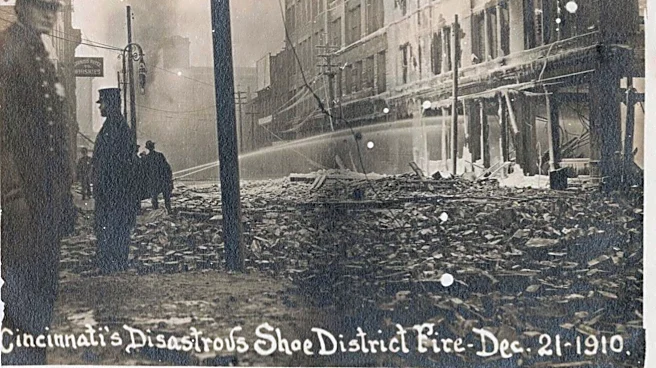








On the icy cold morning of Dec. 21, 1910, a fire in Cincinnati’s shoe factory district on Sycamore Street consumed several city blocks.
“They may never stop this one,” policemen told anxious residents living close to the fire zone.
Firefighters from nearly every fire company in town responded, rushing 35 horse-drawn steam fire engines to the Downtown district. Crews battled winds and freezing temperatures that froze deadly knives of ice on the windows and wires.
Cities were especially vulnerable to fire at the turn of the 20th century. Buildings made of brick and wood were getting taller but often lacked fire protection – fire walls, shutters and elevator shafts lined in brick that would have kept the flames from leaping to neighboring buildings.
The shoe factory district was known by insurance underwriters to be a liability due to the quantity of inflammable materials in the buildings. The rapid spread of the fire nearly overwhelmed the firefighters who fought to contain the destruction to a few blocks.

Worst fire in Cincinnati history at that point
Just after 2 a.m. on that late December morning, a night watchman at the Krippendorf-O’Neil Shoe Co. at Ninth and Sycamore streets noticed the glow of flames in the Twinlock Co. building next door.
About the same time, two Enquirer staffers walking home noticed the firelight and called out, “Fire!” Capt. Peter Purcell at the Engine Co. 44 station house two blocks away turned in the alarm and the engine crew rushed up Sycamore.
Within minutes flames had engulfed other factory buildings on the block and across the street.

“I never saw a fire spread so rapidly,” Purcell told the Cincinnati Post. “The flames jumped from house to house. The fire became so hot that our men had to keep getting out of range.”
The Taylor-Poole Leather Co. and Cahill Shoe Co. were aflame. Then, somehow, the A.J. Nurre Manufacturing Co., a block east on Broadway, caught fire. It quickly became the worst fire in Cincinnati history up to that date.
“While firemen worked in the street between the seething flames that were leaping in all directions from the two seven-story buildings, the walls and floors of the shoe factory fell out. Some of the falling bricks were thrown across the street …,” the Post reported.
And the fire turned deadly.

3 firefighters, 1 spectator killed
Fireman Robert D. Grear of Engine Co. No. 4 was firing the engine when the wall of the K.-O. Shoe Co. collapsed on top of him. He was crushed under tons of bricks. It had been Grear’s day off. He had planned to do Christmas shopping later in the day, but he responded to the alarm and didn’t desert his post.
Walter Morris, an 18-year-old spectator in the crowd, was killed when a fallen wall dragged down telegraph wires already laden down by heavy ice. The poles snapped, and chunks of wood struck Morris in the head.
Fireman Charles Schwengel of Hook and Ladder Co. 15 was helping to rescue more than 100 horses trapped in nearby livery stables when the structure suddenly collapsed. He didn’t make it out. His body lay buried under the debris for days before it was recovered.
Six firefighters were sent to the hospital with serious injuries. Among them were Frank Humphreys, who lost a leg when a wall fell on him, and Assistant Fire Marshal Philip Hurley.
Hurley was in command of companies operating a high-pressure watering device called a “three-way” atop a one-story building on Cheapside Street. A support beam for the apparatus fell, and the uncoiled hoses whipped about, knocking Hurley nearly off the roof. He suffered broken bones and was hospitalized; then his condition worsened, and Hurley died from pneumonia eight days later.

The fire was under control by 8 a.m. on Dec. 21, though it took days before the last embers were extinguished.
Four city blocks were destroyed, calculated as $2 million in losses ($70 million today). But it could have been worse if not for the firefighters’ efforts and sacrifice.
Sources: Enquirer and Cincinnati Post archives, Cincinnati Fire Department History blog.

This article originally appeared on Cincinnati Enquirer: A deadly 1910 shoe district fire was among Cincinnati's worst ever