







Should Cincinnati build a modular housing production facility?
It's one of the first questions a new group of real estate experts and nonprofit housing leaders seeks to answer in an effort to fix the region's housing shortage, which has driven up mortgages and rents.
Through the new Housing Innovation Lab, the group aims to find the "most promising ideas for addressing housing affordability," according to a press release from Greater Cincinnati Foundation, one of the project leaders. The University of Cincinnati Real Estate Center and LISC Greater Cincinnati are also helming the group, which will serve as a testing ground for scalable housing solutions.
The lab's initial goal is to assess whether Greater Cincinnati could support its own regional
manufacturing facility capable of producing prefabricated homes and parts for local builders. The study would examine area demand, how much it would cost to build the plant, who would run it and more.
Can modular production get more families into homes?
The project is based on a modular housing concept plan developed by Joe Hansbauer, president and CEO of Habitat for Humanity of Greater Cincinnati. This spring, his organization completed its first pilot project in Latonia Lakes, Kentucky with NB Modular Development.
“Families across our region are being priced out of homeownership, and the cost of building a home is a big part of the reason,” said Hansbauer. “We owe it to them to ask hard questions about how homes get built. This study will tell us, based on evidence, whether regional modular production can lower costs and help more families own a home."

What modular housing has been built in Cincinnati?
While modular housing has yet to gain a major foothold in Cincinnati, there's been a clear uptick in interest across the United States. The national market for modular homes reached $20.5 billion in 2025, according to a recent report from the international trade organization, the Modular Building Institute.
It's gaining popularity because modular construction speeds up project timelines by 20% to 50%, reducing costs. This is largely due to the fact that site work, such as running utilities, can be done at the same time the house is being manufactured. And because the majority of work happens indoors, the project is less likely to be delayed by weather.
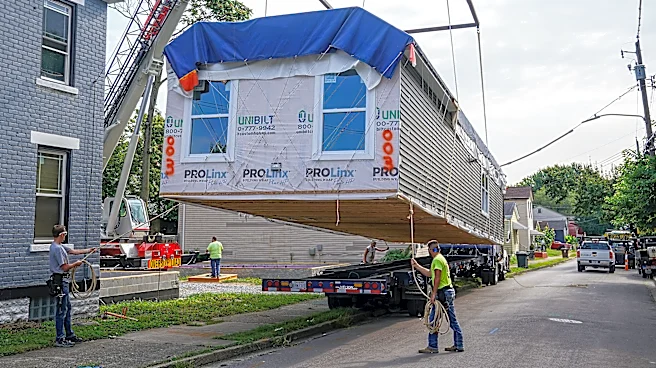
The region has seen several recent projects, including a townhome development in Evanston and two homes along Covington's Pleasant Street. The Enquirer reported that those Covington houses were built at a modular housing plant near Dayton and shipped to the site for assembly. They are the first in a series of houses planned for Covington's Eastside neighborhood.
This article originally appeared on Cincinnati Enquirer: Could Cincinnati build homes in a factory? New group seeks answers