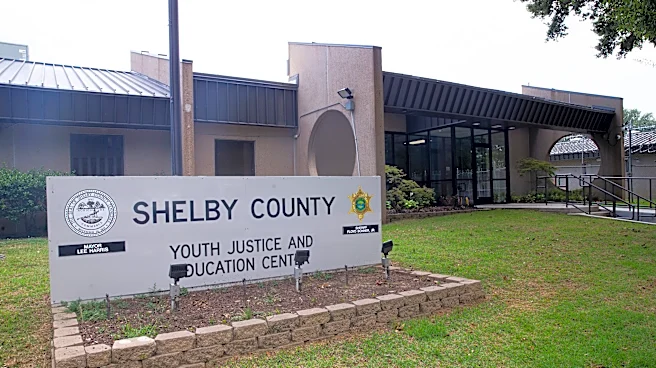







The Shelby County Commission is poised to pass an ordinance limiting the amount of time kids incarcerated at the Shelby County Youth Justice and Education Center can be held in solitary confinement.
The ordinance passed its second reading on Aug. 10 and was spurred by an October 2025 report from MLK50: Justice Through Journalism that found children as young as 13 were being held in solitary confinement cells for 23 hours continuously, and sometimes for longer periods of time.
Kids had been held in solitary confinement units for weeks or even months, MLK50 reported. Tennessee law generally allows for children to be held in a confinement unit for no more than two hours continuously. If the person operating the juvenile detention center deems it necessary,
more time can be spent in a solitary unit, but a child cannot spend more than six hours in solitary confinement within a day.
The ordinance proposed by the county commission would establish those same guidelines, saying "seclusion of detained juvenile detainees shall not exceed 2 hours without an appropriate hearing and shall not exceed 6 hours in one day unless otherwise required by law."

It also would establish near-constant and direct monitoring of kids in the solitary unit, requiring — at a minimum — a face-to-face visual through the cell's window every 15 minutes.
Changes were already underway at juvenile detention center
Prior to MLK50's article publishing, the Shelby County Sheriff's Office was in the process of ceding control over the juvenile detention center to the Shelby County Division of Correction, which is run by the mayor's office and also operates the prison commonly referred to as the Penal Farm.
In June 2025, Shelby County Mayor Lee Harris signed an executive order that formally put an end to what he called "excessive solitary confinement." Under the new rules, a person incarcerated at the Penal Farm could not be in solitary for more than 15 days.
That same month, Harris' office confirmed that it was taking over the juvenile detention facility.
One more passing vote is required for Harris to have the opportunity to sign it into law. That third, and final, vote could happen as early as Aug. 24, just days before a slate of new commissioners are sworn into office.
Several community advocates and commissioners shared their support of the ordinance at the regular Aug. 10 meeting.
Trekeria Rainey, a youth justice advocate and student at the University of Arkansas at Pine Bluff, spoke on her experience spending nine months at the Youth Justice and Education Center, and the importance of supporting restorative justice initiatives.
"I want every young person who's in detention to have the time to reflect. I want them to be able to tell themself, 'this is not where I want to be,'" she said.
Shirley Bondon, executive director of advocacy organization Black Clergy Collaborative of Memphis, urged the commission to pass the ordinance and give children in custody of the county the treatment they "deserve."
"We can hold young people accountable without sacrificing their humanity," she said.
Lucas Finton covers crime, policing, jails, the courts and criminal justice policy for The Commercial Appeal. He can be reached by phone or email: (901)208-3922 and Lucas.Finton@commercialappeal.com, and followed on X @LucasFinton.
Annie Goldman covers government for The Commercial Appeal. She can be reached at annie.goldman@commercialappeal.com.
This article originally appeared on Memphis Commercial Appeal: Shelby County poised to add limits on solitary confinement for kids