


Penny Hardaway is trying something new this season: A slightly less hands-on approach behind the scenes in favor of a more supervisory one.
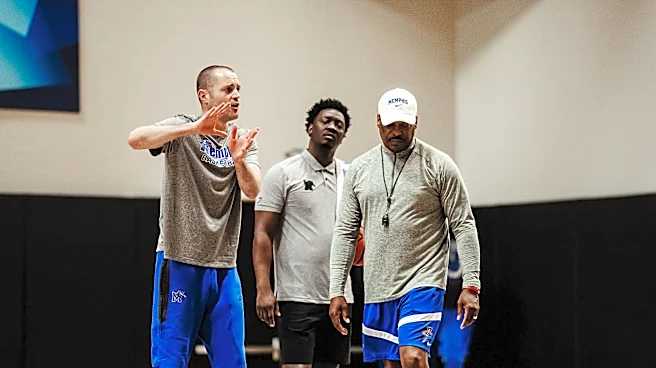
After previously devoting most of his time and energy to orchestrating the offense and directing the defense, the ninth-year Memphis basketball coach is delegating more of those day-to-day responsibilities to his overhauled staff, which includes assistants Tony Madlock, Sean Mock, Trevor DeLoach and Steve Wright.
“I’ve given more freedom to the guys to do more of the offense (and defense), and all those guys have been really vocal,” Hardaway said in July. “I’ve allowed them to be vocal. I want them to be as involved as they need to be.
“We’re building for it. We’re going to keep everybody doing what they’re
doing now during the season.”
How Sean Mock caught Penny Hardaway's eye
After securing Madlock’s return to his alma mater — where he previously served as an assistant for three seasons — Hardaway turned his attention toward Mock and DeLoach.
Mock spent the past seven seasons as an assistant at Tulane, where his work under coach Ron Hunter piqued Hardaway’s interest. He was especially intrigued by Mock’s offensive acumen.
The Green Wave, whose six wins over the Tigers since the 2019-20 season are more than any other team in the American Conference during that span, have traditionally been a tough scout for Memphis. Mock’s positionless offense-based philosophy led to Tulane finishing in the top 100 in the country in adjusted offensive efficiency three seasons in a row, while also landing in the top 60 in turnover percentage offense four straight seasons.
“I think he respected a lot of what we did at Tulane, and enjoyed those battles,” Mock said. “And I think we think very similarly with how offense should be.”
Mock credits Hunter with giving him the freedom to be as creative as he wanted to be at Tulane, where most often the Green Wave employed a 5-out scheme and allowed their players a high degree of freedom of movement.
“It was like, ‘How can you be different than everybody else?’ “ Mock said. “ ‘How can you go against the grain a little bit and make it hard to guard, where it’s not so robotic? Not so predictable.’ “
Which is the same approach he is taking at Memphis.
“It’s very freedom of movement, read-and-react type stuff,” he said. “A lot of shooting. A lot of spacing. That’s another thing Penny and I have talked a ton about — spacing. How we can manipulate the court in the shape of the offense.”
Trevor DeLoach: New Memphis basketball staff meshing well
Hardaway was also no stranger to DeLoach, who spent the past two seasons as an assistant in the American Conference at UTSA and Charlotte.
DeLoach also has spent time at five other programs in his career, giving him a unique perspective on coaching staff dynamics and how they can impact a team.
“From player development to (graduate assistants), we get along really well,” he said. “There are no egos with us. Our only mission is to win.
“And the players see that we’re close. We’re always talking. Even during practice, we take breaks and huddle up, and they see that. And it trickles down to them. They see that we’re on the same page, speaking the same language. And they’re hearing the same message from everybody, which is really important.”
Optimism follows Memphis basketball's roster-building intentionality
Soon after Hardaway put the finishing touches on his new staff, they honed in on putting the roster together. And Hardaway took a more refined approach to that, too.
"It's a good group of young men," he said recently. "We tried to be more intentional on who we went after this year, and it's been boding well for us."
All rosters in every sport are a reflection of the head coach's vision. Even though none of Hardaway's assistants were on staff last season, it didn't mean they weren't familiar with his philosophies. Madlock, who also played alongside Hardaway with the Tigers in the early 1990s, worked as an assistant at Memphis during Hardaway's first three seasons as coach. Mock and DeLoach have experience game-planning for and going up against Hardaway's teams over multiple years.
"We know that Memphis wants to play fast," Mock said.
“I’ve been seeing Memphis for the longest. You always know that toughness and defense is what (Hardaway) wants," DeLoach said.
But there were also some areas where Memphis was particularly vulnerable last season — namely, 3-point shooting and offensive rebounding.
"I think the first guy we signed was Rihards (Vavers), career 42% on almost seven attempts a game," Mock said. "And then, the guys that maybe don’t have those percentages you’d want, like, why are their percentages low? What are they on catch-and-shoot 3's? So our thoughts are, 'If we have good spacing and we have good guard play that can get downhill and play fast, can we get guys more catch-and-shoot 3's versus guys that are shooting poor shots and their percentages are going down?'
"(And) we put a huge, huge, huge emphasis, even with maybe being a little bit smaller than past Memphis teams, on offensive rebounds. Like, we’ve got to be a better offensive rebounding team. We’ve got to get second-chance points. We’ve got to win the shot-margin possession battle by getting turnovers and offensive rebounds. All that stuff has been a major, major emphasis in practice."
Reach sports writer Jason Munz at jason.munz@commercialappeal.com, follow him @munzly on X.
This article originally appeared on Memphis Commercial Appeal: Inside Penny Hardaway's Memphis basketball coaching staff rebuild | Exclusive