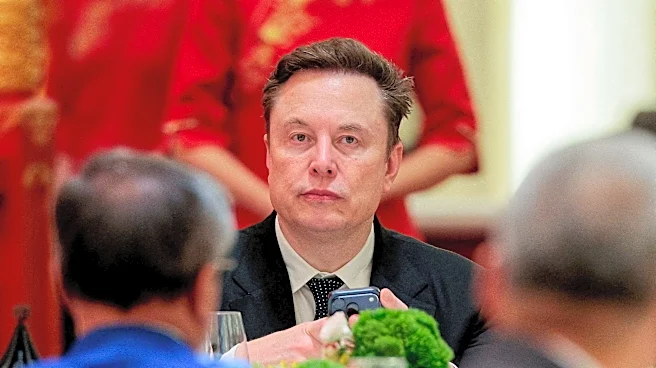





Elon Musk says he got “carried away” with politics during his time leading the Department of Government Efficiency in 2025.
He made the comments in awide-ranging interview with The Economist's "Insider," hosted by Zanny Minton Beddoes, while maintaining that he stood by the department's work.
The comments come a few weeks after DOGE announced it formally shut down a year and a half after its establishment in a July 4 post on X. It is estimated that the agency cut over $200 billion in spending from the federal budget during its first year of operation.
Here's what Musk had to say about his time with DOGE.
Elon Musk says he ‘got carried away,’ stands by DOGE’s work
Musk told Beddoes during an interview published July 23 that in retrospect, his role in President Donald Trump’s White House may have gone too
far.
“I think I got a little too involved in politics,” Musk said. “Got carried away, frankly.”
However, he refused to agree that the work of DOGE, a temporary department tasked with eliminating wasteful spending and fraud, had any negative consequences.
DOGE was initially created in the early months of Trump’s second term. At the time, Musk said the agency would cut upwards of $2 trillion from the national deficit within one year. As its first anniversary neared, DOGE’s own calculations tabulated savings of $214 billion − less than a quarter of its most conservative promises.
Much of that money – $28.3 billion – came from cuts to the United States Agency for International Development, or USAID, a federal program that provides life-saving medicines and assistance to developing countries.
Musk denied that those cuts led to “unnecessary suffering,” as Beddoes described it, calling reports of child deaths due to dismantled programs that got their funding from USAID “nonsense.”
“So you don’t buy the idea that anybody –– to put it really crudely and simply, any kid in Africa died because of the suddenness with which . . .”, Beddoes said before being interrupted by Musk.
“Zero,” the tech billionaire responded.
Beddoes continued to push Musk, saying there were “huge numbers of things shut down in Africa that were health-related.” Musk responded that there were “claims” of programs being shut down, but that they were “false” and “nonsense.”
Impact Counter, a statistical tracker developed by Dr. Brooke Nichols, an infectious disease mathematical modeler and health economist, documented more than 780,000 deaths within the first year of cuts to USAID programs, including more than 518,000 children.
Musk maintained that the organizations that had their funding cut were operating fraudulently, before reiterating that “zero people died because of DOGE.”
DOGE disbands
The Department of Government Efficiency formally shut down a year and a half after its establishment and about a year after Musk left Trump's administration.
The agency, which focused on reducing government spending, began in January 2025, shortly after Trump took office for his second term, and has continued without Musk's leadership since May 2025.
Reuters reported in November 2025 that the agency had disbanded, with eight months left on the mandate, after Office of Personnel Management Director Scott Kupor said the agency didn't exist.
In a July 4 post, the organization wrote on X that its formal mission had ended, but "the mission to eliminate waste, fraud, and abuse will continue. Good stewardship of taxpayer dollars and accountable government are not temporary initiatives."
How much did DOGE save?
When Musk first began his position with the Department of Government Efficiency, he set the ambitious goal of cutting $2 trillion from government spending. On April 11, 2025, Musk announced that DOGE would lower its projected savings estimate for fiscal year 2026 from $1 trillion to $150 billion.
The agencies that DOGE recorded the most savings from include the Department of Health and Human Services, the General Services Administration and the Social Security Administration.
Even though the agency declared its closure in July 2026, its website indicates that the final contract and grant terminations intended to conserve federal funding occurred in October 2025.
Will there be a DOGE stimulus check?
James Fishback, the original creator of the stimulus check idea, described the “DOGE dividend” in a four-page proposal as a refund sent only to tax-paying householders. Noting the difference from past stimulus checks, he added that DOGE checks would not be inflationary, as they would be "exclusively funded with DOGE-driven savings, unlike COVID stimulus checks which were deficit-financed."
The idea was initially floated by Fishback on Musk's social media platform X, suggesting Trump and Musk "should announce a ‘DOGE Dividend’ — a tax refund check sent to every taxpayer, funded exclusively with a portion of the total savings delivered by DOGE." Musk replied, "Will check with the President."
Fishback's proposal would send checks only to households with incomes above a certain threshold, rather than the pandemic-era checks that were sent “indiscriminately.”
Though the idea caught the attention of many Americans feeling the pinch of inflation and rising prices, a DOGE dividend check never materialized. For any stimulus checks to be sent out, Congress must approve the proposal, and there have been no moves to repurpose the funding saved from DOGE for stimulus checks.
USA TODAY contributed to this report.
Jordan Green covers trending news for The Commercial Appeal and Tennessee. She can be reached at jordan.green@commercialappeal.com.
This article originally appeared on Memphis Commercial Appeal: Elon Musk says got he 'carried away' with politics, DOGE but does he regret it?