







When I was 20, I charted my life on a white sheet of paper: college, medical school, public health school, a career as a consultant with an organization like the World Bank, private practice, social change projects—and marriage and family, too.
Forty-three years passed.
Last year, I pulled the sheet out, now tinged yellow, and saw, to my satisfaction, that I had lived up to nearly every line of it. Then, like so many of my baby boomer peers, I asked myself: What's next?
I am not one to retire to Cancun with a virgin piña colada and a paperback. My wife has her own theory about all this. She calls it my mid-to-late-life crisis. I'm still not sure; she may be right.

Third Chapter of Life
The sociologist Sara Lawrence-Lightfoot calls this stretch the "third chapter" of
life, which is not a slow fade, but a stretch of growth, wisdom, and legacy-building. She says it is finding new ways “to adapt, explore, and channel … energies, skills, and passions.”
I hadn't fully felt the pull of that third chapter until COVID arrived. In March 2020, our Memphis mayor requested that I, an infectious disease physician, help lead the city's pandemic response. For nearly two years, I worked 12- to 15-hour days — advising on masking, testing, treatments, and vaccines, and conducting near-daily media appearances during a perilous time. It was the most challenging stretch of my career, and, by any measure, the most necessary and rewarding.
When the pandemic finally receded, so did the adrenaline. I needed to move forward. Not to another crisis, but to another chapter. What I wanted now was: less execution, more reflection; less solving the urgent problem in front of me, more framing and shaping how problems and solutions come about.
For most of my medical career, I thought healthy aging was largely about the familiar prescriptions: eat well, exercise, and get enough sleep. But research suggests there is more to it. Purpose, cognitive engagement, and social connection matter, too.
The importance of a sense of purpose
In one study of nearly 7,000 Americans over 50, those reporting the lowest sense of purpose had more than twice the risk of dying during four years of follow-up compared with those reporting the strongest sense of purpose. Other research has associated lifelong cognitive enrichment with delayed onset of Alzheimer's dementia, while a large meta-analysis found that stronger social relationships were associated with a 50 percent greater likelihood of survival.
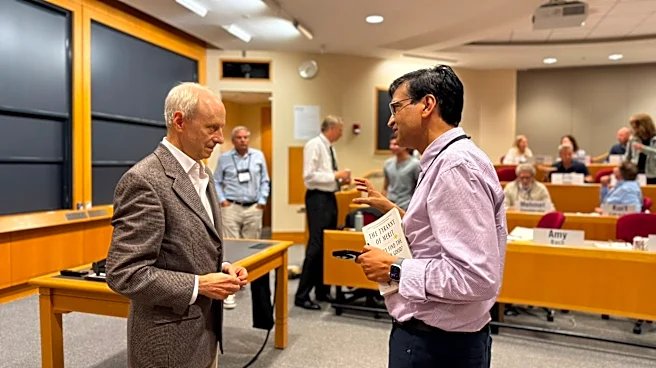
It occurred to me that going back to school could provide all three: something purposeful to pursue, new ideas to wrestle with, and a new community to join. A friend in Boston offered a path. After selling his company and raising his family, he enrolled in Harvard's Advanced Leadership Initiative, a program designed for people transitioning from their primary careers toward work focused on social impact.
"It was a life-changer," he told me. "It gave me renewed purpose and meaning."
I applied. This fall, I joined other fellows and returned to the classroom, taking courses alongside students who, in some cases, will be younger than my children.

Going back to school
Going back to school need not mean a year away from home or even pursuing a degree. It might mean taking a community college class, auditing a university course, joining a lifelong-learning program, or finally studying the history, literature, science, or art that work and family once left little time to explore.
I still don't fully know what I'll study or what project I will do. Our cohort will take classes across the business, law, divinity, public health, and other schools as well as build individual "social impact projects.”
With the demographic shift, I believe a paradigm shift is underway. For those fortunate enough to have the health, time, and resources to choose, retirement doesn't necessarily have to mean stepping away. Alongside the beach bag, there may be room for a backpack.
It turns out this isn't a new idea but an old one, rediscovered. Hindu tradition mapped this same turn thousands of years ago, moving through four stages of life — education, then career and family, then reflection and mentorship, then spiritual depth. A life well lived has always had more than one act.
My wife dropped me off in Boston as we dropped off our three children at college. This is something I'm choosing — a year to retool, a renewed purpose, to be cognitively challenged with new social connections.
On a fresh sheet of paper, I'm writing a set of life plans for the next quarter-century, and putting that page next to the one I wrote less than half a century ago.
Manoj Jain is an infectious disease physician and now a fellow at Harvard’s Advanced Leadership Initiative. Jain is writing about his experiences in several installments for The Commercial Appeal.
This article originally appeared on Memphis Commercial Appeal: Physician explores health and wellness in third chapter of life | Opinion