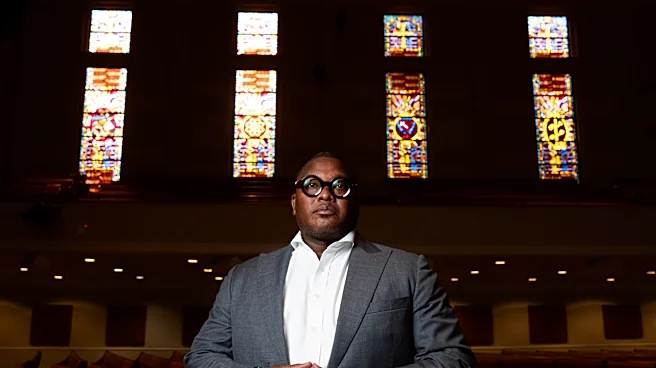




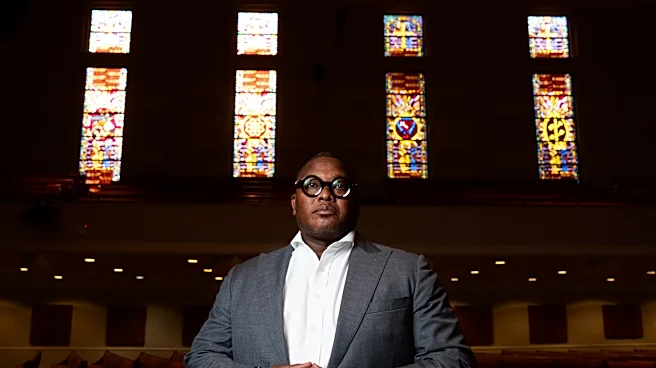

Rev. J. Lawrence Turner led a passionate church service in early September, giving his weekly sermon between interludes from a swaying choir standing around him behind the altar.
But what brought the couple hundred people at Mississippi Boulevard Christian Church to their feet that Sunday morning in Midtown Memphis was the pastor's urging of people to "get off their blessed assurance and vote."
"The time is now. The need is urgent. The opposition is great," Turner told his congregants, his booming voice seeming to rattle every one of the church's stained glass windows. "But greater is 'He' who lives on the inside of us than 'He' that's in the world."

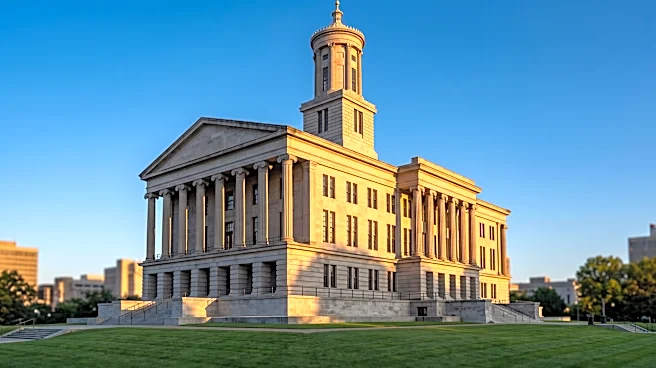
Earlier this year, Tennessee Republicans redrew the state's congressional map, eliminating the one
Democratic, majority-Black district largely within the city of Memphis. The city is now split into three separate districts, 5, 8 and 9, that extend hundreds of miles beyond Memphis, all of which are designed to be Republican-leaning.
This move mirrors the recent moves of Republican legislatures in other states, including Louisiana, Alabama and Mississippi. When the U.S. Supreme Court in April threw out a congressional district in Louisiana that had been drawn to protect Black voting power, it splintered a landmark Civil Rights-era law that has increased minority representation in Congress.
The high court sided with President Donald Trump's administration, a continuation of its conservative "colorblind" approach to the law. In the wake of the court's decision, Trump spurred many Southern states to redraw their voting maps.
In the process, legislators eliminated majority-Black congressional districts ahead of November's midterm elections, where political control of Congress is at stake.
Congressional districts are supposed to be redrawn every decade following the U.S. Census to account for population change, but this new development in the saga of mid-decade redistricting has proved controversial.
Critics are outraged at the court's decision and interpretation of the 1965 Voting Rights Act, while proponents see the gerrymandering as simply part of the American political process. The Supreme Court ruling spurred multiple unsuccessful legal challenges and is contributing to organizers upping their voter mobilization efforts across the South, including in Memphis.
The City of Memphis' population hovers above 60% Black, and just over 50% of Shelby County's residents are Black, according to the U.S. Census Bureau.
On the other hand, the population of the state of Tennessee is about 16% Black.
A University of Memphis professor and political theorist said the recent gerrymandering raises questions about what role geographical identity plays in government representation in the first place. And a local political figure urged that the Republican-led redistricting reflects the founding principles of the U.S.
But they agree: what's happening center stage in Memphis is not an issue likely to be resolved any time soon.
Turner, along with other Black church leaders across the state, has been working for months to invigorate voters and regain Democratic Congressional representation. His sermons have told congregants that elections have consequences, but his work has extended beyond the pews.
"We have all we need," he said to the Commercial Appeal, "if we just activate it."
'Live out your faith'
The intertwinement of advocacy and Turner's faith started in childhood.
His father was a pastor in Nashville, serving their community for 40 years with involvement in voting efforts and holding elected officials accountable.
Black churches in America have a rich history of resisting the status quo, which has often been oppression or discrimination — a legacy that is not lost on Turner.
Turner said his dad's influence left him with one lasting message: "You live out your faith, and you put your life on the line for the things you believe."
Now, Turner said he can't remember another time when he's seen this many people in his community engaged in politics.
"People feel disregarded and disrespected," he said. "It was a very clear attempt to break up not just Democratic power, but Black political power."
Churchgoers that Sunday in September showed it too — many of them wore T-shirts that referenced voting, like one that said: "Voting is my Black job."

Turner has spearheaded efforts to up the vote both at home in Memphis and throughout Tennessee.
In Memphis, that means targeting the precincts with the lowest turnout historically, and getting help from churches in those neighborhoods to mobilize voters. Shelby County has the second-highest rate of infrequent voters in the state, with 29.7% of voters being infrequent voters, according to previous reporting from the CA.
His work as president of the African American Clergy Collective of Tennessee brings religious leaders from across the state together to distribute election-related information to their congregants and organize early voting groups. In partnership with local organizations, like the Black Clergy Collaborative of Memphis, which Turner founded, Black church leaders have also mobilized "an army of volunteers."
It has resulted in 20,000 postcards sent to registered voters, a number he hopes to double in the weeks leading up to Election Day, as well as phone banking and canvassing door-to-door.
Turner said his goal is to raise political consciousness in his community, which many people have been receptive to after the redistricting.
"The challenges have actually worked to galvanize this community and make them pay attention to what's happening, and take action," he said.
The church in particular has been a natural way to build an informed voting base. Since Trump's 2025 inauguration, Turner said people have been showing up to church looking for spiritual guidance and seeking what the religion says about pertinent issues.
But oftentimes, Turner also incorporates politics into his actual sermons.
"There's very few institutions that have a captive audience every week..." Turner said. "How do we use this captive audience for the benefit of driving turnout?"
Lawmakers say gerrymandering based on party, not race
Handfuls of people, many of them students, filed into a classroom at the University of Memphis Sept. 24 to brush up on all things elections before the midterms.
Those in attendance had the ability to ask questions about what congressional district they were now voting in or what issues were on the ballot, or even register to vote with a representative of the Shelby County Election Commission.
Sharon Stanley, a professor in the university’s political science department, gave the crowd an overview of Memphis’ three new congressional districts, including the history of what has led to this point. Her fundamental question: how can race and party be separated?

April’s Louisiana v. Callais Supreme Court decision gets lawmakers “off the hook” for partisan gerrymandering, as the court said for there to be any real constitutional issue, there needs to be a strong inference of intentional racial discrimination and not just dilution of one party’s vote, Stanley said.
“One of the reasons I think that this is so frustrating (for people) is because it sort of assumes that race and party are two completely distinct questions,” she told the CA.
This separation was hard, she said, because both the Democratic and Republican parties have issues and positions that have been shaped by racial histories, which are difficult to disregard.
“To be partisan already means to be racially determined, or at least racially influenced,” Stanley said.
She wasn’t surprised that many view recent developments as a return to Jim Crow-era voting restrictions. Turner has also noticed a "more emotional" base of voters recently.
Luke Cymbal, a prominent figure in Shelby County Republican circles, disagreed.
“I think it’s a really good opportunity to get immutable characteristics, like race, out of the consideration for anything political,” he said.

Prior to the redistricting, he said Tennessee’s map gave Memphis voters a leg up, when it shouldn’t have. The 9th District, solely encompassing an urban area, didn’t align with what the rest of the state looks like, he said. He thinks the new map more accurately uplifts the will of the majority in the state.
Cymbal also said gerrymandering to gain a political advantage is a natural part of the democratic process, and voters can use their ballots to keep gerrymandering supporters out of office if they choose.
“They were drawn in a way that I think will withstand bad years for Republicans,” he said. “I think on Election Day, we’ll see ... nine elected Republicans in Tennessee.”
Gerrymandering has a history across political parties, and Stanley agrees that a sort of "arms race" to redraw districts has taken off in recent decades with both the Democratic and Republican parties participating.
Stanley and Cymbal both pondered the possibility of Tennessee's redistricting backfiring by angering Memphians and driving up the Democratic vote.

“People in Memphis are simultaneously really demoralized, but also because of that demoralization, really angry,” Stanley said.
But ultimately, they both said it will come down to the will of the voters in November.
For some voters, redistricting ignited a battle
Turner is hopeful his efforts will pay off in November.
"Yeah, the deck has been stacked against us," he said. "But if we really do the work ... we can still choose who represents us."
A fired up crowd walked out of Mississippi Boulevard Christian Church that September morning, their pastor's voice echoing in their heads.
"Let us march on until victory is won. And the church said, 'Amen.'"
USA Today contributed to this report.
Annie Goldman covers government for The Commercial Appeal. She can be reached at annie.goldman@commercialappeal.com or 901-930-7431, and followed on X @AnnieSGoldman.
This article originally appeared on Memphis Commercial Appeal: After redistricting, Memphis voters on a national stage during midterms