





For many people thinking about buying their first home in their 20s, 30s and even 40s, purchasing a home could be more within reach than one might assume, despite higher interest rates.
As reports on rising interest rates — specifically 6.67% as of Aug. 13, according to Freddie Mac — saturate housing market data, Shelby County's inventory of 5,000 homes is at its highest in two years, and is currently five times the national rate, making Memphis one of the most saturated markets in 2026, according to data from Realtor.com.
Active listings in the Memphis area rose 11.5% year-over-year, "dwarfing" the modest 2.1% national gain, Realtor.com reported.
With so many homes on the market, competition has increased, putting buyers in a position of power
to potentially close a deal.

As of August, the median sales price in Shelby County is $206,850, according to data from the Memphis Area Association of Realtors. (Meanwhile, median sale prices in Tennessee skyrocketed since the pandemic, growing 77% in nine years.)
Prices have stayed relatively stable in the Memphis area over the last two to three years and could be more negotiable now compared to last year due to high inventory.
Here is a look at just how feasible buying a first home in Memphis really is in 2026, in the eyes of a new homeowner, a home sales consultant, a banking executive and longtime realtors.
Is the Memphis market good for first-time buyers in 2026?
It’s no secret that home prices are up but is the local market still in a good place compared to other cities? Crye-Leike realtor Anna Bishop believes so.
“We still have one of the most attainable markets for young buyers. It might require more planning than it did a few years ago when the rates were much lower, but it absolutely is still possible,” Bishop said. “We still have affordable homes, and right now, we have a lot more homes in inventory, so there's a lot more to choose from.”
With it being a "buyer’s market" according to Bishop, that translates to better "negotiation on closing costs, repairs, and other concessions that would be helpful for a buyer."
New homeowner Jasmine James, a regional sales manager, recently purchased a home in the growing Cordova neighborhood of Amherst, constructed by Grant & Co. It is technically her second home, though she temporarily went back to renting after owning from 2007 to 2014.
James said ownership was back on the table once she was further along in her career, better prepared for the responsibilities of home ownership, and especially when her projected rent would have been even more than her mortgage today.
James said she was able to feel confident about the entire process and worked closely with onsite-realtor and mortgage lender provided by Grant & Co. Builders and Realty, on-site in the neighborhood.
Her advice to new homeowners is "ask questions," as many as needed to get an accurate picture of the process.
"If you have a question, ask it. It's a big, a big investment, regardless of the size of the home or where it's located," she said. "It definitely wasn't a simple, easy process. Knowledge is power. If you know what you're going through and what the expectations are and what you need to get the home of your dreams, that makes it a lot easier than if you're in the dark."
Aaron Clolinger, on-site sales consultant at Amherst with Grant & Co., said the company wanted to help more people achieve home ownership, so they bought down the interest rate "on the front end" with a special lender. Then, the company was able to offer buyers an achievable interest rate and monthly mortgage rate, despite rising rates nationally.
The decision has been successful, he said. The 44 units in the first phase of Amherst are almost sold since construction started in 2025, and the second phase (another 44 units) is just beginning.
"The Grant family is very forward thinking," Clolinger said. "It's been a huge driving factor for first-time homebuyers."
Now, James looks forward to coming home every day, she said.
"Amherst has a quiet, serene feel that I value. It's a small but mighty community that feels peaceful. The construction, build, layout, view and all the natural surroundings has me loving my home more and more every day," James said.

Marguerite Spicer, also a resident of Amherst, said the neighborhood attracted her because of its central location (near the interstate and suburban cities) and because of the single-story dwellings offered after owning a townhome in Downtown Memphis for 15 years.
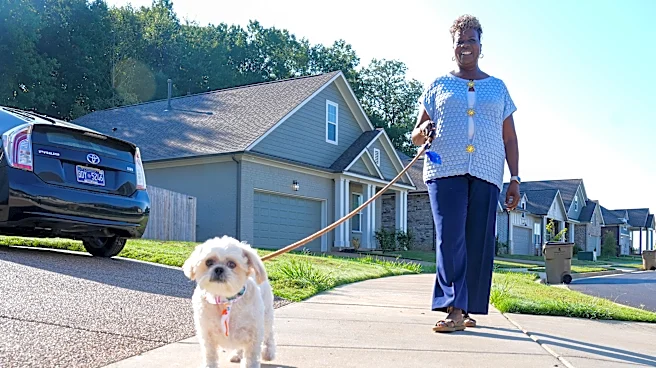
While walking her dog Leo around the subdivision each day, she has met many of her neighbors, like James, and she appreciates the diversity.
"There are first time homebuyers, people who are downsizing, couples, growing families and professionals from many different fields," she said.
She also loves the calm atmosphere. "It's so quiet and peaceful," Spicer said.
What are the most important tips for new buyers to keep in mind?
Home buying can be a long, meticulous process, and Financial Federal Vice President John Summers hates to see a buyer’s savings sitting stagnant while they shop. Opening a money market fund or CD, for example, is a great way to save a little extra on the house, he said. Starting a MMA is also an opportunity to begin talking with a "preferably local" bank that will give sound homebuying advice when the time comes, Summers explained.
“Make your money work for you, and open up a higher interest savings account where you can plug some money in, and at least earn some interest,” Summers said. “Banking is built off relationships, and I do think it's important for a first-time home buyer to start to build that relationship.”
When talking numbers, Summers said they typically recommend a 43% debt to income ratio, though deciding on a comfortable house payment varies wildly person to person, and requires an honest assessment of the cost of a preferred lifestyle and “extracurriculars”.
Bishop said it’s a good time for certain loans and financing options as well.
“It doesn't mean it's forever. You have PMI (Private Mortgage Insurance) with several loans, particularly a Federal Housing Administration loan. But I always tell my buyers, you only have to have 3.5% down to get an FHA loan. And right now, those rates are trending lower than even conventional loans.
"You can always refinance later on ... .”
What mistakes should new buyers avoid?
Buying a home is one of the most important purchases a great many people will make, so it is important to make sure to secure sound finances, no matter what, according to Summer.
“You need to make sure that you don't just get caught up in the process,” Summers said. “And the next thing you know, you've bought something, and you paid more than what you really had intended to pay. And then it has more repairs than what you had expected.”
Some of those extra payments can unsurprisingly come from insurance. Summers recently saw a buyer whose home was in need of light renovation get stuck with high insurance costs because of a 16-year-old roof. If you’re set on a fixer-upper, he recommends the roof and HVAC system still be in good shape, for example.

When she bought for the first time in 2007, James experienced unanticipated repairs to the home, which she said was a learning experience. Her HVAC system went down after foregoing the recommended annual service.
“You can imagine in my 20s, I didn't have the finances to [fix] that,” she said. “People think they're saving a little bit of money by not getting a service every year, every other year. But when it gets to the point where it goes out, if you don't have a home warranty, those expenses can be extremely overwhelming.”
The second go around, James took her time across half a decade, preparing finances and looking at a multitude of floorplans and locations. She thinks the quality-of-life benefits in location outweigh having a dream home with a long commute.
'The world is your oyster'
Making undo assumptions about the process can end pathways to ownership before they even begin, Bishop said.
“A mistake I see buyers making is assuming that they can't qualify for a loan because they don't have the money saved," Bishop said. "[They] think that they have to have 20% saved to buy their first house, and you don't."
Even with high inflation, buying a home is nearly always a worthwhile investment to Bishop.
“I think the world is your oyster,” she said. “[Real estate] usually always appreciates, and you have something for your money. Real estate is one of the best investments that you can make.”
Kerri Bartlett contributed to this story.
Jacob Wilt is a reporter for The Commercial Appeal covering Dining, Retail and Real Estate in the Memphis area. You can reach him at jacob.wilt@commercialappeal.com.
This article originally appeared on Memphis Commercial Appeal: How affordable is buying your first home in Memphis in 2026?