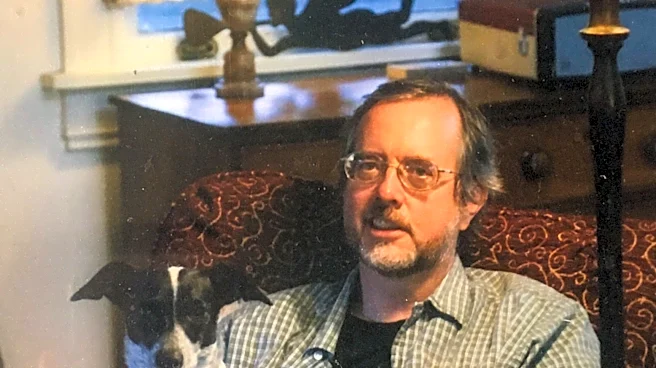

When John Beifuss retired from The Commercial Appeal on Oct. 1 after 45 years as a reporter and film critic, his career statistics were fairly staggering.
He worked for two major Memphis newspapers — the
Press-Scimitar and The Commercial Appeal — and seven different editors-in-chief, covered half a dozen different beats and authored more than 10,000 stories, features and reviews, making him one of the longest-serving, most prolific and widely respected reporters in the history of Mid-South journalism.
Beifuss, 67, is perhaps best known for his 20 years as The Commercial Appeal's film critic, where he was instrumental in covering the emerging Memphis independent film scene starting the mid 1990s. But his contributions, both to Memphis and journalism, extend well beyond any one role or era.
“John’s a very special person in cultural criticism and cultural life in America and specifically in Memphis,” said acclaimed Memphis-born filmmaker Ira Sachs. “His intelligence, his depth of knowledge, his curiosity and his advocacy have been enormously influential for the city and for me personally. I've always felt that John cares and knows my work in a way that's intimate and smart. He’s done that for a lot of filmmakers and artists. He’s just been a treasure for the city.”
Craig Brewer — the Memphis director of “Hustle & Flow,” “Dolemite Is My Name,” “Coming 2 America” and “Song Sung Blue” — noted that getting the approval of Beifuss was like a papal seal for a young filmmaker.
“The best review I've ever had in my career was from John,” said Brewer. “After a screening of my film ‘The Poor and Hungry,’ he just came up to me in that in that great, unique voice of his going, ‘Yeah, Craig, that was awesome.’ John has a relationship with local film artists that was, and is, important. And it’s because he’s such great writer and a uniquely Memphis character in his own right.”
'They took a chance on me'

Though he’s long been one of Memphis' most distinctive writerly voices, John Beifuss was born in Chicago in April 1959. His father, John Paul Beifuss Sr., was a respected English professor and Shakespearean scholar who taught at Loyola University Chicago; his mother, Joan Turner Beifuss, was a writer who had worked for the Chicago Sun-Times newspaper before giving birth to Beifuss and his four younger sisters.
In 1966, when Beifuss was in second grade, the family moved to Memphis, where his father had taken a job as a professor at Memphis State University. Arriving in the Mid-South, the young Beifuss became besotted with local TV horror host Sivad, whose weekly film program captured the boy’s imagination. An avid reader, Beifuss was already devouring gothic horror lit and sci-fi stories while still in short pants.
“Unlike some families where I knew where the parents frowned on those kinds of interests, my dad was a huge science-fiction reader,” said Beifuss. “He actually taught the first science-fiction [literature] classes at Memphis State. So we had shelves filled with literally thousands of science-fiction paperbacks, Ray Bradbury and Isaac Asimov and all that. Concurrently to that, the fiction I was reading at a very young age — when I probably didn't even know half the words — was like Edgar Allen Poe and H.P. Lovecraft.”
While he was inspired by his father’s literary tastes, Beifuss learned the value of journalism and activism from his mother, as she marched and later wrote what's considered the definitive account of Dr. Martin Luther King Jr. and the 1968 Memphis sanitation workers strike, “At the River I Stand.”
After attending St. Louis Catholic School in East Memphis, Beifuss enrolled at White Station High School. By then his passion for film and film criticism was being fed by reading The Commercial Appeal’s movie reviewer Edwin Howard and the work of David Ansen of Newsweek. At 15, Beifuss launched his professional career selling a story on Bela Lugosi and Boris Karloff to the horror magazine Famous Monsters of Filmland. “That was my first real published work,” said Beifuss. “Like I always say, my career has been downhill ever since then.”

After graduating from White Station in 1977, Beifuss headed back to Chicago, attending Northwestern University, and its Medill School of Journalism. He finished his studies in 1981, and after a brief spell working for a Chicago-based trade magazine, Beifuss returned to Memphis that fall where he landed a job with the city’s afternoon newspaper the Press-Scimitar — which shared a parent company, Scripps, and an office with the morning paper, The Commercial Appeal.
“When I got the job at the Press-Scimitar I had no credentials. I mean, I didn't even work for the college newspaper at Northwestern,” Beifuss said. “I didn't have any features or clips, or anything to show them really. But they took a chance on me.”
It was a chance that would pay off for the newspaper and for the city of Memphis, as Beifuss officially began what would prove a long, illustrious career with publication of his first story on Nov. 4, 1981 — a brief news item about the finances of the local United Way chapter.
As a young general assignment reporter, Beifuss was assigned to work the late shift. “I was on the night desk for the first couple of years, where you worked from 3 in the afternoon until midnight,” he recalled. “Afterward everybody would end up going to the P&H Cafe, and there'd be a room full of journalists in there drinking till like 2 or 3 in the morning. It was a different time.”
Beifuss’ early years with the Press-Scimitar saw him as a spot reporter covering major events like the Shannon Street massacre, the St. Jude hostage crisis, and the explosive wrestling feud between Jerry “The King Lawler” and actor/comedian Andy Kaufman.
Even while working officially for the paper’s metro desk, Beifuss flashed a talent as an incisive cultural critic, writing record reviews of Bruce Springsteen’s “Nebraska,” The Clash’s “Combat Rock” and Elvis Costello’s “Imperial Bedroom.” But it was his review of David Cronenberg’s 1983 horror film “Videodrome” — an assignment Beifuss created for himself — that would mark his first bit of film criticism.
“But that’s what it was like working at the Press-Scimitar,” he said. “I’d be covering a fire on a Thursday night, then volunteer to review ‘Videodrome’ on a Friday night, cover a Millington sewage meeting on Saturday, and then write a review of ZZ Top concert on a Sunday.”
But barely two years after getting hired at the Press-Scimitar, the paper was suddenly shuttered by Scripps in October 1983. Having proven himself a bright and versatile reporter, Beifuss was immediately hired to work for The Commercial Appeal. “The last day of publication of the Memphis Press-Scimitar was Oct. 31, 1983,” he said. “On Nov. 1, I just got off the elevator at the third floor instead of the fifth floor because the papers were in the same building.”

Over the next 13 years at The CA, Beifuss worked variously as the paper’s education reporter, religion reporter and even as a columnist covering the Memphis Zoo. Then in 1996, Beifuss moved over the features desk, where he would establish himself as a film critic, and spend the next 20 years largely writing about movies and the movie business.
“I literally just created this position of film reviewer/film writer, without anyone ever really asking me to do that,” he said. “It was almost like I stealth created the job and the beat.”
'John was there for everyone equally'
Beifuss’ ascension to the role of CA film critic in the mid ‘90s would be perfectly timed, as the Memphis film scene was about to explode. Hollywood had rediscovered the Bluff City with major productions like Francis Ford Coppola's “The Rainmaker” and Milos Forman’s “The People vs. Larry Flynt” shooting locally.
“They were all coming to town around the same time,” said Beifuss. “There was a real energy and synergy between the media coverage, what was happening in Hollywood and what was starting to happen in Memphis locally.”
A new generation of young aspiring Memphis auteurs — including writer/directors Mike McCarthy, Ira Sachs and Craig Brewer — were just releasing their first works, and a new film festival, Indie Memphis, was also about to launch.
“All this stuff was emerging at that same time,” said Beifuss. “Like I started doing stories, and Craig Brewer and Ira Sachs started making their movies and then partly inspired by them, all of these other filmmakers started making movies.”

For this class of Memphis filmmakers Beifuss’ thoughtful criticism and coverage would prove crucial in building what would become a viable, even thriving homegrown film scene.
“I think in describing this scene, John made it happen in a way,” said Sachs. “He’s the Boswell of indie Memphis both in terms of filmmaking and of the festival itself. He gave shape and form to what was happening organically among a group of young filmmakers. And that shape could then actually become something that could be recognized, but also something that could be financed. Without that form, there wouldn’t have been anything for people to support.”
Beifuss’ democratic view of film — he was as much a fan of arthouse fare as exploitation schlock, big budget Hollywood blockbusters or local indie efforts — was deeply valued.
“It didn’t matter if you had a film that you self-financed for a couple of hundred dollars or had a big release that was coming out, John was there for everyone equally,” said Brewer. “Having John at The Commercial Appeal, it wasn't just that we had a mainstream spotlight on us. We had an educator, someone who knew and understood the history of film and could talk about it on a cultural level that everyone in Memphis could understand."
“The one thing that has been gratifying since I’ve left the paper,” said Beifuss, “is people saying on Facebook or Twitter that they grew up reading me and that it was a real inspiration, or that I wrote something about them that encouraged them or whatever. So that is nice to know.”
'One of the very best critics of our era'
During his 20 years as a film critic, Beifuss would become a local institution, with his annual Oscar picking competition “Beat Beifuss,” becoming one of the paper’s most popular promotions. Beifuss’ local renown was such that he would inspire a song by the local band Scandalisz Vandalistz, called “Hey Mr. Beifuss.”
“Some of those lyrics are pretty funny,” said Beifuss of the song. “Like they say, ‘Hey Mr. Beifuss, I didn't like your 'Moulin Rouge' review, but what you wrote about 'Ghost World' connected me to you.’ The song is actually really witty.”
In 2016, the Indie Memphis presented Beifuss with its Vision Award, an honor bestowed by the festival board to "someone who has made a permanent impact on the legacy" of Memphis film. Beifuss was cited for his "dedicated coverage" of "independent film locally," which has given "the art of filmmaking an unwavering presence in the press."
Beifuss continued carve a place among astute cineastes nationally with his regular roundup columns of DVD releases. “I had these long columns about like Iranian cinema and Hammer horror and blaxploitation,” he said. “I was writing about all kinds of movies, all the time. I always say, I used to work 60 hours a week for my 40-hour pay."
Beifuss' dedication to the art of film criticism would earn him industry-wide respect. Award-winning New York City writer/director Whit Stillman, in a social media message after Beifuss announced his retirement, hailed him as “one of the very best critics of our era.”

But in summer 2016 — due to the changing needs of the paper — Beifuss was moved off the film beat, causing an outcry among readers, with letters to the editor pouring in protesting decision. Though no longer reviewing movies, Beifuss would continue to write in a roving reporter role within the features department for the next decade, covering culture and entertainment with the same insight as he always had. “John’s love of cinema and music and Memphis itself,” said Sachs, “he brought all that to his writing. He knows how to go deep in a way that's really attractive to a reader.”
As he looked back on his years with the paper, Beifuss rattled off a who’s who of celebrity interviews he’d conducted, which run the gamut of show business history and his own interests: Robert Altman, Samuel L. Jackson, Justin Timberlake, Ice Cube, John Travolta, Ice T, Christopher Lee, Wes Craven, George Romero, John Carpenter, Ray Harryhausen, Lou Ferrigno, Maureen O'Hara and Debbie Reynolds, among the notables.
Beifuss would recall a funny face-to-face interview with outsized rock legend Bo Diddley at the Beale Street Music Festival. “I went to his trailer and literally all he wanted to talk about was how he had recently changed his tire on the highway and how people today can't change their own tires,” said Beifuss, laughing. “He was just going off about how ‘these kids, these young people today' are so inept.”

Then there was the time eccentric garage rocker Question Mark of Question Mark and the Mysterians rang Beifuss with a dire warning. “He had a dream that Graceland was gonna be hit by an earthquake, and he wanted me to tell Graceland to make sure all the breakable items on the shelves were secured,” said Beifuss. “He had like a prophecy that Graceland was going to get hit by an earthquake. I mean, when you do something for 45 years, you do end up with some funny stories.”
Though he remained devoted to The Commercial Appeal — which was bought in 2016 by Gannett, now USA TODAY Co. — during his lengthy career, Beifuss always maintained other creative outlets. In 1993, he began a long and equally impressive run hosting a Monday morning radio show on WEVL, “Welcome to the Working Week.” Some 33 years later, Beifuss still is on the air. “Once I start doing something, apparently I just keep doing it,” he said, chuckling.
Over the years, Beifuss’ writing has also appeared in The New York Times, TV Guide and American Film Magazine. In 1995, Beifuss co-authored a children’s book, with illustrator Peggy Turley, called “Armadillo Ray.” Published by Chronicle Books, it was reviewed favorably in The New Yorker and The New York Times.
Now, with his retirement from the newspaper business, Beifuss will have more time to devote to his greatest passion: watching movies. “I average more than two a day for sure,” he said. “If it’s a Saturday, I might just start at like 10 a.m. and watch movies till midnight. I wouldn't be surprised if there's days where I watch six films.”
Beyond indulging his passion for movies, Beifuss also has plans to keep writing. Though he’s loath to say he’s “working on a book like every journalist who retires says they will,” he hopes to work on a bigger literary project, while staying connected to the creative and cinematic scene he helped foster.
“I mean, I'm not going to be withdrawing from the quote-unquote community in Memphis,” he said. “I'll be at Indie Memphis every day this year. I'll be at the movies. I'll be around.”
Bob Mehr is the music writer at The Commercial Appeal. Contact him at bob.mehr@commercialappeal.com.
This article originally appeared on Memphis Commercial Appeal: A look back at John Beifuss' 45 years of telling Memphis' stories