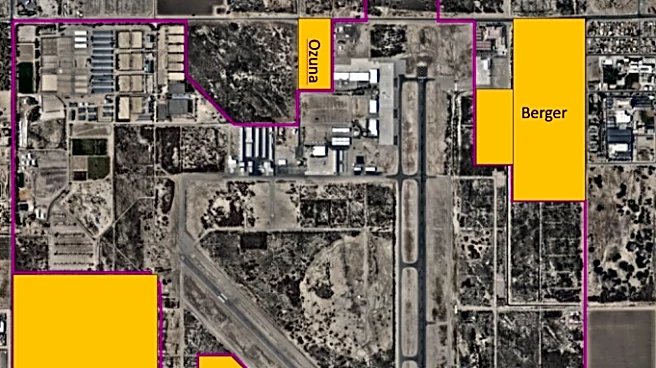








A Coachella Valley Native American tribe’s plans to develop a large swath of land it owns adjacent to Thermal’s airport have been up in the air for years because it says the county won’t grant it access it seeks to the airport's runways.
Now the tribe is accusing Riverside County of fraud, racial discrimination and more after it says the county engaged in "a government-engineered bait-and-switch" by selling the land to the tribe, then passing a resolution that effectively barred it from moving forward with the envisioned development. The county's motivation, the tribe alleges, was to protect the interests of other aviation businesses already operating at the airport.
In a lawsuit filed in federal court last month, attorneys for the Twenty-Nine
Palms Band of Mission Indians say the tribe paid the county about $12 million for around 612 acres on the southwestern edge of the airport back in 2022.
The attorneys write that the tribe was drawn to the land because it was marketed as being “uniquely valuable for aviation-oriented developments" that would require being adjacent to the airport and being able to taxi planes directly onto the runways.
The tribe says it bought the land intending to locate a foreign trade zone — a term for a place where merchandise can be stored or processed while avoiding tariffs and other taxes — and a facility for importing and holding horses and similar animals. A part of the property was also to be used as a new base for Coulson Aviation, an aerial firefighting business already operating out of the airport that has told the county it would likely leave the airport if the new base could not be built.
Supervisor Perez ‘surprised’ by lawsuit
But the attorneys write those plans were dashed when the county suddenly reversed course and, “on rushed notice,” adopted a resolution that banned the county from making any agreements with private landowners to taxi aircraft from their land to the airport.

The suit argues that the move was made “not to serve any Federal Aviation Administration mandate, but to needlessly advantage incumbent airport tenants.” It states that the county continued to allow The H.N. and Frances C. Berger Foundation to taxi planes onto the airport under an agreement dating back to 1970 that is like one the tribe was seeking.
“The County’s conduct is not a policy judgment entitled to deference; it is unlawful government misconduct,” the tribe's attorneys write. “The County and its agents fraudulently induced the Tribe’s investment, then destroyed or substantially impaired the very property value and investment-backed expectations the County itself created.”
The Desert Sun reached out to Riverside County for comment on the lawsuit. It was sent a statement from Supervisor V. Manuel Perez in response, in which Perez said the county owns and operates five airports and does not have such “through the fence (TFF) agreements” — the term for an agreement allowing plans to access airports from private property — at any of them.
“We are aware of this lawsuit and are surprised by it,” said Perez, whose district includes the airport and the rest of the Coachella Valley. “We are reviewing it to determine next steps, and we hope to find a resolution with Twenty Nine Palms.”

Perez and the rest of the county supervisors are among the 16 county employees named in the suit, a list that also includes the county’s aviation director Angela Jamison and Perez’s former chief of staff, former Coachella Mayor Steven Hernandez.
County says it could not risk losing federal grants
Before they passed the ban on "through-the-fence" agreements in 2025, Perez and the other supervisors got a memo from county staff recommending the move and saying such agreements would violate FAA requirements and put the county at risk of losing federal grants to fund airport operations.
The lawsuit states that the county moved to ban such agreements in 2024, long after the tribe bought the land from the county believing it would be able to have access to the airport. The staff memo, meanwhile, suggests developments outside the airport fence are unnecessary since there is "significant developable land available on existing airport property."

A Patch.com story detailing the two hour discussion states the supervisors heard from a variety of speakers on both sides of the issue, including the owner of a company called Desert Jet that operates at the airport and was planning a $20 million investment in its operations there. The owner, Jim McCool, said “nobody will invest in airports that permit unfair competition using through-the-fence.”
The tribe's lawsuit lists six claims against the county: fraudulent inducement, regulatory taking, racial discrimination in contract, equal protection, substantive due process and fraud.
“The County discriminated against the Tribe in contracting, denied equal protection by treating the Tribe worse than a similarly situated private through-the-fence user without any rational basis, and deprived the Tribe of substantive due process through arbitrary, irrational, and conscience-shocking action,” it reads.
The tribe's attorneys allege it was subject to racial discrimination because "Defendants treated Plaintiff less favorably than similarly situated non-Native entities in connection with airport-adjacent contracting opportunities and TTF access."
The suit asks the court to bar the county from enforcing the resolution against the tribe and to instead order it to work with the tribe and FAA “in good faith” on an agreement that would give it access to the airport. It also requests “just compensation” for the taking of the tribe’s property with interest and attorney’s fees.
The suit argues that the tribe only purchased the land and invested time and money in both making plans for the development and trying to negotiate a through-the-fence agreement with the airport because the county deceived it.
“The Tribe would not have taken those actions, or would have acted differently to protect its rights and investments, had Defendants disclosed that the County would refuse to enter into, approve, support, process, evaluate, or even consider a TTF agreement for the Thermal Property,” it states.
Paul Albani-Burgio covers growth, development and business in the Coachella Valley. Email him at paul.albani-burgio@desertsun.com.

This article originally appeared on Palm Springs Desert Sun: How Twenty-Nine Palms tribe says Riverside County defrauded it of $12M