




Insofar as Artificial Intelligence is evidently going to kill us all in a few years, now might be a good time to complete some of those collections you've been working on. Since jobs will be non-existent and everything will be free, you won't get that sense of accomplishment you've been striving for all these years. Thus, you might as well stock up on bits of remembrances that will allow you to recall things like "work" and "thought" and "effort." Sigh.
So much for humor. With that as background, let's talk about something … well … more banal.
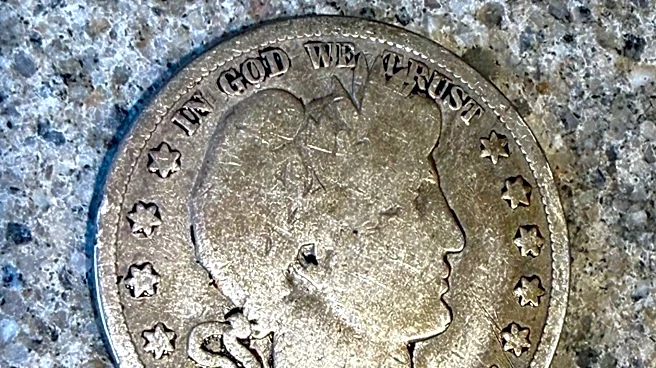
Since coin collecting is nearly universal, let's take a look at the Barber half dollar. If you're an enthusiast and have been around more than 120 years — another distinct possibility in the near future
— you might even remember it.

The coin came about in the late 19th century as Americans were growing tired of its predecessor, the Seated Liberty half dollar. That coin had been around since 1839, and with the Industrial Revolution going full steam ahead, it was time for some new money. The United States Mint decided on an egalitarian approach and asked the public to submit design concepts. In the end, no one was happy with the results so the Mint's chief engraver stepped in with an idea for three thematically related coins. His name was Charles Barber, and thus the Barber trio of half dollar, quarter dollar and dime was born.
Barber's design naturally included Lady Liberty but with the somewhat odd addition of a Phrygian cap. This unpronounceable accessory had its origins in Turkey and can best be described as a beanie with a forward tilting lump on top. For some reason, it frequently seemed to turn up at the world's various revolutions, including ours, and over the years had become associated with freedom and liberty. It now reigns as one of the potentially most unanswerable questions on "Jeopardy!"
The reverse of the Barber design featured a nicely rendered eagle with the usual arrows and olive branches in its talons. All in all, Barber's conceptions gained immediate favor with the powers that be, and the new half dollar became coin of the realm in 1892.
Like nearly all half dollars preceding it and those that were minted through 1964, the Barber model was 90% silver and widely minted in four locations: Denver (mint mark "D"), New Orleans ("O"), San Francisco ("S") and Philadelphia (no mint mark). It was finally replaced in 1916 with the Walking Liberty half dollar, viewed by many as America's best-looking coin of all time. The Barber's quarter century as legal tender was in keeping with an Act of Congress from 1890 that required all newly introduced coins to circulate for at least 25 years before they could be changed.
An interesting twist occurred in 1892 when a few Barbers were minted in New Orleans with a mint mark meant for the smaller dime. A slightly smaller than usual "O" may not seem like much, but sharp-eyed collectors will strain their eyeballs looking for it, and this tiny difference, when it appears, makes a huge difference in value. Known as the "micro-O" variant, one of those in top condition can sell for upwards of $30,000. Due to a relatively low minting, the 1904-S is no slouch either and can easily bring five figures.
The upshot is that it's difficult and expensive, but not impossible, to put together a complete collection of Barber 50s. Hey, you only live once.
Mike Rivkin is the former proprietor of Antique Galleries of Palm Springs. His new venture will open later this fall. Contact him at scmcorp@sbcglobal.net.
This article originally appeared on Palm Springs Desert Sun: What makes a Barber half dollar sell for five figures?