





The developer behind a controversial data center proposal once planned for Coachella has begun pressuring the city to over its cancelled contract.
In a letter sent to Mayor Frank Figueroa and the city council in early August, Stronghold Power Systems says the council's decision to cancel a development agreement that would have resulted in a hyperscale data center being built within Coachella's borders means officials passed up an opportunity for the city and other local institutions to earn $54.2 million in annual tax revenue.
"The City’s decision to breach the contract with Stronghold Power Systems has real financial consequences for the City and the region, both in what Stronghold has already expended on the project and in lost revenue," Stronghold Power said
in a press release accompanying the letter.
The company claimed to have spent $8 million of its own money to perform design work required under its contract with the city. That money and the contract could now become the subject of a legal dispute, although Stronghold has indicated it would like to avoid a lawsuit.
"We are not trying to take anything away from the people of Coachella," Stronghold CEO Scott Bailey said in the release. "We would rather sit down with the City and work something out than end up in a courtroom. That is still where we would like this to go."
Stronghold's push to force a settlement with Coachella raises the possibility of a financial consequence for the city council's decision to cancel its agreement with the power company and permanently ban data centers, which it did in mid-August.
But Mayor Frank Figueroa remained firm when asked about the council's vote.
"The residents were clear. They did not want it," he said, referring to Stronghold's proposal to build a data center. "They knew what could come from it. I’ve said no amount of money can be put on someone’s life, because we all saw, and we’re seeing what’s happening across America, and what data centers are doing to neighborhoods."

Coachella planned to use data center to expand
Stronghold had entered into a contract with the city known as a Master Utility Development Agreement, which was designed to expand the city's power infrastructure to facilitate future growth on the city's east side, which is now mostly agricultural land.
As part of the agreement, the city would have allowed Stronghold to build a large data center near Avenue 52 and Filmore Street that would potentially use up to 300 megawatts of electricity, enough energy to power a small town.
As part of the data center development, Stronghold would have to build out electrical infrastructure to power the data center. The city had planned to then expand on that infrastructure for the construction of new neighborhoods and businesses, using tax revenue generated by the data center.
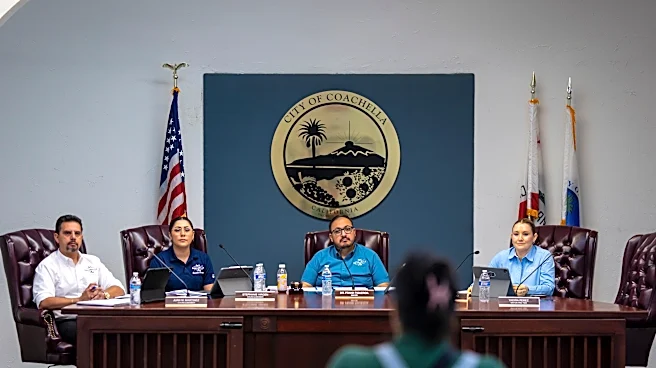
But the cityfaced fierce pushback from local community members, who became enraged at the idea of the data center sucking up vast amounts of energy and water. Hundreds of protesters gathered at Coachella City Council meetings to voice their disapproval of the project.
The council eventually voted to cancel the contract and instituted the Coachella Valley's first permanent ban on data centers.
"We did what the people wanted to do in the first place and what we should have done in the first place," Figueroa said.

Stronghold Power says Coachella residents will miss out
"The residents of Coachella are entitled to know the magnitude of what was lost," Bailey, the Stronghold CEO wrote in his letter to the city.
According to the power company, the city of Coachella would have received around $22 million per year as part of the agreement, although its unclear from city documents how much discretion the city would have on spending this money. A part of the agreement stipulated that some revenues would be used to pay back Stronghold for development costs and operating expenses.
Stronghold also estimated an additional $32.2 million would have been generated from property taxes. The beneficiaries of the property tax revenue would have been as follows:
- Schools and educational agencies: $19.7 million
- Riverside County: $5 million
- Coachella Valley Water District: $2.5 million
- City of Coachella: $3 million
- Other special districts: $2 million
Property tax revenue typically goes into a city's general fund to be spent on general services, like police and fire, meaning Coachella would have theoretically gained $3 million in unrestricted funds, a significant boon for a city with a total budget of around $39 million.
Without the revenues from Stronghold's proposal, the city must come up with a new plan for expanding its east side.
"How do we grow when we know we have a lack there of electricity?" Figueroa said. "We need to go back to the drawing board and see what other options that we have."

Dispute over an alleged breach of contract
Coachella now faces a threat of a lawsuit over its decision to cancel its agreement with Stronghold.
"The actions of the city council are a clear breach of the council-approved contract, and what Stronghold is owed is defined by the terms of the agreement the city negotiated and approved," Stronghold said in a statement. "At the direction of the council, Stronghold invested approximately $8 million of its own capital in Coachella and continued performing the work the contract required, delivering the design documentation this August."
The company said it was currently reviewing its options and hoped to work with the city to come up with a "mutually beneficial settlement."
Figueroa declined to comment on the legal aspects of the city's agreement with Stronghold, citing the potential for litigation.
However, in a report to the council prepared by then-Interim City Manager Lincoln Bogard and City Attorney Ryan Guiboa, the city officials contended Coachella had the authority to cancel the contract without cause.
"Accordingly, the question is not if, but when, the City has the right to terminate," the officials wrote in the report.
The agreement also states that all costs incurred by Stronghold during the initial development period do not need to be reimbursed if the city decides to drop the project.
Figueroa directed questions about the alleged breach of contract to the city attorney. The Desert Sun did not hear back by the time of publication.
Sam Morgen covers local government for The Desert Sun. Reach him at smorgen@gannett.com.
This article originally appeared on Palm Springs Desert Sun: Data center developer presses Coachella over cancelled contract. Will lawsuit follow?