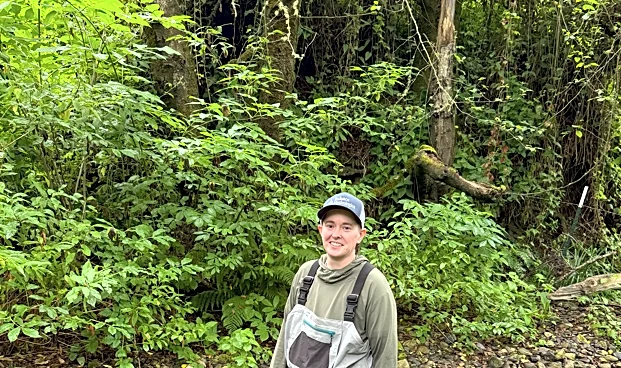





It's not every day that an unusual rock turns out to be a 10,000-year-old fossil, but that's what happened to geomorphologist Brigid Lynch.
As part of a habitat enhancement project for the threatened California red-legged frog, Lynch — who works for Balance Hydrologics — was exploring a Midpeninsula Regional Open Space District
(Midpen) preserve in San Mateo County, the agency said in a Sept. 9 news release.
As Lynch surveyed a creek bed, she spotted what appeared “to be an oddly shaped rock.” The object that seemingly blended in with its surroundings, though, was something far rarer: Paleontologists later confirmed it “to be an intact, adult Pacific mastodon molar.”

“As a geologist, I've gone out and seen stuff in the field, but definitely nothing
as exciting as this,” Lynch said in the release.
The discovery left veteran paleontologist Wayne Thompson, who owns Pacific Paleontology, in awe.
“I had chills and shivers up and down my spine,” Thompson said.

The tooth, he said, “is in immaculate condition.”
“It's the most complete mastodon molar from our area, and the most spectacular mastodon molar that I've ever seen. ... It's another puzzle in the Ice Age saga that we can put into place,” Thompson said.

'The newest species of mastodon'
“The Pacific mastodon is the newest species of mastodon to be recognized,” according to the agency.
The species was officially recognized as a distinct species in 2019, according to the Western Science Center. Previously, Ice Age mastodons from California were classified as Mammut americanum.
“The new species is defined by proportionally narrower teeth, as well as differences in the hips and hind legs,” the museum said.

The massive elephant-like creatures roamed parts of “what is now California, Oregon, the northern Rocky Mountain region of the western United States and parts of Mexico,” according to Midpen officials.
“These massive herbivores roamed local ecosystems during the Pleistocene epoch, spanning 2.5 million years ago until their extinction around 11,700 years ago,” the agency said.
Unlike mammoths, which fed on grasses, mastodons used “their massive trunks to strip leaves, soft shoots or fruits of high-growing, generally woody plants,” officials said.

While the mastodons are long gone, traces of the Ice Age ecosystem they encountered remain.
The San Francisco Bay Area still mirrors ancient landscapes, with “many of the same iconic wildlife and plants we see on our trails today,” the agency said.
Mountain lions and bobcats may have hunted alongside saber-toothed cats and dire wolves before adapting to smaller prey as large herbivores disappeared.
“Tule elk, coyotes and American badgers likely roamed the valleys inhabited by mastodons and bison-sized Jefferson’s ground sloths,” the agency said.
What will happen to the fossil?
Midpen has donated the fossilized tooth to Stanford University’s Doerr School of Sustainability, where researchers will use carbon dating to determine an exact age, as well as “perform a 3D-scan and print a copy of this specimen for Midpen's to use for public outreach and education.”

“We can study fossils to better understand Earth’s past, past wildlife and the ecosystem they were a part of, and to help us make better predictions and better decisions about how to help our ecosystems and biodiversity thrive into the future,” Christine Garcia, Curator and Manager of the Geoscience Specimen Collection at Stanford, said in the release.
This article originally appeared on Palm Springs Desert Sun: ‘Oddly shaped rock’ in CA creek turns out to be 10,000-year-old fossil