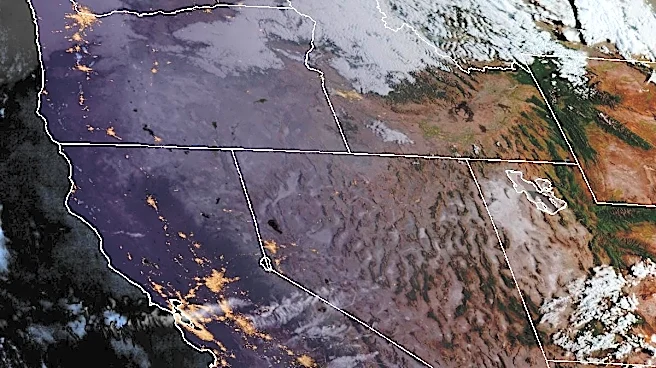







California had a busy weekend underground, with hundreds of micro-earthquakes recorded across the state, including a preliminary magnitude 3.0 quake in Contra Costa Countyon Monday morning.
The activity may sound alarming, especially in a state where residents have long been warned to prepare for a major earthquake known as the "Big One." But a burst of smaller earthquakes does not necessarily mean a major earthquake is about to strike.
So what happened this weekend, and should Californians be worried?
Here's what to know about the recent earthquake activity and what scientists say it can — and can't — tell us about the next major quake.
How worried should Californians be about the 'Big One'?
California has been waiting a long time for another
major earthquake along some of its most dangerous faults.
The last major rupture of the southern San Andreas Fault occurred in 1857, when a magnitude 7.9 earthquake ruptured roughly 225 miles of the fault. Known as the Fort Tejon earthquake, it produced shaking that lasted an estimated one to three minutes and killed two people.
The state looks very different today. California's population has grown dramatically since 1857, with millions of people now living in densely populated areas near active faults.
Researchers have long said another major earthquake will eventually occur in Southern California. The question is when.
A 2026 study from researchers at the University of Hawaiʻi at Mānoa found that stress levels on the southern San Andreas and San Jacinto fault systems are at their highest levels in roughly 1,000 years, based on physics-based modeling of the region's earthquake history.
The finding adds to scientists' understanding of the region's earthquake risk, but it does not mean a major earthquake is imminent.
“Right now, with stress at historically high levels across the region and more than 160 years elapsed since the last major rupture, the system is in a critically loaded state,” study lead author Liliane Burkhard said.
Does a burst of earthquakes mean the 'Big One' is coming?
Not necessarily.
Earthquake swarms and clusters of smaller earthquakes happen in California and elsewhere. A stretch of heightened activity does not give scientists a reliable way to determine whether a larger earthquake is about to occur.
Scientists can identify faults that are capable of producing large earthquakes and estimate the likelihood of future activity, but they cannot predict the exact time, location and magnitude of an earthquake.
That means hundreds of small earthquakes do not amount to a countdown clock for the next major quake.
Can earthquakes be predicted?
No. Scientists cannot currently predict earthquakes with enough precision to say when a major earthquake will happen, where it will strike or how large it will be, according to the U.S. Geological Survey.
The U.S. Geological Survey says neither it nor other scientists have successfully predicted a major earthquake, and there is no expectation that reliable earthquake prediction will become possible in the near future.
Instead, scientists monitor seismic activity, study faults and calculate earthquake probabilities to better understand the risks communities face.
Why are earthquakes so common in California?
California sits along the boundary between the Pacific Plate and the North American Plate. The plates are constantly moving past one another, creating stress in Earth's crust.
When that stress overcomes friction along a fault, the fault can suddenly slip, releasing energy as seismic waves. People experience those waves as an earthquake.
The San Andreas Fault is the best-known fault system in California. It stretches roughly 800 miles through the state and marks the primary boundary between the two tectonic plates.
But it is far from the only fault capable of producing earthquakes. California has hundreds of active faults, including the Hayward, Calaveras, San Jacinto, and Elsinore fault systems.
Earthquakes also occur offshore, including near the Mendocino Triple Junction, where the Pacific, North American and Gorda plates meet.
Why is the San Andreas fault so risky?
The San Andreas Fault is a major boundary between the Pacific and North American tectonic plates. The plates slide horizontally past each other, building stress that can eventually be released in a major earthquake.
Some sections of the fault have gone centuries without a large rupture.
Jonathan Stewart, a UCLA professor who studies earthquake engineering, told USA TODAY large ruptures on the San Andreas have occurred at intervals of roughly 150 years in some sections. But those intervals are not a schedule for future earthquakes.
A section of the fault south of the 1857 Fort Tejon earthquake has not experienced a large rupture since around 1690, Stewart said. That means significant stress may have accumulated, but it does not mean an earthquake is "overdue" or that scientists can predict when the next one will happen.
A major San Andreas earthquake could affect millions of people and cause damage well beyond the fault itself. Strong shaking could damage buildings, roads and other infrastructure, while soft or water-saturated soils can amplify shaking and increase the risk of liquefaction.
Southern California's water infrastructure is another major concern. Stewart said a major earthquake could damage many of the aqueducts that bring water into the region.
“Most people will not be in a collapsed structure after this earthquake, but everybody's going to be affected by water problems,” Stewart said.
But a major San Andreas earthquake would not cause California to split off from the rest of the country or fall into the ocean.
The San Andreas is a strike-slip fault, so its primary movement is horizontal. During a major rupture, sections of the ground on opposite sides of the fault could suddenly shift several feet, producing intense shaking and permanent displacement along parts of the fault.
Is California falling into the ocean?
No.
The San Andreas Fault does not represent a giant crack that could cause California to drop into the Pacific Ocean. It is a transform boundary, where tectonic plates slide horizontally past one another.
Over millions of years, however, that movement has gradually shifted portions of coastal California northwest relative to the rest of North America. At an average rate of roughly 45 millimeters per year, the movement is comparable to the rate at which fingernails grow.
That adds up to roughly 150 feet over 1,000 years.
The movement is not constant. Some sections of faults creep gradually, while others become locked and accumulate stress that can eventually be released in an earthquake.
How does California's earthquake early warning system work?
California's earthquake early warning system is designed to give people a few seconds of notice before strong shaking arrives.
The system uses seismic sensors to detect an earthquake and rapidly estimate the expected ground motion. Alerts can be delivered through several systems, including Wireless Emergency Alerts, Android Earthquake Alerts and the MyShake app.
The warning does not predict an earthquake before it happens. It detects an earthquake that has already begun and can sometimes alert people farther from the epicenter before the strongest shaking reaches them.
Depending on how close someone is to the earthquake, an alert may arrive only moments before shaking begins — or after shaking has already started.
What should you do during an earthquake?
If an earthquake strikes, experts recommend:
- Drop to your hands and knees.
- Cover your head and neck and, if possible, get underneath a sturdy table or desk.
- Hold on until the shaking stops.
If you are indoors, generally stay there rather than rushing outside while the ground is shaking. People in coastal areas should also be aware of tsunami hazards following a strong earthquake.
Brandi D. Addison covers weather across the nation as the Weather Connect reporter for the USA TODAY Network and contributes to Texas Connect coverage across the state. She can be reached at baddison@usatodayco.com. Follow her on Facebook here.
This article originally appeared on Palm Springs Desert Sun: 150+ earthquakes rattled California this weekend. Is the 'Big One' coming?