






California’s billionaire tax measure holds a slight lead among voters, while more voters oppose the voter ID measure than support it, according to a new poll of two proposals headed to the November ballot.
Both measures divide voters largely along partisan lines, according to a UC Berkeley Institute of Governmental Studies poll released Friday, Aug. 14.
The two proposals are among 14 ballot measures Californians will decide on in November.
Here’s what the Berkeley IGS poll found about the two controversial measures.
What to know about wealth tax initiative and poll results
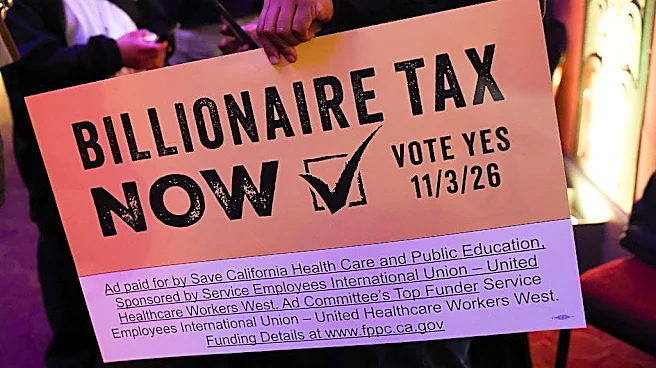
The state’s wealth tax initiative, Proposition 40, is a proposed one-time 5% tax on the wealth of the Golden State's billionaires. Most of the revenue generated from the measure would go toward health care, while the remaining would go to education
and food assistance programs.
Thetax would be due in 2027, according to the Legislative Analyst’s Office. Taxpayers, however, could opt to pay over time with payments spread out over five years at a higher cost.
The state would likely collect tens of billions of dollars, but the exact amount would be difficult to predict given several factors, the LAO said.
The SEIU-United Healthcare Workers West, the primary union driving the measure, has argued it is necessary “to prevent the collapse of California healthcare and help fund California public K-14 education and state food assistance programs.”
The measure has divided the state’s top Democrats.
The California Democratic Party has endorsed the measure, while Gov. Gavin Newsom and gubernatorial candidate Xavier Becerra oppose it, citing concerns that it will drive billionaires to flee the state.
The Berkeley IGS poll found that while 48% of voters said they would support the measure, 41% said they would oppose it.
Support and opposition are largely tied to political ideology, with about 7 in 10 Democrats and 86% of strong liberal voters in favor of the measure, and 8 in 10 Republicans and conservatives opposed.
“These results suggest that the Billionaires Tax initiative is shaping up to be a closely fought contest, with the key question being whether opponents can make big enough inroads among the state’s traditionally Democratic-leaning voters,” IGS co-Director Eric Schickler said in a news release.
Regionally, Proposition 40 is garnering strong support from voters in the San Francisco Bay Area and Los Angeles County, according to pollsters. By contrast, opposition is stronger in Orange County, the Central Valley, and the state’s North Coast/ Sierras region.
Pollsters also found support varied by voters’ age, gender and race/ethnicity. A majority of young voters, women and voters of color favor the initiative, while pluralities of voters age 65 or older, men and white voters oppose it.
Two countermeasures to the proposed wealth tax, Propositions 41 and 42, have also qualified for the November ballot. The initiatives are intended to limit the effects of Proposition 40 if voters approve it.
If approved by voters, Proposition 41 would require the California State Auditor to review programs funded by any new special tax proposed through the initiative process before the measure appears on the ballot and to conduct audits every four years of programs funded by special taxes approved by voters or the Legislature, according to the LAO. The proposal would also limit the state's ability to exempt spending from new special taxes from California's spending cap. If Propositions 41 and 40 both pass, Proposition 41 could prevent the wealth tax measure from taking effect if it receives more votes
Meanwhile, Proposition 42 would prohibit new state taxeson financial assets, such as stocks and investment accounts, as well as other personal property, according to the LAO. If approved by voters and it receives more votes than Proposition 40, the measure could block the wealth tax initiative from taking effect.
The two measures, though, are not well known among voters, who are largely undecided, the poll found.
For Proposition 41, 35% of voters said they support the measure, 37% said they would oppose it, and another 28% are undecided. A similar pattern emerges for Proposition 42: 40% of voters back the measure, 37% oppose it, and 23% are undecided.
What to know about voter ID initiative and poll results
Another contentious ballot measure that divides voters sharply along partisan lines is the voter ID initiative, Proposition 39.
The proposal would amend the California Constitution to require voters to show a government-issued ID when voting in person or provide the last four digits of a government-issued ID number when voting by mail. The measure would also require the state to issue voter ID cards upon request and require election officials to annually report the percentage of voters in each county whose citizenship has been verified.
If passed, the measure would increase state and local government costs each year by tens of millions of dollars to low hundreds of millions of dollars, according to the LAO.
San Diego Republican Assemblymember Carl DeMaio is leading the initiative's effort, calling it a way to improve “public trust and confidence in our elections.”
Opponents, including the ACLU and League of Women Voters of California, argue the measure would create additional barriers for voters.
The IGS poll found that 51% of voters would vote against the measure, compared with 42% who would support it.
“Voter reactions to Proposition 39 are also highly partisan and ideologically based, with 80% of Democrats and greater than eight in ten liberals voting No,” pollsters said.
On the other end of the political spectrum, more than 9 in 10 Republicans and voters identifying as strongly conservative say they would vote for the measure.
“Foes of the Voter ID initiative have already started to solidify, making it a more typical Democratic-Republican fight, in which Democrats in California generally hold the advantage,” Schickler said.
Support for Proposition 39 also varies by region, with opposition strongest in the San Francisco Bay Area, Los Angeles County and Central Coast counties. By contrast, support for the measure is strongest in Orange County, the Inland Empire, San Joaquin Valley, and the state’s North Coast/Sierras region.
The IGS poll, conducted between Aug. 3 and Aug. 9, used a weighted sample of 2,310 likely November voters drawn from a larger pool of 4,207 registered voters across California. The poll's margin of error was ±2.5 percentage points.
This article originally appeared on Palm Springs Desert Sun: CA billionaire tax narrowly leads as voter ID measure faces opposition