






Should California tax billionaires to help pay for health care and other public services?
That's what voters will decide on with Proposition 40, a closely watched ballot measure that would impose a one-time 5% tax on residents worth more than $1 billion. Supporters say it could generate billions in revenue for state programs, while opponents warn it could drive wealthy taxpayers out of California.
With Election Day just weeks away, here's what voters should know about Proposition 40.
What the wealth tax initiative would do
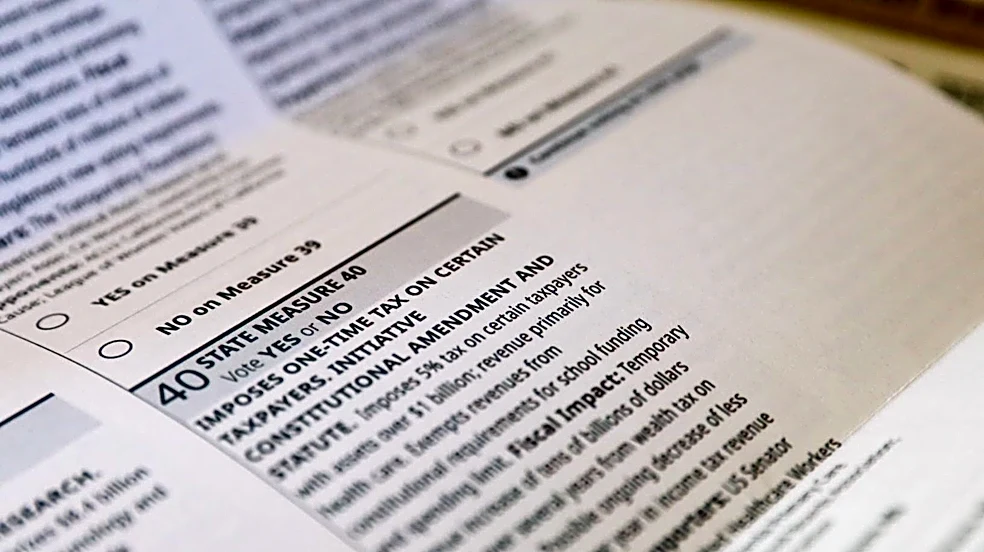
Proposition 40 would impose a one-time 5% tax on residents whose net worth exceeds $1 billion. The tax would apply to people who were California residents as of Jan. 1, 2026.
"Real estate, pensions, and retirement accounts generally would be excluded from the tax,"
according to the Legislative Analyst's Office.
Ninety percent of the revenue would go to health care programs, while the remaining 10% would go to education and food assistance programs.
Taxpayers could opt to pay the tax, due in 2027, over five years, but would have to pay more to do so, according to the LAO.
What LAO's fiscal analysis says
The LAO said in its analysis that the state would likely collect tens of billions of dollars from the proposed wealth tax. The funds would be spread across several years, but predicting when and how much the state would collect is hard for several reasons, including what actions billionaires may take to reduce the taxes they owe.
Additionally, because much of that wealth is tied to constantly changing stock prices, it is difficult to predict an exact revenue amount.
If passed, the initiative could also possibly decrease state income tax revenues, the agency said. All California residents, including billionaires, pay state income tax. In response to the wealth tax initiative, some billionaires may find ways to reduce their income tax payments, according to the agency.
For example, some billionaires may leave the state, meaning the agency would no longer collect revenue from their annual income taxes.
The agency estimates that such responses could reduce state revenues by less than $1 billion per year. The reduction could mean less money for the state's General Fund, which funds public services, including education, health care, and prisons.
The agency said another cost would be administering the wealth tax, including determining how much taxpayers owe and collecting payments. Those expenses, paid for with wealth tax revenue, are expected to total tens of millions of dollars annually for several years.
What proponents say about billionaire tax measure
Service Employees International Union – United Healthcare Workers West, the measure's primary sponsor and creator, says it's needed “to prevent the collapse of California healthcare and help fund California public K-14 education and state food assistance programs.”
The labor union says the measure is in response to the Trump administration's H.R. 1, or “One Big Beautiful Bill Act," which "slashes $100 billion from California’s healthcare funding over the next five years, pushing our state towards a healthcare collapse."
“The billionaire tax is a commonsense solution to a looming crisis,” according to the labor union.
The tax "would be paid only by Californians worth more than $1 billion,” or about 200 people, and would raise $100 billion for the state, SEIU‑UHW says.
Groups supporting the measure include the California Democratic Party, ACLU of Southern California, California Federation of Labor Unions, AFL-CIO, California Federation of Teachers, and California Nurses Association.
Bernie Sanders is also among the measure’s proponents.
"(Billionaires) believe, like the monarchs of the 19th century, that they have a God-given right to rule. They have all the wealth; they have all the power, and who the hell do you think you are to challenge them? Well, I think on Nov. 3 they're going to learn a very powerful lesson," Sanders said at a rally in downtown Los Angeles in early October, ABC 7 News reported.
What opponents say about wealth tax initiative
Opponents, such as Gov. Gavin Newsom, worry the measure will drive billionaires to flee the state, along with their tax dollars.
Earlier this year, Google founders Sergey Brin and Larry Page had reduced their “California presence," The New York Times reported. At the same time, Meta CEO Mark Zuckerberg was reportedly eyeing purchasing a mansion in Florida, the Wall Street Journal reported in February.
“This is my fear," Newsom told POLITICO of his worries about California billionaires preparing to flee the state in response to the proposed measure. "It’s just what I warned against. It’s happening."
Both gubernatorial candidates, Xavier Becerra and Steve Hilton, oppose the proposed wealth tax.
Other opponents include the California Teachers Association, California Medical Association, California Children’s Hospital Association, California Professional Firefighters, and State Building and Construction Trades Council of California.
What recent polls have found for Proposition 40
Recent polls on Proposition 40 show voters are largely split on the measure.
A Citrin-POLITICO poll released Monday, Oct. 19, found that 46% of likely voters favor the measure, while 43% oppose it.
A separate Independent VoterProject survey released Oct. 5 also found voters split over the measure, with 40% in favor and 38% opposed, while a UC Berkeley Institute of Governmental Studies poll released Friday, Sept. 25, found similar results, with 45% support and 42% opposition among likely voters.
“The findings suggest tough news for Proposition 40 proponents. With less than 50 percent support this close to the election, ballot measures for new taxes tend not to pass, as undecided voters likely break toward ‘no,' " IGS Co-Director G. Cristina Mora said in a statement. "Unless we see meaningful pushes in marketing and canvassing aimed at reaching younger voters, and others who often stay home during midterm elections, the climb looks quite steep."
Countermeasures on the ballot meant to limit effects of Proposition 40
Two countermeasures to the proposed wealth tax, Propositions 41 and 42, have also qualified for the November ballot. The initiatives are intended to limit the effects of Proposition 40 if voters approve it.
Proposition 41 would prohibit new state taxes that exclude revenue from the state spending limit, while Proposition 42 would prohibit new personal property taxes and certain retroactive state taxes passed after January 2026.
Money pours in to fight over wealth tax
Campaign spending by bothsides opposing and supporting Proposition 40 and its countermeasures surpassed $200 million in late September, according to the Los Angeles Times. The opposition campaign has largely driven the spending and has outspent supporters by more than 5-to-1, according to the Sacramento Bee.
Opponents of the wealth tax have raised more than $130 million in contributions, while supporters of Proposition 40 have raised nearly $33 million, campaign finance data accessed on Oct. 10 shows.
Additionally, more than $186 million in contributions have poured in to bolster Propositions 41 and 42, which aim to curb Proposition 40's effects if it passes, according to campaign finance data. Opponents of those measures have raised about $2.75 million.
Proposition 40: Bottom line
What a yes vote means: The state could collect a one-time 5% tax on the wealth of California billionaires.
What a no vote means: The state could not collect a one-time 5% tax on billionaires' wealth.
This article originally appeared on Palm Springs Desert Sun: What California voters should know about Proposition 40