





Dozens of sick sea lions have been turning up along California's Central Coast, as marine animal rescuers field hundreds of calls daily.
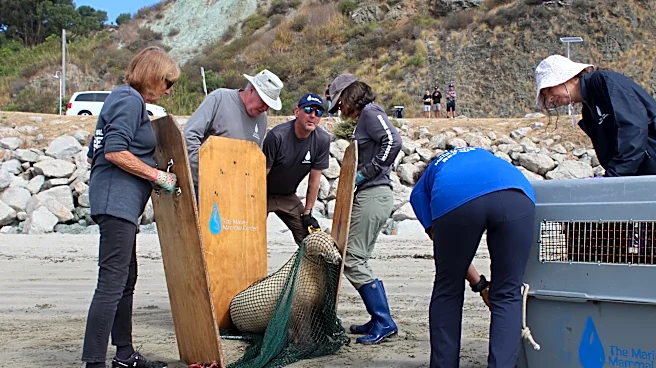
The Marine Mammal Center has rescued about 30 California sea lions sick from domoic acid poisoning in Monterey County and southern Santa Cruz Counties over the past week, said Giancarlo Rulli, a spokesperson for the nonprofit.
Rulli said that count also does not include additional rescues in San Mateo, San Francisco, Marin and Sonoma counties. There have also been a handful of northern fur seals affected.
The spike in sick animals has also triggered a surge in reports from the public.
"Our dispatch team is receiving anywhere from 300 to more than 600 calls to our hotline every single day, which is an incredibly
high volume of calls," Rulli said.

Typically, in an average year across the center's 600-mile California response range from San Luis Obispo County to Mendocino County, they will see from about 75 to 90 cases of domoic acid poisonings in sea lions.
"We're already over 100 cases at this point as we turn the page into the month of September, and there's no real clear indicator as to how long this current situation may last," Rulli said.
What is domoic acid poisoning?
Domoic acid is an algal toxin that is naturally occurring in the marine ecosystem, according to Rulli.
"We're talking here on the U.S. West Coast in the Pacific, and this algal toxin is a neurotoxin that basically works its way up the food chain," Rulli said.
The toxin accumulates in fish and shellfish, which are not directly impacted, Rulli said.
But when large marine mammals, such as California sea lions, eat a high concentration of those forage fish, the algal toxin can result in a range of neurological symptoms including lethargy, disorientation, unpredictable behavior, twitching, tremors and seizures.
"California sea lions and other marine mammals don't drink water for their hydration like humans do," Rulli said.

Instead, the mammals get all their hydration from the food they eat.
"If they're eating food with high concentrations of the toxin, there's no way for them to flush that toxin out of their system on their own," according to Rulli.
The Marine Mammal Center first documented domoic acid poisoning in California sea lions in 1998.
"So, it's not new to the California coast, but what is new is that this algal toxin has become more unpredictable," Rulli said.
Outbreaks have become less seasonal, 'more intense'
Since the toxin was first identified nearly 30 years ago, the outbreaks in marine animals have become less seasonal and "more intense," Rulli said.
"It used to primarily be we would see cases flare up during the summer, and now we see this toxin flare up in sea lions and in other marine life throughout the year," Rulli said.
The reasons underlying the shift to year-round domoic acid outbreaks, though, "are still being very much investigated by algal toxin experts and oceanographers," according to Rulli.
For The Marine Mammal Center, Rulli said the new year-round phenomenon "presents unique challenges from a rescue and response side of things."
The sea lions that the center typically sees are subadult or adult sea lions, which which weigh anywhere from 100 to more than 300 pounds, Rulli said. To rescue the large animals, it requires anywhere from four to six trained volunteer responders equipped with a 50-to-100-pound metal carrier.
"These are quite large animals who are, of course, wild animals and unpredictable," Rulli said.
And, with the abnormal neurologic behavior stemming from the domoic acid poisoning, the animals' behavior is even more erratic and difficult to read, even for the center's trained volunteer responders, Rulli said.
'A very insidious, brutal disease'
Once the sea lions arrive at the center, Rulli said veterinary staff provide them with bagged fluids to try and flush the toxin from their system. In addition, staff give the animals anti-seizure medication and put them on a long-term treatment plan.
Some animals, however, may have what's called a "breakthrough seizure," which is when they have a seizure even though they are on an anti-seizure protocol with anti-seizure medication.

"That can be a sign of chronic domoic acid poisoning," Rulli said.
With domoic acid, animals may experience either acute or chronic poisoning, according to Rulli.
Acute poisoning occurs when an animal recently consumes a high concentration of the toxin and begins showing symptoms such as lethargy and disorientation, Rulli said. Then, there's chronic domoic acid poisoning, where an animal has potentially picked up the toxin multiple times over several months or in previous years.

"It can be quite an uphill veterinary challenge to care for these animals, and we do our very best to try and get them back to the wild as quickly as possible, but there are many that do not make it," Rulli said. "This is a very insidious, brutal disease."
The impacts extend beyond individual animals, Rulli said.
'True sentinels for ocean health'
Rulli called California sea lions "true sentinels for ocean health."
"They are near coast foragers. They eat the same food that we do," Rulli said.

When flareups of domoic acid poisoning happen along the coast, Rulli said it's a cue for the center, along with other response organizations, to alert the California Department of Public Health to begin testing marine organisms, such as shellfish and crab, as humans can also get domoic acid poisoning. In humans, though, it's called amnesic shellfish poisoning.
California sea lions, Rulli said, are "canaries in the coal mine" that can signal broader problems in a stressed ocean ecosystem.
"These animals are the first indicators of wider issues going on," Rulli said.
Tips for beachgoers over Labor Day weekend
Rulli said he would urge beachgoers who happen upon a distressed marine mammal to report the animal so rescuers can take the appropriate steps.
"If you see a sea lion or a seal that appears to be in distress, please keep your distance of at least 150 feet," Rulli said. "Do not intervene. Leash your dog. Do not allow your pet to approach."
Rulli recommends using the zoom on your camera to take a photo, then report the animal to the appropriate rescue.
If you are within the center's response range from San Luis Obispo County to Mendocino County, you can call The Marine Mammal Center's hotline at 415-289-7325, Rulli said.
With the inundation of calls in recent days, howevr, Rulli urged the public to have patience.
"If you do not receive a call back, or a live dispatcher does not pick up and it goes to voicemail, I would just tell the public that please don't be discouraged," Rulli said. "We are taking that information down. It just may be that there may be 20 to 30 calls on that same individual. So there, there are a lot of repeat calls that are happening."
So far, domoic acid flareups have not been present in Southern California. But should beachgoers who are outside The Marine Mammal Center's response range notice any distressed marine animals, they should reach out to marine centers that service their counties, such as the Pacific Marine Mammal Center in Orange County and Marine Mammal Care Center in Los Angeles County.
This article originally appeared on Palm Springs Desert Sun: Dozens of sick sea lions rescued amid Central Coast toxic algae outbreak