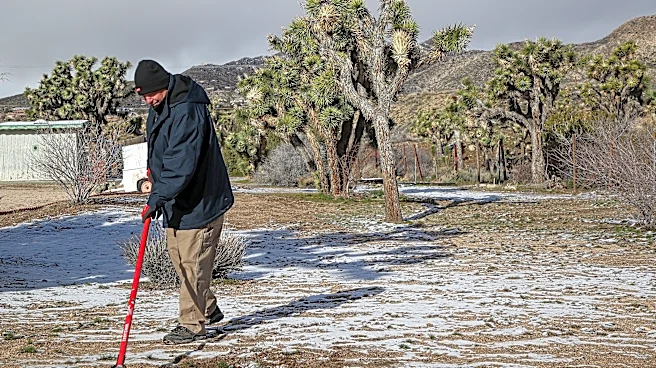

California is making it easier for property owners to remove dead or hazardous western Joshua trees and expanding how Native American tribes can legally obtain and use the protected trees for cultural
purposes.
Assembly Bill 1663, authored by Assemblymember Greg Wallis, R-Bermuda Dunes, and signed by Gov. Gavin Newsom on Tuesday, Sept. 29, revises the Western Joshua Tree Conservation Act, adopted in 2023 to permanently protect the species. Its suitable habitat is expected to decline substantially by 2100 due to climate change, especially in the southern portions of its range — meaning the western Joshua tree would largely be unable to survive in its namesake park by the end of this century.
Three years later, lawmakers are refining the law based on challenges that emerged as homeowners, tribes and local governments, particularly in the high desert, began navigating the new permitting system.
"Joshua Trees are part of what makes our desert home," Wallis said in a press release Tuesday. "A homeowner with a dead tree leaning on the house can now get a permit without extra hoops, and tribes have more room to use these trees in their cultural traditions."
Property owners can already remove certain dead or hazardous western Joshua trees without paying mitigation fees, but the law has required them to manage the approval process themselves — a hurdle for those who don't live at the property full time or have someone else managing it.

The new law, which takes effect Jan. 1, 2027, will streamline that process by allowing someone acting on the owner's behalf to submit the permit request and eliminating the requirement that the owner or a desert native plant specialist separately certify that the tree is dead.
The law will also expand the California Department of Fish and Wildlife's authority to permit tribes to buy, sell, take and possess western Joshua trees for cultural purposes.
When can a dead western Joshua tree be removed?
The iconic western Joshua tree has been permanently protected under California law since 2023, when lawmakers adopted the Western Joshua Tree Conservation Act after years of debate over how climate change, wildfires, urban growth and renewable development could affect the species.
That law generally bars people from removing or damaging western Joshua trees without state approval, but it makes exceptions for certain dead or hazardous trees. They are not, however, currently protected under the federal Endangered Species Act.
A dead tree can be removed without mitigation fees if it has fallen within 30 feet of a structure, is leaning against one or poses an imminent threat to public health and safety. The state considers a western Joshua tree dead if it has no green leaves, no new growth along its main stem and no sprouts at its base. A fallen tree can also qualify if it has separated from its roots or its roots are no longer touching the soil.
Property owners — or, under the new law, someone acting on their behalf — will still need to provide the property address or parcel number and photographs showing why the tree qualifies. Once a permit is issued, an owner or their agent can remove a detached tree or limb. All other removals and all trimming of western Joshua trees must still be done by a desert native plant specialist.
The state typically has 30 days to act on requests when a Joshua trees has fallen near or is leaning against a structure, and 10 days when a tree poses an imminent threat to public health or safety.

Why did California change Joshua tree rules for tribes?
Nurseries have been one source of western Joshua trees for tribes seeking them for cultural purposes, but under the 2023 conservation law, tribes could take and possess the protected trees with state approval — not buy them.
The Department of Fish and Wildlife, which administers the state's western Joshua tree protections and tribal agreements, brought the issue to Wallis' office and, under the new law, can approve those purchases and sales.
Native American communities had found many uses for Joshua trees long before European settlement. The Cahuilla people, for example, used the leaves for baskets and sandals and ate the flower buds and seeds raw or roasted, according to the National Park Service.
What will it cost to remove a Joshua tree?
Another bill signed Tuesday, which took effect immediately, lowers the cost for some single-family homeowners to remove or trim up to 10 western Joshua trees, while also reducing fees for certain public works projects.
Fees now range from $37.50 to $250 per tree — down from $150 to $1,000, depending on the tree's size — to make those costs more manageable for homeowners and to help local governments move forward with infrastructure projects.
Assemblymember Juan Carrillo, D-Palmdale, who authored Assembly Bill 1808, said in a social media post that the lower fees would allow "local communities to update critical infrastructure and homeowners to do the work on their home they've always dreamed of."
Some cities can already issue western Joshua tree permits instead of sending applicants through a separate state approval. The new law adds commercial and industrial projects with up to 40 trees, allowing applicants to seek the city's project approval and Joshua tree permit through a single local process.
Wallis, who coauthored the bill, said the changes will "make it a lot easier for families, businesses and local governments to work with the state," without weakening the Western Joshua Tree Conservation Act. "Our desert can keep moving forward, and the Joshua Tree will still be standing for generations to come."

Previous reporting by formers Desert Sun staffers Erin Rode and Janet Wilson was used in this story.
Jennifer Cortez covers education and breaking news in the Coachella Valley. Reach her at jennifer.cortez@desertsun.com.
This article originally appeared on Palm Springs Desert Sun: California making it easier to remove dead Joshua trees