





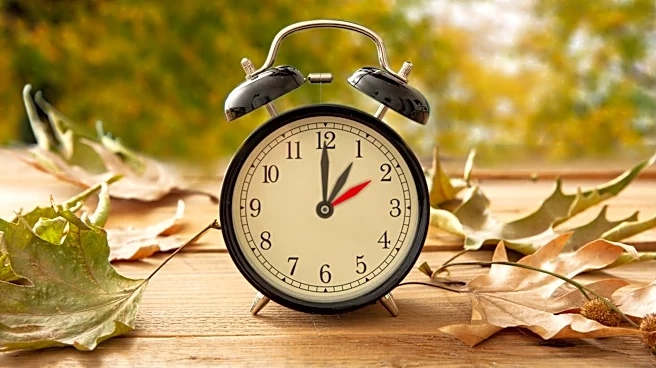
Despite California's recent heat waves making it feel more like summer, it's almost time to "fall back."
The annual fall time change comes as Congress considers the Sunshine Protection Act of 2025
, which is legislation backed by President Donald Trump that would make daylight saving time permanent. Unless Congress acts before Nov. 1, however, Californians will turn their clocks back one hour when daylight saving time ends.Each time change comes a transition period, as the body typically needs about a week to adapt to new sleeping, eating, and activity schedules, according to the Centers for Disease Control and Prevention.
"Until they have adjusted, people can have trouble falling asleep, staying asleep, and waking up at the right time," the CDC
says. "This can lead to sleep deprivation and reduction in performance, increasing the risk for mistakes including vehicle crashes."
The agency says the issues stem from disrupted circadian rhythms and sleep.
"Circadian rhythms are daily cycles of numerous hormones and other body functions that prepare us for the expected times for sleeping, eating, and activity," the CDC says. "Circadian rhythms have difficulty adjusting to an abrupt one-hour time change."
Ahead of the time change, here are some tips for navigating the transition, as well as when Californians are scheduled to change their clocks in 2026.
Health tips to ease time change adjustment
Dr. Stephanie M. Stahl, an associate professor of clinical medicine at the Indiana School of Medicine, said in a university blog post that people should try to make gradual changes to their sleep and wake times at least a few days before the time change.
"If possible, by going to bed and waking up about 10-15 minutes later each day," Stahl wrote. "If you can’t do this, try to go to bed and wake up 30 minutes later the Saturday night of the time change and then make another 30-minute change the Sunday night of the time change."
Children also need to gradually change their sleep patterns leading up to the time change, according to BlueCross BlueShield. Parents should let their children stay up late in the evening, then sleep later in the morning.
"They should feel less drowsy once the clocks are set back an hour and be better prepared for school on Monday morning," BlueCross BlueShield said.
Stahl also recommends getting outdoors in the evening a few days before and after the time change.
"The light exposure in the evening can help delay the internal body clock," Stahl said.
If you wake earlier than your desired wake time, avoid looking at screens until your intended wake time, according to Stahl.
Other tips from BlueCross BlueShield to help your body adjust to the time change include:
- Taking a nap: Though you should typically avoid napping during the day, a nap after a time change can help, especially "if you are experiencing significant drowsiness because your sleep patterns have been disrupted," the company said. Limit naps to 20 minutes, and avoid napping too late in the afternoon or evening.
- Don't consume caffeine too late in the day: Because caffeine can remain in your system for more than 10 hours, consuming foods or drinks with caffeine too late in the day can make it harder to sleep. Avoid caffeine after 2 p.m.
- Try a sleep mask: "If you don’t usually wear a sleep mask, you might want to try one for a few days after a time change," the company said, adding that blocking out light can help you avoid getting up too early.
- Exercise: Exercise can help boost your mood, so, the company said, "getting plenty of exercise on the days after the fall time change will help counter any negative feelings you have about it getting dark earlier."
When does daylight saving time end in 2026? Here's when clocks fall back
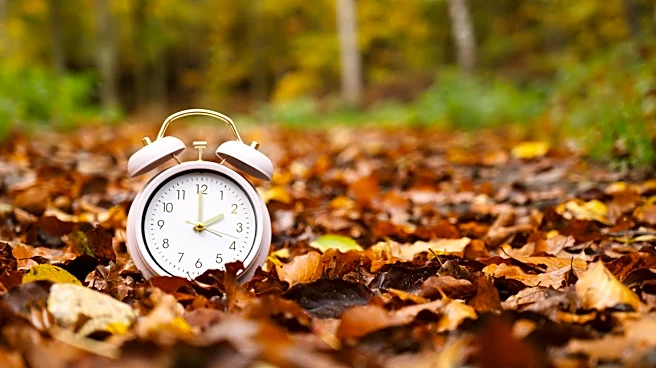
Californians are slated to turn their clocks back one hour when daylight saving time ends Sunday, Nov. 1. The shift will give Californians an extra hour of sleep but also brings earlier sunsets during the winter.
What is daylight saving time?
Congress created daylight saving time when it established standard time zones under the Calendar Act, also known as the Standard Time Act, in 1918. The idea behind the time change is to make "use of sunlight during more of the hours when people are typically active."
Since its creation, the regulations governing daylight saving time have changed multiple times. The current schedule was introduced in 2007 under the Energy Policy Act of 2005, according to Time and Date.
Currently, daylight saving time starts on the second Sunday in March and ends on the first Sunday in November, Time and Date says.
Is it daylight saving or daylight savings?
Though you may often hear people refer to the time change as "daylight savings time," the correct phrase is "daylight saving time" without the "s."
"It's likely that the incorrect term 'savings' entered the popular vocabulary because it's so often used in everyday contexts, like 'savings account,'" according to Time and Date.
Do all states observe daylight saving time?
Not all states observe daylight saving time.
Several states and U.S. territories remain on standard time year-round, including:
- Hawaii
- Most of Arizona (except the Navajo Nation)
- American Samoa
- Guam
- Northern Mariana Islands
- Puerto Rico
- U.S. Virgin Islands
Most of the rest of the nation switches between daylight saving time and standard time each year.
What is the status of the Sunshine Protection Act?
Despite support from Trump, dozens of states and a bipartisan majority in the House, the Sunshine Protection Act remains stalled in the Senate, USA TODAY reports. Currently, Congress is away on an extended campaign recess for the 2026 midterm elections, leaving little time for the Senate to act before clocks fall back on Nov. 1.
Americans are ready to stop changing the clocks
Several public opinion polls suggest Americans are ready to do away with the twice-yearly time change, including a 2023 YouGov survey that found 62% favored eliminating clock changes. A separate January 2025 Gallup poll offered similar findings, with 54% saying they wanted to end the practice; however, Americans were divided over whether the nation should adopt permanent daylight saving time or permanent standard time.
This article originally appeared on Palm Springs Desert Sun: Health tips to help Californians prepare for the fall time change