
Mountain residents and others who drive the twisting Highway 74 have long warned it's dangerous. Now they have more proof.
A new study found the collision rate on a stretch of the highway starting in Palm
Desert is more than twice as high as on similar rural two-lane highways in Riverside County. Some of those crashes have been deadly.
But over a year after mountain residents began pushing for better road conditions and stricter traffic enforcement on the road, which climbs thousands of feet from the Coachella Valley’s floor, its safety issues still need fixing.
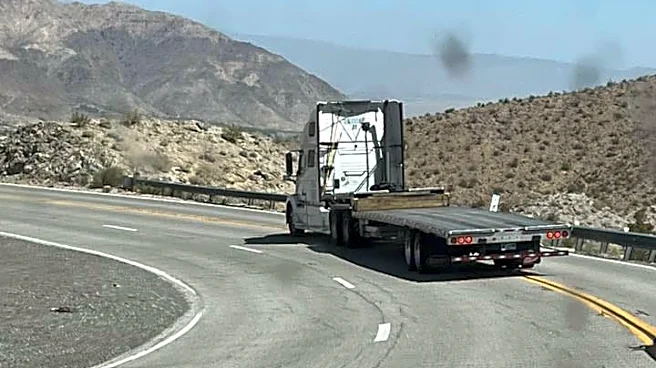
Along with finding the road's crash rate 125% higher than comparable highways, the study recommends a prohibition on trucks with more than three axles along the highway’s curviest stretch, running roughly 20 miles from Palm Desert to State Route 371, “as vehicles of that axle configuration cannot consistently stay within the traveled way at this segment.”
The study, conducted by the Riverside County Transportation Department, also includes a recommendation to prohibit vehicles with a kingpin-to-rear-axel (or KPRA) that exceeds 38 feet, citing similar safety issues.
“Unfamiliar drivers of large vehicles have been observed making dangerous maneuvers along hairpin curves, such as driving entirely on the opposing lane in anticipation of the curves,” the study states.

But it’s unclear if the study’s recommendations will be implemented. Local elected officials who’ve focused on the issue say that Caltrans, the state’s transportation department, is requiring more analysis that will delay any new rules.
Representatives from Caltrans did not answer several questions submitted by The Desert Sun in recent weeks, with one saying their team was unable to meet the newspaper’s deadline and another directing the newspaper to file requests for the records.
The county-led study also includes a timeline of the necessary steps for new restrictions to be implemented on the highway, indicating several steps remain before that might happen.
The highway, which rises from the desert floor through the Santa Rosa and San Jacinto mountains, has many switch-backs, with steep drop-offs and low visibility around corners. At least two people have died driving it in 2026, while another person was killed in a shooting through a construction zone on the highway.

In recent years, residents who live near the highway — which serves as the only road for commuters to the valley and other larger communities — have described deteriorating road conditions, as well as an increase in the number of semitrucks using the narrow highway.
The community’s push for change drew responses from local elected officials, the California Highway Patrol and Caltrans, who worked to improve the road’s potholes and ramp up law enforcement patrols at the highway’s base near Palm Desert.
But in recent months, some mountain residents who use the road say its conditions remain unsafe, despite what they view as progress. Even as a state bill sparked by their concerns heads to Gov. Gavin Newsom for his signature, they say more must be done.
Bill sparked by safety concerns heads to governor's desk
Residents’ calls for action, which gained momentum in 2025, eventually reached the California State Capitol in Sacramento, where two local members of the state Assembly filed legislation in response.
The bill, Assembly Bill 1145, is known as “Tristin’s Bill” in honor of Tristin Bourgeois, a 27-year-old who died on the highway in October 2024 when a big rig going down the road lost control, overturned and crashed into his car heading the opposite direction.

The legislation from Assemblymembers Jeff Gonzalez and Greg Wallis, whose districts include the Coachella Valley and Highway 74, initially proposed doubling fines on commercial truck drivers who violate vehicle weight rules while using the highway from Palm Desert to Anza. It was later amended to instead require a comprehensive safety study of the road, then changed again.
Its final version, which has passed the California Legislature and was awaiting the governor’s approval as of Sept. 15, requires Caltrans to examine the costs and alternatives to any local ordinance changing road rules and, if it rejects it, offer an explanation.
Tina Bourgeois, Tristin’s stepmom, who’s become a major advocate for improving Highway 74, said her family was encouraged by the legislation heading to the governor’s desk, yet disappointed that it was changed.
“You feel like, this is not what I wanted, but then you have to realize and look at the positive of what is being done,” Bourgeois said of the revised bill, adding it will create more accountability over Caltrans’ decision-making.
Bourgeois also noted the community’s efforts can continue in future legislative sessions, when the legislation could be altered or new bills related to Highway 74 could emerge.
Gonzalez, whose district includes part of the highway, said his team hoped the county-led study’s findings “could provide the supporting evidence needed to strengthen AB 1145.”
“Instead, we were told by Caltrans that additional studies and information were needed,” Gonzalez told The Desert Sun in a statement.
“As the goal posts continued to move, we amended AB 1145 to ensure there is greater accountability and transparency in the process and that local communities are not left waiting indefinitely while dangerous conditions persist,” Gonzalez added.
Gonzalez said it’s “disappointing that Caltrans has refused to listen to the people who live with these dangerous conditions every day.”
“I will continue working with Supervisor Perez and our constituents to make Highway 74 safer and prevent unnecessary deaths,” Gonzalez said.
Study finds ‘severe safety concerns’ on Highway 74

Local officials have also been taking steps to curb the highway’s safety issues, most notably with a comprehensive safety study led in part by Riverside County Supervisor V. Manuel Perez, who represents the valley and nearby mountain communities along the highway.
The study completed in March — the first step required as part of a lengthy process for any new rules to take effect — includes extensive data about the road’s collision rate, as well as field observations and counts on its current usage by truckers.
The study notes that California had at least 25 highway segments with specific truck restrictions as of March, many of which were enacted on “mountainous roads with steep grades or limited shoulder areas.”
While the stretch of highway near Palm Desert has signs noting that KPRA lengths over 30 feet are “not advised,” the study found the vehicles over that size still use the road. It notes that other roads, such as a 10-mile highway segment in Mono County, have the full 38-foot limitation, thus restricting common 40-foot KPRA trucks.

A multiday count included in the study found 79 trucks with four or more axels per day at Cahuilla Way near Palm Desert, either heading to or from the most winding stretch of Highway 74.
The study also included collision data on the road from 2019 through 2024, with the rates of deadly and injurious crashes revealing “severe safety concerns” along the highway.
“SR-74 has a disproportionate number of collisions onto a fixed object, which includes guardrails, signage, and rock escarpments,” the study found. “Between the SR-371 Junction and Palm Desert, 60% of the collisions were fixed object collisions.”

While the study features recommended actions, Perez told The Desert Sun in a statement that his team “recently learned that Caltrans is requesting additional areas of study.” (His team declined to specify what additional areas must be examined.)
“These new requirements have delayed progress at a time when our community is understandably seeking action and answers,” Perez said. “As the County Supervisor representing this area, I will continue engaging with Caltrans and our state partners while exploring potential legislative solutions to help move this important work forward.”
“I share the community’s frustration that we do not yet have a concrete resolution,” Perez added. “However, I remain fully committed to this effort and will continue working with all parties until we achieve meaningful progress.”

Mixed results with CHP enforcement
Bourgeois, Tristin’s stepmom, described the dynamics working with officials at the state and local levels as a “moving chess game.”
In late 2025, Perez’s office announced the California Highway Patrol was “stepping up enforcement,” with more patrols on the highway and additional training for officers to detect commercial trucking violations.
Bourgeois said that enforcement was noticeable for several months after the operation was announced, but added the police presence had become less noticeable lately.
“(Residents in our community) were happy,” Bourgeois said of the initial operations. “Now, we’re very discouraged again, and I have to try to keep people to keep on calling.”
Bourgeois has also been in touch with at least one logistics company about the danger of bringing their trucks through the mountains, but she’s had no success in convincing them to change their routes. (She declined to identify the company she’s spoke with, but said it’s one that people see “everywhere” on the roads.)
“It’s all about the money and getting the product there,” Bourgeois said. “It’s not about safety.”
Alison Kelemen, who lives in Pinyon Crest along the highway and started the initial petition calling for road upgrades, said she’s observed fewer semitrucks using the highway this year, but she described CHP’s presence as “totally inconsistent.”
The number of citations issued along the highway has gradually increased in recent years, with 1,305 citations issued so far this year, according to CHP spokespersons from the Indio and San Gorgonio offices that both enforce the law on parts of the highway.
Some have previously speculated that the highway is used by truckers as a way to avoid weigh stations on main freeways, such as one on Interstate 10 in Banning, but the county’s study used 48 hours of video traffic data and found no prevalent cut-through travel between Banning to other locations.
A long timeline toward rule changes
The completed study offers only one alternative to its recommendations for the highway: Widening the highway at its hairpin turns by several feet to accommodate the large trucks.
“However, this alternative is considered largely infeasible due to the magnitude and scale of engineering design, construction costs, and environmental impacts,” the study states.
It’s unclear exactly what will happen next in the process, but a timeline included in the study shows that Riverside County would prepare a draft of the proposed truck restriction and notify some Caltrans officials.
The next steps would be for the county to hold public hearings on the proposal, followed by a review and recommendation by Caltrans District 8.
After that, Riverside County would prepare a “final truck inspection report” that goes to Caltrans headquarters for approval. Then the county's elected board of supervisors would vote on its final ordinance once it receives written approval from the Caltrans director.
Meanwhile, Caltrans has discussed plans for a larger project — revamping about 45 miles of Highway 74 and replacing guardrails and sign panels — and previously told The Desert Sun it would begin in 2028.
Caltrans has also conducted crack-sealing and fixed potholes along Highway 74, and Bouregois said she gives the agency “kudos” for its efforts to respond to reported damage.
“They’ll get somebody out there and they’ll patch it, but the patching doesn’t last very long,” she said.
Kelemen said she’s seen “very few” potholes on the highway lately, but added that recent rainfall has brought some mud and sand onto parts of the road.
Kelemen said she’s seen fewer trucks on the road recently, but she’s still had some heart-pounding moments, describing a recent time when she saw a lengthy truck try to make a U-turn by pulling into her neighborhood.
“If I had seen that on the road, I would’ve had a heart attack,” Kelemen said. “The danger of these vehicles on these roads, nobody can possibly describe how bad it is.”
Tom Coulter covers local government and politics for The Desert Sun. Reach him at thomas.coulter@desertsun.com.
This article originally appeared on Palm Springs Desert Sun: Highway 74 is twice as dangerous as other roads. What's being done?