

California voters remain divided over the state's billionaire tax measure just weeks before Election Day, with a new poll suggesting that "the climb looks quite steep" for the initiative.
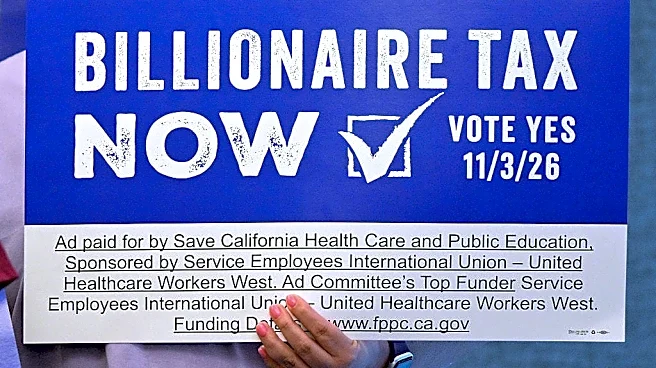
Proposition 40, a proposed one-time 5% tax on the wealth of California billionaires, receives 45% support and 42% opposition among likely voters, while 13% remain undecided, according to a UC Berkeley Institute of Governmental Studies poll released Friday, Sept. 25.
“The findings suggest tough news for Proposition 40 proponents. With less than 50 percent support this close to the election, ballot measures for new taxes tend not to pass, as undecided voters likely break toward ‘no,'" IGS Co-Director G. Cristina Mora said in a statement. "Unless we see meaningful
pushes in marketing and canvassing aimed at reaching younger voters, and others who often stay home during midterm elections, the climb looks quite steep."
Meanwhile, Proposition 39, which would require voters to present additional identification to cast a ballot, is opposed by a 13-point margin, 52% to 39%. Nine percent of likely voters remain undecided.
The poll also measured support for five other propositions on November's ballot, bringing the total to 14 statewide measures. Here's a closer look at the survey, conducted between Sept. 15 and Sept. 20 among 6,989 registered voters, including 4,512 likely general election voters. The margin of error is ±2 percentage points.
Support for billionaire tax initiative slips slightly, poll finds
Compared to an IGS poll released in August, support for Proposition 40 has slipped slightly. The latest poll found the measure leading by 3 percentage points, while the August survey showed a 7-point advantage, 48% to 41%.
Similar to other recent polls, support for and opposition to Proposition 40 break sharply along partisan lines. Democrats support the initiative by more than a 3-to-1 margin, while Republicans oppose it by nearly 8-to-1. Independent voters narrowly support the measure, 45% to 41%.
"Support for the proposition has declined five points among its primary backers, both Democrats and non-partisans, since August," pollsters wrote.
Support for the measure also varies significantly by age. Twice as many voters younger than 30 support it (68%) as voters 65 and older (34%).
Two counter measures to the proposed wealth tax, Propositions 41 and 42, have also qualified for the November ballot. The initiatives are intended to limit the effects of Proposition 40 if voters approve it.
"The two counter initiatives to Proposition 40 placed on the ballot by its opponents hold early leads in the latest poll, but neither receives majority support with many voters undecided," pollsters wrote.
Voter ID initiative's support also slips, poll finds
According to the latest IGS poll, Proposition 39 faces a 13-point deficit, slightly larger than the 9-point deficit recorded in the August poll.
"Canvassing against Proposition 39 has seemed to successfully link the initiative to the Trump agenda and this has made the proposition less likely to pass," Mora said in a statement.
A separate poll from SurveyUSA released Sept. 21, however, had contrasting results, with 48% of likely voters in favor of the measure and 38% against.
The Berkeley IGS poll found that, like the billionaire tax measure, support for and opposition to Proposition 39 break largely along partisan lines. More than 9 in 10 Republicans support the measure, while about 8 in 10 Democrats oppose it. Independent voters also oppose the measure, 51% to 37%.
"Opposition is also broad-based across major demographic subgroups of the electorate, with majorities or near majorities of voters opposed across all major age, gender and race/ethnicity subgroups," pollsters wrote.
Support for the measure varies by education level, with those with fewer years of formal education more supportive of the initiative and majorities of college graduates and two in three voters with a postgraduate degree opposed.
Poll's findings on other November ballot measures
Voters support Proposition 3, which would make tax rates approved by voters in 2012 for residents earning more than $371,000 annually permanent rather than allowing them to expire in 2031, by a wide margin, 54% to 34%. Thirteen percent remain undecided.
"By contrast, voters oppose Proposition 43 to increase the voting threshold required for voters to approve local special taxes, 40% to 31%, while many voters (29%) remain undecided," pollsters wrote.
Many voters remain undecided (30%) about Proposition 4, which would repeal the ban on state and local governments using public money to help fund election campaigns. Voters with a preference are evenly split on the measure, with 35% in favor and 35% in opposition.
Pollsters again found that support for and opposition to the measures break sharply along partisan lines.
"Democrats are currently backing both Proposition 3 and 4 but opposing Proposition 43, while the reverse is true among Republican voters," pollsters wrote.
Here's a breakdown of Berkeley IGS poll's findings for seven of the 14 measures slated to appear on California's general election ballot:
When is California’s general election?
California's general election will be held on Tuesday, Nov. 3.
According to state officials, the last day to register to vote for California’s general election is Oct. 19. Counties will begin mailing ballots to registered voters no later than Oct. 5.
This article originally appeared on Palm Springs Desert Sun: Voters divided on billionaire tax initiative weeks before Election Day