





With California's general election just weeks away, voters may be wondering what safeguards are in place to protect their ballots and ensure every vote is counted accurately.
Kim Alexander, president of the California Voter Foundation, said that because the Golden State offers more voting options than most states, it can raise questions about election security.
“People wonder how we are able to do that while keeping ballots secure, and so that's why I always want to make sure people know there's more going on in the election offices than you know to make sure that nobody's voting more than once and that only valid ballots are counted,” Alexander said.
Here's what to know about the safeguards California has in place to secure ballots and protect
the election process.
Election process safeguards
“What people don't know about vote by mail that I think is helpful for voters to know is that there's a lot that happens on the back end of the administrative process in elections that voters aren't aware of,” Alexander said, “and they're actually invited to tour election offices to see firsthand the procedures that are deployed in ballot processing.”
One election safeguard in California is that at least two people must handle ballots at all times, Alexander said.
"If you go and observe elections, you will always see people working in teams," Alexander said. “You don't see anybody working alone."
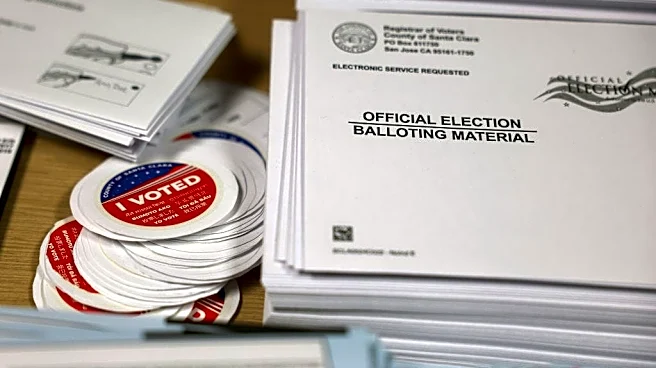
Another safeguard is that every mail-in ballot return envelope in California includes a unique barcode.
“It's actually an identification envelope. It's not a normal envelope," Alexander said. "It's uniquely coded to that voter that it was issued to."
County election officials use the barcodes to track whether and when a voter has cast a ballot.
“Vote centers are equipped with real-time access to the county's voter registration database, so they know whether the ballot that was issued to you has been cast or not, and that's how we keep people from voting more than once,” she said.
Another election protection is that California law requires that signatures on every mail-in ballot envelope be verified before it can be opened and counted, Alexander said.
If election officials find that a signature is missing or does not match, you will be notified and given a deadline to fix the signature, according to the California Secretary of State.
What to know about post-election audits
In California, state law requires every county to randomly select 1% of its precincts and publicly hand count the ballots cast in those precincts.
During the post-election audits, election officials compare the hand-tallied counts to the machine-tallied counts to “verify that the machine tabulated the votes accurately,” Alexander said.
“And California has been undertaking this procedure now for 60 years,” she said. “We've been doing this and continued to refine it and enhance it.”
Counties must then include the audit results in the report they send to the county’s board of supervisors for certification, Alexander said, adding that it’s all part of the public record.
“People can go and read those audit reports. ... It's not exciting, but the long and short of it is that the technology works; the tabulation is accurate,” she said.
If there is an error, Alexander said, it’s often because the hand count is off rather than the machine being incorrect.
“It’s a fundamental part of our security protocols to conduct post-election audits, and they could be right every time in the future, and we still will do them and should do them,” Alexander said.
Why the vote count takes so long in California
Among the criticism that surfaced during California’s June primary was how long it took the Golden State to count ballots and certify the results. The lengthy process has become “the biggest challenge we face when it comes to strengthening voter confidence,” Alexander said.
“We have in California increasingly taken longer to count our votes and delayed the ability of AP and other news organizations to call our close races because of our long vote counts, and there are a couple things going on there,” she said.
The first, she said, is that the state has more voters than any other state. In addition, many of those voters are now opting to vote using mail ballots.
Nearly 9 in 10 ballots cast in California's June 2026 primary were vote-by-mail ballots, according to the California Secretary of State's Statement of Vote.
“They take longer to process,” Alexander said. “There's no way around it.”
Another issue is that many voters are choosing to turn in their mail-in ballots on Election Day, which means they cannot be processed until after Election Day, according to Alexander.
“You end up with what we call a pig in the python problem, where you have this giant wad of ballots that has to move through the ballot tabulation process, the verification and tabulation process, all at the same time,” she said.
Some counties for the June election said they received 50% of all their ballots in envelopes at drop boxes, through the mail, and at vote centers on Election Day, according to Alexander.
“So, they pre-process everything they can, but I think the problem is that voters, you know, they want something to do on Election Day, and we've sent them a vote-by-mail ballot, and so they're like, ‘OK. I'm going to go turn in my ballot today.’ And so that really slows down the vote count,” Alexander said.
In hopes of speeding up the vote count, Alexander said some counties offer what’s called “Sign Scan and Go,” which lets voters cast mail-in ballots as in-person ballots for immediate counting at voting sites or county elections offices.
Voters can bring their completed mail-in ballot, sign a roster under penalty of perjury, as all in-person voters do, and then the ballot can be counted without signature verification, Alexander said.
“And in some counties, the voter can take it out of the envelope and insert it directly into a scan and have it counted right on the spot, and we are urging voters to choose that option where it's available,” she said.
California Voter Foundation's survey found that 31 counties across the state offered this option to voters for the June primary.
Be mindful of misinformation
Election misinformation is likely to circulate online in the run-up to Election Day, Alexander said, urging voters to be cautious of claims.
“If you see something that's shocking, you may just be being manipulated into being shocked. It may not actually be true,” she said.
Still, Alexander said California's election system includes multiple safeguards designed to protect ballots and ensure accurate results.
“But the reality is that California election officials are well prepared to provide a secure and trustworthy election for our voters," she said.
When is California’s general election?
California's general election will be held on Tuesday, Nov. 3.
According to state officials, the last day to register to vote for California’s general election is Oct. 19. Counties will begin mailing ballots to registered voters no later than Oct. 5.
This article originally appeared on Palm Springs Desert Sun: What Californians should know about ballot security ahead of November