





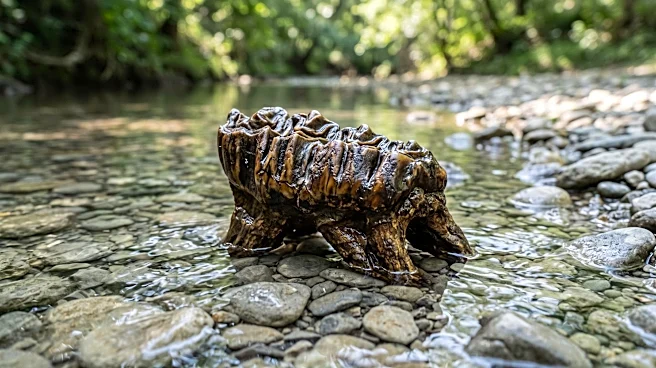
A routine excavation for an Oceanside infrastructure project led to a "remarkable" discovery: fossils from a large mammal that roamed what is now California roughly 40 million years ago.
Joseph El Adli, the principal paleontologist, spotted the "significant fossil finds" at the project site earlier this month, Oceanside said in a Sept. 22 news release.
“It is always exciting
,” El Adli told the San Diego Union-Tribune.
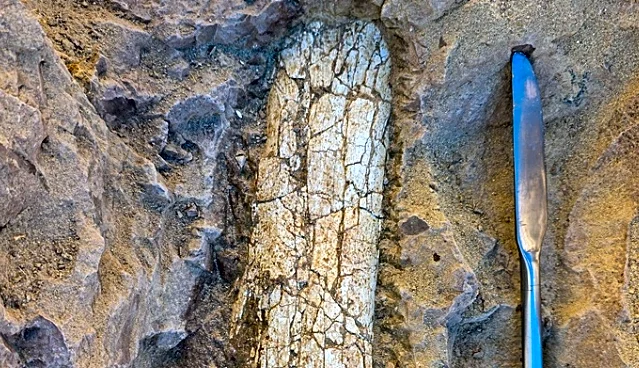
The fossils, which the city said included several limb bones, ribs, and numerous other bones and fragments, were found about 12 feet below the surface at the project site. The city said it is withholding the exact location to protect the site's integrity. The remains are believed to have belonged to "a large, hoofed mammal that walked
the ancient floodplains of Oceanside" 40 million to 45 million years ago.
"We dug in to build Oceanside's future and came up with a piece of its very distant past," the city wrote in a Facebook post.
Fossil discovery in Oceanside
California environmental review laws can require agencies to evaluate and protect fossil resources if construction projects could affect them. As with the Oceanside infrastructure project, paleontologists are involved in excavations in areas considered sensitive for fossils.
When the Oceanside project’s regular state-mandated archaeological monitor took a sick day, the San Diego Union-Tribune reported that El Adli was called to the site.
“I found this thing within five minutes of showing up,” El Adli told the newspaper, describing something unique he spotted toward the bottom of the excavation site.
After making the discovery, El Adli and his team spent seven days exposing the remains, which were buried beneath "several tons of hardened mudstone and sandstone" in the Santiago Formation, according to the city. The formation, "a thick sequence of sedimentary rocks exposed across parts of northwestern San Diego County," dates to the Eocene Epoch.

Fossils from that time have previously been found in Santiago Formation within the city, as well as other places across the region, the city said.
Paleontologists estimate that the recently unearthed fossils are between 40 and 45 million years old, based on the age of the surrounding rock and nearby fossils, according to city officials. This would mean the fossils trace back to the Uintan North American Land Mammal Age.
Creature from one of two extinct mammal families
El Adli believes that based on the bones' size and shape "they likely belonged to an animal from one of two extinct mammal families that once roamed North America, both of which belong within the order Perissodactyla, the odd-toed hoofed mammals," the city said.
The fossils may belong to a member of the Brontotheriidae, sometimes called titanotheres or "thunder beasts."
"These were massive, hoofed mammals with a deep chest, pronounced hump at the shoulder, and, in many species, a distinctive Y-shaped bony horn on the nose," the city said.
The species was about the size of a modern black rhino and had "small horns on its saddle-shaped skull," city officials said. The creatures were land-dwellers that fed on leaves and vegetation in forested habitats.
Alternatively, El Adli believes the fossils may be "the remains of an amynodon, historically referred to as a 'swamp rhino,'" officials said. The mammal is part of an "extinct family of large-bodied herbivores distantly related to rhinos."
"Amynodon had hornless faces and squat, hippopotamus-like bodies," officials said.
The mammals had wide, barrel-shaped bodies, short sturdy legs, flat heads and tusk-like teeth instead of horns. While some spent much of their time in rivers, ponds and lakes eating plants, others lived primarily on land.

What happens with fossils next?
El Adli and his team encased the fossils in a plaster field jacket, the city said.
The specimens were then transported to a climate-controlled lab, where they will be removed from their protective plaster casing, and experts will carefully clean away the rock surrounding the bones.

"Several blocks are still sealed, and a skull, the find that could settle the question, may be waiting inside one of them," according to the city.
Experts will also strengthen the bones with special glues and resins to help preserve them.
After the lab work is complete, they are expected to be sent to a museum collection for public display, city officials said.
This article originally appeared on Palm Springs Desert Sun: 'Remarkable' 40-million-year-old fossils found at California project site