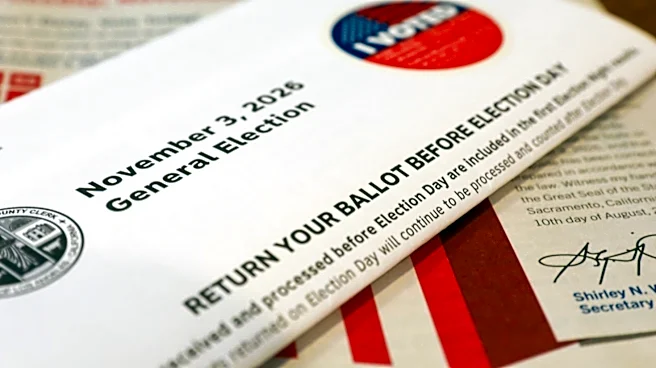


With vote-by-mail ballots already landing in mailboxes across California, state election officials are sending voters a simple message: Don't wait until Election Day to cast your ballot.
"Vote early because that's important, and that gives us an opportunity to make sure that we can get every eligible Californian voting and have their voice heard in this election," California Secretary of State Shirley N. Weber said during an Oct. 13 elections roundtable.
Returning ballots early, she said, gives election workers more time to process and count votes before the polls close.
“We hope you take advantage of (early voting) because so often people want to know why does it take long for California to count?” Weber said. “The reality is, if you vote early,
we have an opportunity to begin that counting process.”
Weber also stressed that election officials are equipped to accurately count the millions of ballots cast statewide.
“California is the largest voting base in the nation. We know that, and we have more ballots than some collection of states has altogether,” Weber said. “So, we work very hard to make sure that every ballot counts.”
With three weeks until Election Day, here's what California officials want voters to know.
How to check if you’re registered to vote, how to register
To check whether you are registered to vote in the Nov. 3 election, you can do so online through the California Secretary of State’s website.
“You can check your voter registration status at voterstatus.sos.ca.gov and look yourself up and see if you are registered to vote,” Jana Lean, chief of elections with the California Secretary of State, said.
If you're not registered, or need to re-register or update your registration, you can also do that online at registertovote.ca.gov, Lean said.
When is the deadline to register to vote?
The deadline to register to vote in the November general election is Oct. 19.
“While we do have a registration deadline, you are eligible to do same-day registration all the way up to and through Election Day,” according to Lean.
You will have to go to your county elections office, vote center, or polling place on or before Election Day to complete conditional voter registration, or what's often called same-day voter registration, according to state officials.
You can find alist of county elections offices on the California Secretary of State's website.
Ways to cast a ballot in California
“There are many options to return your ballot in California, so you don't just have to go on Election Day,” Lean said. “Your ballot should be in your hands. Don't wait. Vote early.”
After filling out your ballot, you can return it to a secured ballot drop box, or bring it to an authorized ballot drop-off location or county elections office, according to Lean.
To find the nearest drop box or drop-off location, you can visit the California Secretary of State's website here: caearlyvoting.sos.ca.gov.
“You can vote in person, of course, on Election Day at a polling location or at a vote center, or you can put it through the post office and go through USPS,” Lean said.
No postage is required to return a ballot through the mail.
“But we do want folks to make sure that if you are going to put it through the mail, that you get it in the mail about a week (or seven days) out to make sure that it is received by the county elections official,” Lean said.
If you haven't turned in your mail-in ballot by Election Day, Lean said she’d advise returning it at a drop box, the county elections office, or a polling place.
If you return your ballot on Election Day via USPS, go inside the post office and get a manual hand stamp from a postal worker.
“We are a postmark state, which means that as long as the vote-by-mail ballot envelope is postmarked on or before Election Day, and it's received within a week following Election Day, it's considered timely,” Tricia Webber, president of the California Association of Clerks and Election Officials, said.
The most common reason for ballot rejection
More than 148,000 California mail-in ballots were rejected during the June primary, according to state election data, with nearly two-thirds being disqualified for the same reason: They arrived too late to be counted.
“Postmarks don't necessarily happen when you deliver your mail to the post office or when it's picked up from the box,” Webber said.
Instead, she said, mail is often not postmarked until about a day after it's dropped off in a mailbox.
“It’s possible (a mail-in ballot) was not postmarked on Election Day or by Election Day, even though people put it in the mail (with) what they thought was enough time,” Webber said, adding that “the postmark is very important.”
What if a signature does not match?
With each mail-in ballot, election officials verify that the signature on a voter's voter registration card matches the signature on the ballot envelope.
If the signature doesn't match or is missing from the envelope, voters receive a notice in the mail saying they need to cure their signature, along with instructions on how to do so, according to Webber. Election officials will send another follow-up if they have another contact method for the voter, such as an email address or phone number.
"The voter will cure their signature through the form, which requires them to sign an oath that they were who voted, and provide their signature,” Webber said.
The form can be returned by fax, email, mail or returned to a county elections office, according to Webber.
“Voters have up until the 22nd day following the election to cure their signature, and then once it's cured, then we can count that ballot and put it into the tabulation,” Webber said.
How to track my ballot
You can track your ballot's status using the state’s “Where's My Ballot” tracking tool.
“It's free. It's available in multiple languages,” Lean said. “You just need to go to wheresmyballot.sos.ca.gov to sign up. It's very easy.”
The service, powered by BallotTrax, lets voters see when their vote‑by‑mail ballot is mailed, received and counted. It also allows you to sign up for automatic email, SMS (text), or voice call notifications about your ballot’s status.
“If there's an issue with your ballot, you'll know right away, and you'll have time to fix it. So we really encourage folks to sign up for 'Where's My Ballot,’” Lean said.
Election officials emphasize ballot security and voter confidence
For voters feeling anxious about the election process, Weber urged them to know that election officials have “probably taken every precaution possible to make sure that their ballots will be received, that they will be safe, and that the process will be safe for them to vote.”
“We do what we've done every year, which is to really take precautions,” Weber said. “Some people think we're doing this because of this election, but ... there has always been an effort to make sure that we have security at the polls.”
Additionally, Weber said poll workers know the rules and regulations, and law enforcement is “informed of what their responsibility is.”
“Our folks are well trained at the polls,” Weber said.
Those who may feel apprehensive about voting in person can instead drop off their ballot at a drop box, Weber said.
“We have these monstrous drop boxes at libraries, universities, and various other places where you can just walk in and put your ballot in, and that is secured because that's our box,” Weber said. “We're the ones who will be picking those up and taking them in in a timely manner, so take advantage of that.”
Be mindful of misinformation
Jonathan Snow, with the California Governor’s Office of Emergency Services, emphasized that the public should rely on voting information from their county election officials or the secretary of state.
“False and misleading information can undermine public confidence in elections, create confusion about voting procedures and election results, and potentially discourage voter participation,” Snow said. “Be cautious of sensational claims, misleading headlines, or manipulated images or videos and information designed to provoke fear and distrust.”
Snow said voters should also watch for “unverified claims about election security, voting procedures, or election results, particularly on social media.”
“We encourage Californians to pause, verify, and think before sharing election-related information,” Snow said.
This article originally appeared on Palm Springs Desert Sun: What California election officials want voters to know before Election Day