





With several resident-led lawsuits in the courts over flooding, a Brunswick County city recently changed its flood ordinance to better protect future residents.
Boiling Spring Lakes commissioners adopted several amendments to its flood damage prevention ordinance on Sept. 1. One of the most notable changes requires new homes be built higher, in hopes of decreasing potential flood risks.
Residents behind filed lawsuits believe the city should have done it years ago because it would have saved their prone-flood homes.
Here's what you need to need to know about the changes and its impacts.
Behind the flood damage prevention ordinance
The city participates in the National Flood Insurance Program (NFIP), a federal program administered by the Federal Emergency Management Agency (FEMA). The program makes
federally backed flood insurance available to property owners in participating communities.
As a condition of participation, the city is required to adopt and enforce a flood damage prevention ordinance that meets FEMA's minimum floodplain management standards.
The city's current flood damage prevention ordinance regulates development within FEMA-designated special flood hazard areas, which are areas shown as having a 1% annual chance of flooding. These special flood hazard areas serve as the basis for the city's floodplain management regulations and the federal mandatory flood insurance purchase requirement for structures securing federally backed mortgages.

Previous discussions by city officials and staff
In efforts to better address flood risk in areas that have already experienced flooding, city commissioners previously directed city staff to craft a unified development ordinance amendment requiring finished floor elevations for all new construction to be elevated, as stated in the staff report.
Staff presented a proposed amendment that incorporated the requirement as part of a broader lot drainage plan requirement and a public hearing was held. However, commissioners decided to remove the finished floor elevation requirement from the lot drainage plan requirement.
The board asked staff to conduct additional research and develop an approach that would target areas located outside FEMA's special flood hazard areas with known flooding concerns, rather than applying the requirement citywide.
Boiling Spring Lakes officials press changes forward
Using the state's updated 2026 Model Flood Damage Prevention Ordinance, city staff drafted amendments incorporating required and optional state-identified revisions. The amendments keep the city's ordinance consistent with FEMA’s minimum floodplain management standards and allow the city to use available flood hazard data to regulate development in areas with documented or anticipated flood risks.
City officials declared advisory flood studies data provided by the North Carolina Floodplain Mapping Program part of the ordinance. The data provides non-regulatory flood hazard information for previously unmapped areas and areas beyond the traditional regulatory floodplain mapping extents.
Areas identified through the data will be regulated similarly to properties located within special flood hazard areas. Development within these areas will also be regulated like development within special flood hazard areas, using the city's floodplain development standards.

As for new construction and substantial improvements in these areas, finished floor elevations must meet or exceed the applicable base flood elevation, where a base flood elevation has been established for the 1% annual chance flood event.
The city is also applying a new, two-foot freeboard requirement above the applicable elevation to provide additional protection.
Where advisory flood mapping identifies an area subject to the 1% annual chance flood event but does not provide a base flood elevation, the updated ordinance requires the finished floor elevation of structures be lifted a minimum of two feet above the highest adjacent grade.
The amendments alsoestablish regulatory requirements for shaded zone x areas identified on FEMA Flood Insurance Rate Maps. However, the changes do not change FEMA's Flood Insurance Rate Maps, special flood hazard area boundaries or alter the federal mandatory flood insurance purchase requirements.
Residents say the damage is already done
"It's not the cure to the problem, you're curing the symptom but not the problem," city resident Dawn Smith told commissioners.
Smith shared her experience of a backyard galvanized pipe collapsing during a storm sometime around 2015. A 36-inch, $8,000 replacement pipe was installed and continues to fill with water during normal rain events, Smith said. Smith worries the pipe, as well as the surrounding stormwater drainage system, is inadequate to support nearby construction along 50 Lakes Drive.
"As soon as we have a rain, I'm going to tell you, my place is going to get flooded," Smith said. "My place, my neighbor's place, everybody that's downstream is going to flood -- instead of chickens, we'll have ducks."
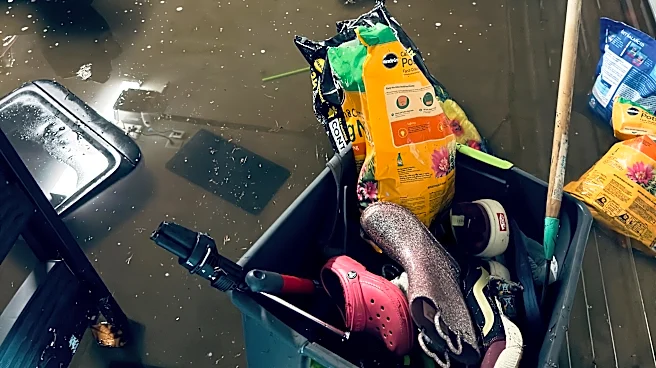
Tiffany Braden is one of six residents behind a recently filed lawsuit against Logan Homes, Dominion Land Corporation and the city of Boiling Spring Lakes. Braden is a resident of The Highlands community who experienced flood waters just under a foot high inside her home in 2024.
"We still watch the ditches when it rains, while homes continue to be built and sold in the same development," Braden said. "The Highlands is one example of why this ordinance matters."
The resident-led lawsuits claim developers of The Highlands expressed concerns about stormwater drainage and flooding before some of the land was purchased and developed. Residents also state the city knew about the issues as well.
"The city's town staff report acknowledges something many homeowners may not realize, FEMA maps don't identify every area that can flood... These changes may have come too late to prevent what happened to us, but that doesn't mean existing homeowners shouldn't be left behind," Braden said.
Braden believes preventative measures, like the new ordinance, would have significantly lowered the amount of damage done to her home in 2024. Now, the changes will only protect future structures and homeowners.
STAY CONNECTED: Keep up with the area’s latest Brunswick County news by signing up for the Brunswick Today newsletter and following us on Facebook and Instagram.
Savanna Tenenoff covers Brunswick County for the StarNews. Reach her at stenenoff@usatodayco.com.
This article originally appeared on Wilmington StarNews: Brunswick city residents question if new flood rules are enough