

The town of Carolina Beach has released results from a survey that indicate what some residents want for the future of Freeman Park.
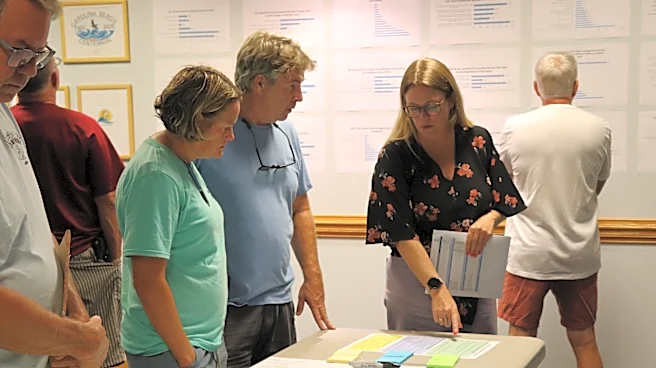
Carolina Beach hosted an open house on the next steps for the 300-acre preservation
on the town’s north end on Aug. 24. The event allowed residents to identify their top priorities for the land, with answers ranging from camping and 4x4 vehicle access to ecological preservation.Deputy Town Manager Ed Parvin gave an overview of the next steps in the development of a land management plan for the park. Following review of public input, a town committee will review and finalize a draft of the plan by November. Formal adoption by Town Council is expected in January or February.
In addition to highlighting future use of
the park, Parvin noted sea level rise and flooding along Canal Drive remain among the top concerns for the north end.
“It’s pretty scary stuff that’s continuing to happen, but our planning and adaption to our strategic approach is going to be crucial for making us successful,” Parvin said.
What residents want
Survey responses shared at the open house detail what some residents envision for the future of Freeman Park. Over 56% of respondents said that vehicle access is “essential and should not change.”
The survey prompted residents to select their two top issues at the park. Maintaining 4x4 vehicle access was a top priority for 62.2% of respondents, followed by erosion and nourishment among 51.7%. Beach nourishment was also identified as the top issue impacting the park’s long-term health.
Managing overcrowding was a top priority for 39.8%, while wildlife and nesting protection was selected by 28.5%. Creating additional access in dunes and marsh area had the lowest amount of support at 15.5%. Dune protection received the highest support on a question asking which ecological features were considered the most important.
To support additional resource needs, 47.8% of respondents supported user fees, while 39.8% favored limiting daily capacity at the park. Tax increases, limiting operation hours, and halting the expansion of vehicle access were among the least popular alternatives.
Limiting nighttime access was the most popular selection for a potential tradeoff to improve long-term conditions.
When choosing from a list of projects to implement in the next five years, 28% of respondents selected beach nourishment, followed by an option supporting no additional regulations and restoring the inlet to reopen the north end of the park.
Over 55% envisioned no commercial activity at the park, while 31.3% favored essential services such as ice, water, snacks and emergency towing. Only 5.6% supported expanded commercial activity with food trucks and supply rentals.

What makes the land sensitive
Parvin highlighted a range of factors that make the land at Freeman Park uniquely sensitive. Coastal dunes, which provide a natural buffer against storms, can be impacted by erosion and invasive plant species such as beach vitex that promote loss of sand.
Loggerhead and green sea turtles utilize the upper beaches of Freeman Park for nesting from May through August. The marsh area serves as a nursery for a variety of marine life, including bottlenose dolphins.
Other sensitive wildlife includes nesting shorebirds, which nest directly in shallow sand depressions along the upper beach and dunes. Colonial seabirds nest in highly vulnerable, dense colonies. Their eggs and colonies are camouflaged to resemble sand and shells, making them highly susceptible to accidental crushing by vehicles, pedestrians and off-leash dogs.
Daniel Sheehan covers New Hanover County for the StarNews. Reach him at dsheehan@usatodayco.com.
This article originally appeared on Wilmington StarNews: Carolina Beach shares what's next for Freeman Park's future