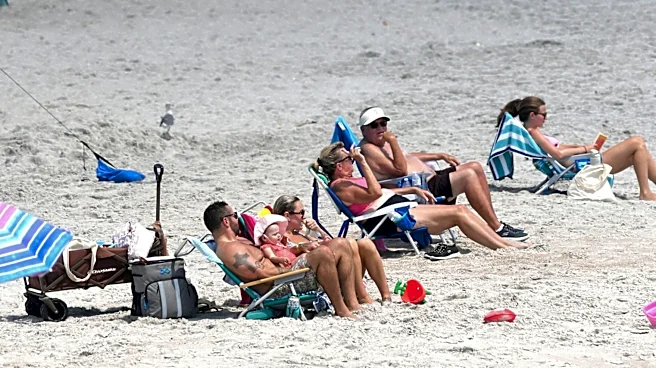

A traffic jam stretching a mile from the beachfront, a parking lot filled to the brim with cars jostling for a space, an hour-long wait at your favorite downtown restaurant -- these are scenes that shouldn’t
be difficult for Wilmington-area residents to imagine.
In the off-season, such events are rarities, but they’re the status-quo when the tourist season peaks in the summer.
For local residents, it may be an annoyance. But the crowds are exactly what tourism officials hope for.
Visitor spending topped $2.65 billion across the Cape Fear region in 2025. New Hanover and Brunswick counties each recorded over $1.2 billion, while Pender County’s smaller tourism industry reported just over $200 million -- all in all, a record year for the region.
It was also the fifth straight year of growth in visitor spending after tourism plummeted during the pandemic.
With the industry’s growth showing no signs of slowing, it raises questions over whether the Wilmington area can handle more and more visitors every year, and who ultimately benefits.
A record year
Visit North Carolina, a nonprofit focused on supporting tourism in the state, commissions annual studies that examine the tourism economy statewide and regionally.
The 2025 data, released in August, showed another record year for the state in terms of both visitor spending and tourism-related employment, and the Wilmington-area counties were some of the top performers.
Tourism was also directly tied to thousands of jobs across the Cape Fear region in 2025 – 6,035 in Brunswick and 7,250 in New Hanover. For both counties, that’s about 200 more jobs than the year prior.
As for visitor spending, Brunswick and New Hanover counties ranked 6th and 7th respectively out of all North Carolina counties. That spending represents billions supporting local restaurants, hotels, shops and more.
It also represents tax value.
Visit North Carolina’s study calculated that tourism generated around $90.5 million in tax revenue in Brunswick County, around $85.3 million in New Hanover County and about $16.1 million in Pender.
The study suggests that this created significant tax savings for residents of the three counties -- estimated at $509 per resident in Brunswick, $345 in New Hanover and $230 in Pender.
Not just growing, but changing
The whole picture provided by the data shows a tourism economy that is growing. But there’s more to the story than just steady growth.
Breaking down the numbers reveals that Wilmington’s tourism industry is evolving – and that’s by design.
According to Kim Hufham, president and CEO of Wilmington and Beaches, Wilmington saw double-digit percentage growth in room occupancy tax collections for both December and January -- historically two of the weakest months for tourism.
“The seasonality of the tourism industry has always been its weakest spot, especially in an area that obviously is driven by the beach,” said Mouchine Guettabi, a professor of economics at the University of North Carolina Wilmington. The drop in visitation during colder months can be a blow to the leisure and hospitality industry. In Wilmington, total employment falls by thousands in the winters.
So the tourism growth in December and January wasn’t incidental, but part of a collaborative campaign to increase tourism around the holiday season, Hufham said. The overarching goal? For Wilmington to become a year-round destination.

A more resilient industry
Hufham said that expanding tourism into the slower months will allow businesses to stay open and retain workers year-round. She added that the off season is also the area where Wilmington’s tourism industry has the most potential to grow.
“I think that gradually we're seeing more and more activity that seems to defy seasons,” Guettabi said.
In terms of employment, at least, the gap between summer and winter is shrinking, according to data from the U.S. Bureau of Labor Statistics.
In the three-year period between 2017 and 2019, the number of employed people in the Wilmington area fluctuated by an average of 11,636 between January and July. Between 2023 and 2025, the average seasonal swing dropped to around 10,178 between 2023 and 2025.
For Guettabi, this is an encouraging sign of an industry that is becoming more resilient.
“Any time you can get away from dependence on specific months or a small portion of the year, that makes revenues more stable, that encourages more people to enter business, that encourages people to stay in the industry.
Investing in Wilmington’s downtown is another way tourism officials are trying to diversify the industry. Hufham said she hopes to see Wilmington expand on the convention center market, but doing so would require more hotel rooms to accommodate a larger center.
As Guettabi put it, “Limits are going to be driven by investment. And investments are going to require a long-term horizon.”
What tourism can do
The Karen Beasley Sea Turtle Center in Surf City is one of the most popular attractions in the Cape Fear region, offering a unique experience to visitors. More than that, it's an organization focused on protecting sea turtles. But it would have a tough time accomplishing that without tourists.
According to Kathy Zagzebski, the center's executive director, around two-thirds of the center's revenue comes from tours, which helps fund the conservation efforts.
"It's the public tours, the actual tourists who are buying the tickets, (that) really help to fund a lot of what we do," she said.
It's also a way to spread the center's message of conservation, Zagzebski said. She added that many of their visitors are people who repeatedly come back after the first time.
The Sea Turtle Center is far from the only Wilmington attraction that relies on visitors. Dr. Jay Martin, executive director for the Battleship North Carolina Memorial, said the Battleship lives and dies on its visitors.
Martin highlighted how tourists who visit the Battleship don't just benefit that one organization.
"When people visit the Battleship, it's often one piece of a much bigger Wilmington experience," Martin said. "Someone who comes aboard in the morning will have lunch downtown, visit another attraction in the afternoon, stay overnight, stay the weekend."
Martin said that he wants to see local organizations work closer together to benefit even further from this effect. Together, they can keep tourism strong as Wilmington continues to grow.
"All communities change over time. But one of the things that has remained the same … is the ongoing attractions, the parts of the community that tell a story that's specific and iconic to the Wilmington metropolitan area," Martin said.
The impact on residents
Visit North Carolina reported that the tourism industry saved Cape Fear residents hundreds of dollars in state and local taxes.
But is it really so simple?
There’s no doubt that tourism generates a substantial economic impact, creating jobs and bringing new dollars into the community.
However, there are also costs associated with the industry, ranging from additional strain on infrastructure to longer waits at restaurants. For some residents, hearing about the economic impact won’t be nearly as impactful or salient as sitting in traffic behind a line of out-of-state license plates or dealing with beach nourishment projects during the off season.
But on the other hand, tourism can also help draw new businesses to the region, which residents can benefit from just as much as tourists can. Hufham said that without Wilmington’s visitor base, she couldn’t see the area being able to support all these restaurants and attractions.
“Yes, our beaches can be crowded in the summer. Yes, the traffic's a little worse. But the actual impact and the advantages of tourism far outweigh the disadvantages as far as the visitors coming into town,” Hufham said.
But when looking to the future of tourism in the Cape Fear region, one important question is whether residents will agree with her.
Guettabi said that how residents feel “is certainly part of the equation” when it comes to tourism. The local reaction as tourism continues to grow could in part drive where the industry heads next.

What’s ahead?
After five straight years of growth, and with an encouraging outlook on off-season visitation, the Cape Fear region’s tourism industry appears to be in a strong position.
The Wilmington area is growing rapidly, with an economy that is only getting more diverse. All in all, the region is growing beyond being dependent on tourism.
But in the meantime, tourism is changing too -- perhaps most importantly, by becoming more resilient.
Charlie Kingree is the Pender County and trending topics reporter for the StarNews. He can be reached at ckingree@usatodayco.com.
This article originally appeared on Wilmington StarNews: Record tourism spending fuels jobs, tax savings in the Wilmington area