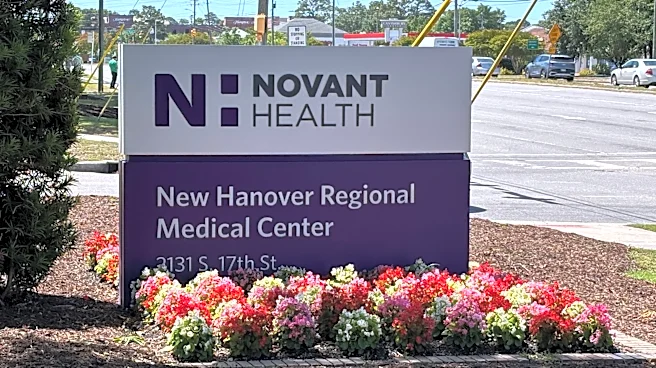









Novant Health New Hanover Regional Medical Center's Comprehensive Stroke Center has begun using a newly approved clot-removal technology that health system officials say could further reduce treatment times for patients experiencing ischemic strokes in Southeastern North Carolina.
The Wilmington hospital is the first in North Carolina to incorporate THUNDERBOLT, a computer-assisted vacuum thrombectomy system developed by Penumbra, according to a news release. The device received clearance from the U.S. Food and Drug Administration in June and represents a first-of-its-kind advancement in stroke treatment, according to the release.
With a recent procedure, neurosurgeon Justin Cappuzzo became the first neurosurgeon in North Carolina to use the technology
following FDA approval. According to the release, Cappuzzo also was the first neurosurgeon in the world to deploy the technology through a transradial approach, which accesses an artery through the wrist.
"This technology is a powerful addition to our capabilities and is only the latest example of how our center provides southeastern North Carolina with world-renowned stroke care," Cappuzzo said in the release. "Thanks to our advanced protocols, we are already removing clots faster than the national average, and this technology will allow us to be even more efficient in a situation where every minute counts to save brain cells."
How the technology is used
THUNDERBOLT is designed to help treat ischemic strokes, which occur when a blood clot blocks a blood vessel supplying oxygen to the brain.
At New Hanover's Comprehensive Stroke Center, care teams remove those clots through a thrombectomy, a minimally invasive procedure intended to restore blood flow.
Previous approaches included mechanical thrombectomy, which uses a catheter to pull out a clot, and aspiration thrombectomy, which uses suction to assist with removal.
The new system uses what is known as modulated aspiration, adjusting suction force during clot removal. According to the news release, the technology can also pull a clot through a catheter rather than requiring clinicians to manually drag it out.
Recognizing stroke symptoms
Stroke remains a leading cause of long-term disability in the United States. According to Novant Health, someone in the country experiences a stroke every 40 seconds.
Health officials encourage residents to remember the BE FAST warning signs of stroke:
B — Balance: Is the person suddenly unsteady?
E — Eyes: Is someone suddenly experiencing blurred vision, double vision or complete loss of sight in one or both eyes?
F — Face: Ask the person to smile. Does one side of the face droop?
A — Arms: Ask the person to raise both arms. Does one arm drift downward?
S — Speech: Ask the person to repeat a simple phrase. Is the speech slurred or strange?
T — Time: Call 911 immediately if any of these symptoms are present.
Rapid treatment is critical because restoring blood flow quickly can help limit brain damage and improve outcomes for stroke patients.
This story was created with the assistance of Artificial Intelligence (AI). Journalists were involved in every step of the information gathering, review, editing and publishing process. Learn more at cm.usatoday.com/ethical-conduct.
This article originally appeared on Wilmington StarNews: New stroke device could speed treatment at New Hanover hospital