



Despite multiple rainfalls over the last month, data shows Brunswick County's critical drought conditions remains with the sizzling summer heat.
Brunswick County is staying in the highest level of drought according to the most recent update from the North Carolina Drought Management Advisory Council (NCMDAC), according to a recent news release from the county. Brunswick has been classified as an Exceptional Drought (D4) county since July 9, the highest tier on the U.S. Drought Monitor scale.
The county first announced a stage one water conservation alert on June 9. County officials moved to a mandatory stage two water conservation alert on June 26, restricting irrigation from specific days and times for residents using public water.
By July 10,
the county jumped to stage three water shortage warning with mandatory restrictions due to nearly a third of Brunswick being classified under an Exceptional Drought. That day, county officials began prohibiting automated outdoor irrigation and pool filling for Brunswick County Public Utilities water customers.
Where Brunswick compares to other counties in North Carolina
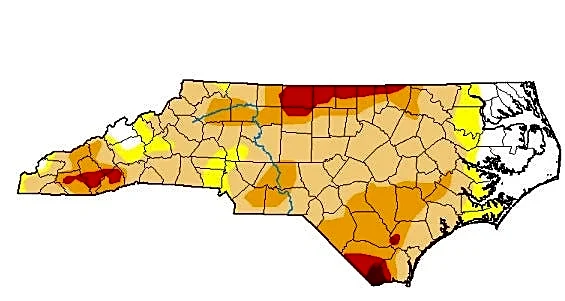
Most of the state is still in moderate to severe drought, with Brunswick experiencing the worst drought conditions, according to a Aug. 6 North Carolina Department of Environmental Quality (NCDEQ) news release.
Rain was hit or miss in the Wilmington area during the first week of August, with just above three inches of rainfall in Wilmington but only 0.71-inches around Longwood, as stated in a Aug. 4 drought update on the NCMDAC website.
As of Aug. 6, most of Brunswick remains under severe and exceptional drought conditions.
“A rainy July brought steady improvements in drought conditions across most of North Carolina. Groundwater and reservoir levels have been slower to recover. It’s only the beginning of August so we expect higher temperatures and increased water demand for at least another month,” said Klaus Albertin, chair of the NCMDAC and NCDEQ Water Resources engineer.

Nearly 20 inches of rain is needed to catch up
This is the driest the county has been in 15 years, according to the Drought scale. The NOAA Drought Termination and Amelioration map shows the Wilmington area, including Brunswick, needing roughly 17 more inches of rainfall to end the drought by Sept. 9.
National Weather Service Meteorologist Jordan Baker said the Wilmington area has a daily rainfall average of .24 inches during this time of year -- typically because of tropical systems.
Though the Wilmington area has had roughly 11.35 inches of rain in the last month, Baker said southern Brunswick has only had 4.17 in the last month and is already running in a water deficit. A deficit can increase quickly when there is no rain for one or more days at this time of year, Baker said.
"We definitely need the rain, but when in comes in thunderstorms and scattered thunderstorms in the afternoon, it misses a lot of different places," Baker said.
Water restrictions still stand for Brunswick
Under the county's Stage 3 limited irrigation schedule, water customers may only water lawns and landscaping with automatic irrigation systems less than one inch of water per week, between the hours of 8 p.m.-4 a.m. on designated days.
There are certain exemptions for commercial power washing and commercial car washing.
Full details about the restrictions and fees can be found on the county website.
Residents who have questions should contact their water service provider directly or Brunswick County Public Utilities at 910-253-2657 or utilityadmin@brunswickcountync.gov.
Funding available for impacted small businesses
The U.S. Small Business Administration (SBA) announced the availability of low-interest federal disaster loans to small businesses and private nonprofit organizations in North Carolina to offset economic losses caused by a drought beginning on April 28. The disaster declaration covers numerous counties, including Brunswick, Columbus, New Hanover and Pender counties. Dillon and Horry counties in South Carolina were also listed.
Under the declaration, the SBA’s Economic Injury Disaster Loan (EIDL) program is available to eligible small businesses, small agricultural cooperatives, nurseries and private nonprofit organizations — including faith-based organizations — with financial losses directly related to the drought. The SBA is unable to provide disaster loans to agricultural producers, farmers, or ranchers, except for aquaculture enterprises.
The loan amount and terms are on each applicant’s financial condition. Loans can be up to $2 million with interest rates as low as 4% for small businesses and 3.625% for private nonprofit organizations, with terms of up to 30 years. The loans may be used to pay fixed debts, payroll, accounts payable and other bills which could not be paid due to the drought.
The deadline to return economic injury applications is Jan. 19, 2027.
To apply online visit sba.gov/disaster. Applicants may also call SBA’s Customer Service Center at 800-659-2955 or email disastercustomerservice@sba.gov for more information on SBA disaster assistance. For people who are deaf, hard of hearing, or have a speech disability, dial 711 to access telecommunications relay services.
STAY CONNECTED: Keep up with the area’s latest Brunswick County news by signing up for the Brunswick Today newsletter and following us on Facebook and Instagram.
Savanna Tenenoff covers Brunswick County for the StarNews. Reach her at stenenoff@usatodayco.com.
This article originally appeared on Wilmington StarNews: With Brunswick in extreme drought, what it'll take to ease water woes