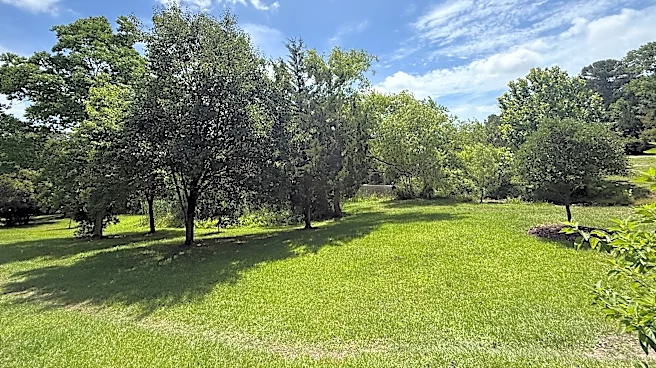









At first glance, Woodberry Forest and Whisper Creek look like many of the other middle-class neighborhoods in the Wilmington area.
But recently, these communities have gained attention for having the longest life expectancy in New Hanover County — nearly 85.8 years — according to a study that examines the life expectancy in census tracts across the nation.
A life expectancy of nearly 86 years is much longer than in other neighborhoods in New Hanover County and even exceeds the national average of 78.4 years, according to data from the Centers for Disease Control’s National Center for Health Statistics. It’s also a generation longer than Wilmington’s Northside, which has the lowest life expectancy at 68.4 years.
“The difference in the years — 17
years — is very striking, and in my opinion, that should interest a lot of people,” said Leslie Smiley, a resident of Woodberry Forest.
While the life expectancy data is based on averages, a closer look at the neighborhoods provides insight on what may have contributed to this disparity. Here’s a look at Woodberry Forest and what factors likely contribute to the health — and longer lives — of those who live there.
A sense of community
After their daughter was born, Smiley knew that her family had outgrown their home.
At the time, the couple was living on Peachtree Avenue in Wilmington. Smiley explained they were looking for a larger home with a yard and a “neighborhood situation” where there would be other families who looked out for one another.
She said they began looking around Woodberry Forest because it had “the look and feel of a family neighborhood.”
“We wanted a place where kids could ride their bikes,” Smiley said.
Nearby schools and affordability also mattered, as did accessibility and convenience. Woodberry Forest and Whisper Creek are located adjacent to James E.L. Wade Park in Wilmington, and both Long Leaf Park and Halyburton Park are just a short drive away.
Ultimately, the Smileys settled in Woodberry Forest. There they found community with their neighbors, many of whom were families with children. She added that when homes do come up for sale, they are often purchased by families who are looking to remain there for at least the next 15 years or longer.

“I know we have some folks on our street who were here when we moved here, and they’re still here,” Smiley said.
The story is similar for Aimee Allen, who also calls Woodberry Forest home. Allen noted that she was also considering the schools as she looked for a home.
Allen recalled that her neighbors host parties to get to know others on the street and socialize.
Overall, neighbors described the area as “quiet,” and noted people are often out walking, and it’s a place where neighbors gather their children for playdates.
“During Halloween, there’s a lot of people that do come to Woodberry Forest — or at least my neighborhood — to trick-or-treat,” Allen said.
Trees and greenspace matter
Driving through the Woodberry Forest and Whisper Creek neighborhoods, the first thing you notice are the trees.
The area has everything from tall pines and big live oaks to flowering trees and shrubs, and studies show the presence of those trees — and several nearby public parks — may lead to better overall health for those in the surrounding community.
As urban areas become more dense due to development, more researchers are looking at the correlation between greenspace, trees and health. Most of those studies have found that the presence of trees and publicly accessible greenspace have a positive impact on health outcomes for those in the surrounding communities. An article titled “Urban Trees and Human Health: A Scoping Review,” published in June 2020, analyzed 201 studies on how exposure to urban trees and forests affected health outcomes and found that “exposure to trees is associated with multiple health benefits.”
The issue of trees and greenspace came up during a listening session hosted by the Coastal Journalism Hub at the Pine Valley branch of the New Hanover County Public Library on Monday, Aug. 10, and attendees began making comparisons between the Woodberry Forest area and the Northside.
“The neighborhood around Portia Hines is really devoid of trees,” said Suzanne Wertman, project manager for the Coastal Journalism Hub.
Lori Birdsong, a resident in the downtown area of Wilmington, agreed.
The 2020 study also addressed the issue of inequity in tree distribution, noting studies have shown "there are often disparities in distribution of trees in urban areas with greater tree density being found in neighborhoods having higher household incomes, which may in turn exacerbate existing socio-demographic health inequities."
While the group discussed efforts to establish new trees in the Northside, Birdsong acknowledged that while there are many grants available to plant new trees, the trees must be cared for and watered, and most grants are looking for statistics about tree planting, not necessarily tree maintenance.
“The statistics when you get a grant are, ‘We planted this many trees,’” Birdsong explained. “Nobody wants to say, ‘We watered this many trees this many times.’”
The group at the listening session discussed how the presence of trees and greenspace does more than make for an appealing landscape; it contributes to more outdoor recreation as shade from the trees provides some respite from the area’s sweltering heat and grass cuts down on the dust and dirt that can be tracked into homes.
Those who live in the Woodberry Forest and Whisper Creek area often can be seen out walking, biking, and jogging. There are even bike lanes in the areas around Wade Park.
Access to fresh food
In addition to the presence of trees, parks, and outdoor recreation opportunities, residents in the Woodberry Forest and Whisper Creek neighborhoods also have access to fresh food thanks to a number of grocery stores.
Publix, Harris Teeter, Food Lion, Aldi, Lidl and Whole Foods are all located within five miles of the Woodberry Forest and Whisper Creek neighborhoods. There is also a Trader Joe’s nearby, as well as a Walgreens and a CVS.
“People ride their bike to the Aldi,” Allen said. “Kids are going to the CVS on their bikes.”
In addition to the number of grocery stores, the level of food insecurity is much lower in this area with only 9.6% of the population facing food insecurity.
Those attending the Aug. 10 listening session pointed out that this was a stark contrast to Wilmington’s Northside, which remains a food desert despite efforts to bring a grocery store to the area. In addition, nearly 34% of the population in that census tract faces food insecurity.
Jerry Jones Jr., a New Hanover County resident and candidate for the board of education, attended the listening session and questioned the percentage of poverty in the Woodberry Forest/Whisper Creek community. He equated the situation to genetics with the number of stores being the physical expression of what lies beneath — the incomes of the residents in that area.
Data shows that the poverty rate in the Portia Mills Hines Park census tract is just over 30%, while the poverty rate in the Woodberry Forest/Whisper Creek area is less than 5 percent.

Less stress contributes to better health
While it’s difficult to pinpoint exactly why those living in the Woodberry Forest and Whisper Creek area have a longer than average life expectancy, medical professionals agree it’s likely a combination of factors, often summed up with the term "allostatic load," which refers to the cumulative wear and tear on the body caused by chronic stress.
A 2022 study published in the "American Journal of Preventative Medicine" found that high allostatic load was associated with an increased mortality risk of 22% for mortality of all causes and an increased risk of 31% for cardiovascular disease mortality.
While residents in the Woodberry Forest and Whisper Creek area have lower rates of poverty and food insecurity, those who attended the listening session noted this equates to more stability and a lower allostatic load.
“Allostatic load can alter your genetic patterns and your whole life because it wears you down,” Allen said.
“It’s not just mental; it’s physical,” Wertman agreed.
Renee Spencer is the community engagement editor at the StarNews. Reach her at rspencer@usatodayco.com. This story was produced in partnership with the Coastal Journalism Hub, a collaborative focused on health and wellbeing in New Hanover County.
This article originally appeared on Wilmington StarNews: These factors link to living longer in New Hanover's healthiest area