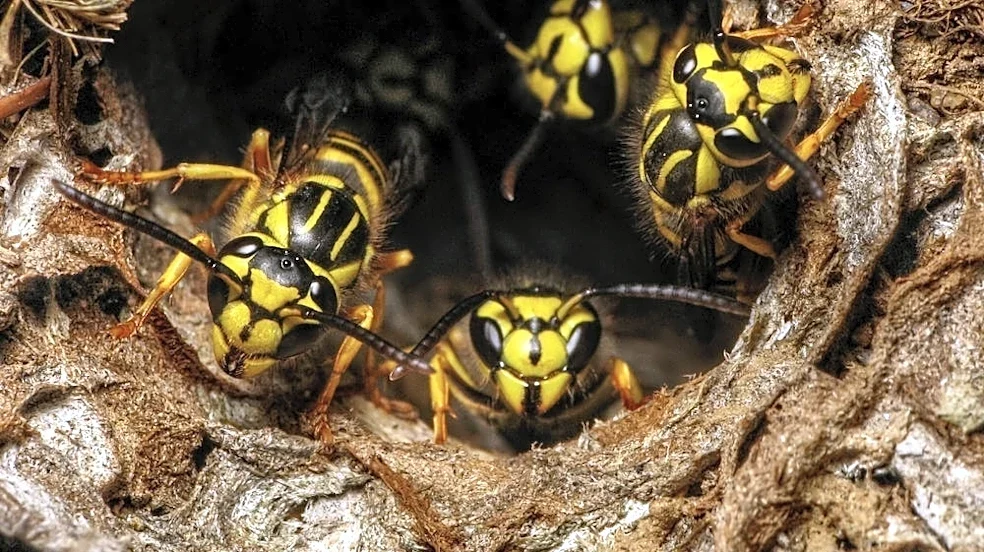








An angry bunch of wasps is causing a bit of a problem on Bald Head Island near the mouth of the Cape Fear River.
But researchers and local officials say the situation could be worse, especially if the irate hornets had been found out to be interlopers from Southeast Asia as some had initially speculated.
While the yellow-legged hornet, an aggressive invader first discovered around Savannah, Georgia, in 2023, has been making its way north in the Carolinas, with the first established presence in North Carolina discovered in late July 2026 near Charlotte, it might only be a matter of time before the invasive species establishes itself in the Cape Fear region.
Still, the native wasps on the Brunswick County enclave have created a problem that's prompting
officials to act.

What's the buzz?
In early October 2026 Bald Head officials received word of aggressive wasps harassing people and pets along part of the Bald Head Woods Reserve trail. Bald Head Woods is a roughly 190-acre protected maritime forest that's part of the N.C. Coastal Reserve system.
Village officials responded by closing a chunk of the trail and working to determine what species of insect was causing the problem.
Researchers with the Bald Head Island Conservancy and N.C. Department of Agriculture and Consumer Science quickly identified the insects as native Southern yellow jackets, a type of wasp that can become aggressive if their ground-based nests are disturbed. That appears to be what happened here.
But the village on its website initially declared the wasps as "invasive," which prompted some confusion.

The recent arrival
Interest in invasive wasps has been in overdrive in the Tar Heel State since officials in late July 2026 announced the discovery of yellow-legged hornets near Charlotte.
The invasive invader has been slowly moving north since its arrival, probably via lumber or other cargo from Asia, in Georgia, so its sighting in North Carolina is not a surprise.
But researchers, while unlikely to stop its advance into North Carolina, are at least hoping to stem its spread. That's because the Asian hornet is a very dangerous threat to honeybees, important pollinators that drive agricultural productivity along with producing honey for a variety of products.
With entomologists calling it "hawking-like behavior," the hornets are known to linger outside the entrance of bee hives, picking off bees one by one. Once they have a bee, the hornets have been known to rip them apart limb-by-limb and then decapitate them to reach their rich, gooey abdomen. The hornets can decimate hives in a short space of time.
The one characteristic scientists hope to use against the hornet is its visually striking colors. The hornet has large eyes, an orange face and legs painted gold − hence its name. That should make the invasive bug easy for beekeepers to spot.
Stepped-up monitoring for the invader is ongoing around Charlotte, with officials setting up hundreds of traps around the Queen City.
And they are finding more invaders. Dr. Greg Wiggins, biological control administrator with the N.C. Department of Agriculture, said another nest was found in the Harrisburg area of Charlotte on Monday, Oct. 12.
"We will continue to trap in the area to make sure there is not another nest associated with the infestation," he said.

Back to Bald Head
Clemson University, which has an aggressive program tracking the expansion of the yellow-legged hornet, has yet to record any nests north of the Charleston area in Georgetown or Horry counties along the S.C. coast.
But that doesn't mean the wasps aren't already there, since discovering the expanded range of the invaders often falls on the shoulders of beekeepers and backyard citizen-scientists.
While researchers watch, wait and try to monitor the hornet's march northward, officials on Bald Head are dealing with a more immediate problem.
Officials have sprayed the yellow jacket nest several times, but that only caused the wasps to relocate a little farther down the trail, said village spokesperson Carin Faulkner.
State officials also have gotten involved, since the trail is on state property.
Christy Simmons, spokesperson with the N.C. Division of Coastal Management, of which the state coastal reserves fall under, said reserve staff are coordinating with the village to deal with the wasps and to protect visitor safety.
"Because the insects have been confirmed as a native species, there was not an invasive-species removal effort," she said.
Reporter Gareth McGrath can be reached at GMcGrath@usatodayco.com or @GarethMcGrathSN on X/Twitter. This story was produced with financial support from Journalism Funding Partners. The USA TODAY Network maintains full editorial control of the work.
This article originally appeared on Wilmington StarNews: Bald Head Island has a wasp problem. But it could be much worse