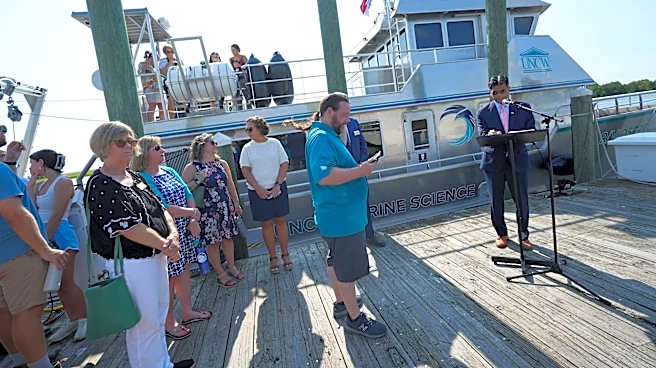







As the boat's silver hull and superstructure glittered under the hot Carolina sun, the smiling dignitaries and guests at the University of North Carolina Wilmington's Center for Marine Science admired the school's new state-of-the-art research vessel that had been more than a decade in the making.
"The R/V Osprey represents what we are as a university," said UNCW Chancellor Dr. Aswani Volety
on Thursday, Sept. 3.Dr. Ken Halanych, executive director of the Center for Marine Science, echoed the sentiment.
"It is a commitment to ask bigger questions," he said.
Filled with all of the latest scientific bells and whistles, the Osprey promises to propel UNCW into the upper echelon of ocean research universities.
Literally a seismic jump in capabilities
from the school's existing research vessel assets, the 78-foot-long − 1 foot longer than Duke University's research boat, Halanych noted proudly − the Osprey arrived at its home port at the school's marine center in Myrtle Grove on Tuesday.
The $7.2 million vessel was largely funded through state appropriations and unlike the school's former lead research vessel, the Cape Fear, was purpose-built for science missions.
The Osprey was constructed in Washington state before hitching a ride on a container ship to South Florida. There a UNCW crew lead by Jay Styron, associate director of the school's marine operations, picked it up and brought it to Wilmington, with an overnight stop in Charleston, South Carolina.
On Sept. 3, the 97-ton vessel had its official unveiling before school brass and excited researchers and students.
Calling it a powerful platform to promote a greater understanding of the ocean, officials said the Osprey has the range, sensors and facilities to allow scientists to work on projects anywhere along the East Coast and more than 100 miles offshore − beyond the continental shelf, where there is still much to be discovered and explored.
Styron said onboard facilities include wet and dry labs, an A-frame crane that allows the deployment and retrieval of things like offshore buoys, and satellite communications to allows researchers to share and receive real-time data. With a healthy range, an onboard system to deliver fresh water, a catamaran-style hull to help with stability, and facilities to support parties of up to 10, he said the only real limitation on how long the Osprey can stay out at sea is food supplies.
"It is really going to take our science to that next level," he said.
And how does the Osprey drive?
"Like a dream" Styron said smiling while standing on the bridge, which is full of large computer screens that monitor the boat's performance, surroundings and the weather. "It's a lot of fun to operate and we all can't wait to take our science out to sea."
Reporter Gareth McGrath can be reached at GMcGrath@usatodayco.com or @GarethMcGrathSN on X/Twitter. This story was produced with financial support from Journalism Funding Partners. The USA TODAY Network maintains full editorial control of the work.
This article originally appeared on Wilmington StarNews: UNCW's new research vessel opens up new waters, projects for scientists