





After months of delays, New Hanover County has adopted an update to its comprehensive land use plan.
The Board of Commissioners unanimously voted to adopt the 2026 New Hanover County Comprehensive Plan at a meeting on Oct. 5. The document outlines the long-term vision for growth and development across New Hanover, aiming to address concerns of overdevelopment and infrastructure needs.
Planning and Land Use Director Rebekah Roth said that her staff had worked on the update for several years, utilizing public comments, staff analysis, commissioner direction and planning board recommendation. The update was previously presented back in February, though commissioners decided to delay adoption to allow for more public input.
Here are four things to
know about the new plan.
New place types
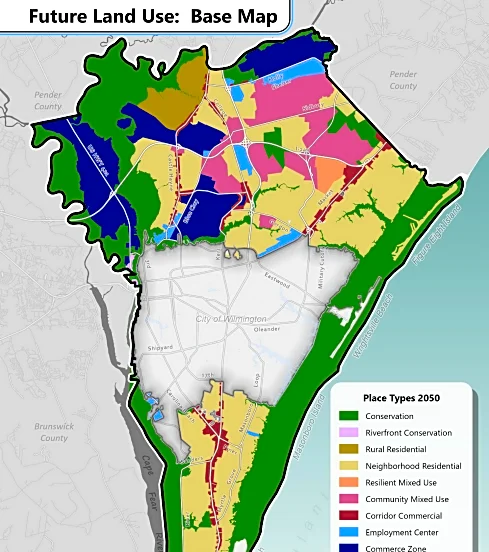
The plan establishes three new place types across the county. While place types aren’t legally binding like zoning districts, they are used by planning staff to ensure cohesive design, infrastructure efficiency, and coordinated service delivery.
The Resilient Mixed Use place type will be applied to three properties to encourage walkable centers that include homes, shops, offices and civic spaces. The designation allows for moderate-density development up to 17 units per acre. Two of the smaller properties are located near the southern end of New Hanover, while the largest property is east of the Military Cutoff Extension.
Commercial Corridor areas will concentrate commercial development along major streets to ease traffic on secondary roadways. The corridors are located along roadways such as Market Street and Carolina Beach Road. Encouraged uses will include retail, commercial services, office, medical and civic.
Additionally, the plan establishes a designated Riverfront Conservation place type for environmentally sensitive properties along the west bank of the Cape Fear River.
Updated name
The updated plan bears a new name. The previous draft was titled “New Hanover County Destination 2050” and it was initially designed to be a roadmap for the coming decades. Roth said that the new name, the 2026 New Hanover County Comprehensive Plan, speaks to the fact that it is a living document that is intended to adapt alongside the county’s changing needs.
Despite the name change, the plan still uses 2050 as a reference point. Data included in the plan notes that New Hanover’s population is projected to jump to 328,626 by 2050, a 45% increase since 2020.
Minimum housing code recommendation
The new plan directs county staff to research and recommend implementation of a minimum housing code for the unincorporated areas of the county. Minimum housing codes, such as the one adopted by the city of Wilmington, outline specific requirements for residential dwellings including adequate ventilation and plumbing facilities.
Commissioner Rob Zapple noted the plan does not establish a code on its own. County Manager Chris Coudriet said that a comprehensive plan is not the proper venue for the code, but that approval of the plan would empower staff to pursue development of a code. Once drafted, the minimum housing code would either be incorporated into the county’s Unified Development Ordinance or become a standalone ordinance.
Master planning prioritization
Master planning of developments on large parcels is identified as one of the county’s top goals in the plan. County staff collaborated with large property owners and developers to “craft land use alternatives and guidance for cohesive, infrastructure ready projects and recommendations for master planned development proposals.”
Through the review process for large development proposals, the county can implement conditions for infrastructure improvements in the surrounding area. This often includes roadway and utility improvements.
Daniel Sheehan covers New Hanover County for the StarNews. Reach him at dsheehan@usatodayco.com.
This article originally appeared on Wilmington StarNews: Four things to know about New Hanover's new development plan