


Somewhere in Raleigh this summer, without a press conference or a vote to shut anything down, a "Closed" sign was hung on one of North Carolina's signature industries.
The North Carolina Film and Entertainment Grant is the program that persuades film and television productions to spend their money here instead of somewhere else. It is funded at $31 million a year, and it works exactly the way taxpayers should want it to: a production receives nothing up front, spends its money in North Carolina first, submits to an audit, and only then is rebated a portion of what it demonstrably spent. But the program committed more than its allotment could cover, the reserve that once cushioned it is gone, and the state's own Department of Commerce now says
North Carolina likely "will not be able to award any significant film grants for new productions until 2029."
Read that sentence again. Not a lean year. Not a belt-tightening. Three years of nothing.
How the fund was allowed to overcommit itself is a conversation worth having, and I will leave it for another day. What matters now is what three dark years will actually do to us — because I am not sure most North Carolinians, or most of our legislators, have fully reckoned with it.
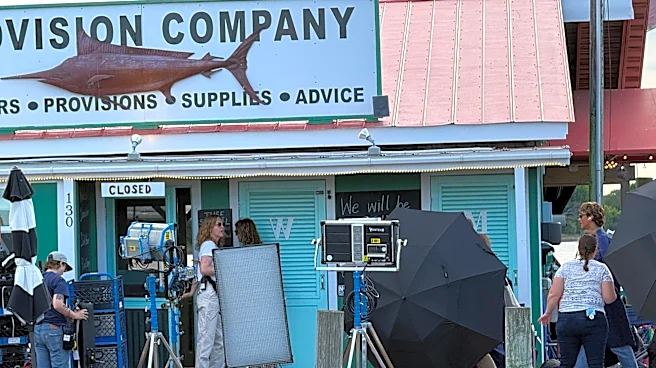
Here is the irony we should say out loud: the fund ran dry because the program was working. Demand outstripped supply. In 2024, more than 55 productions filmed across this state, generating over $302 million in direct in-state spending — the second-best year since the current program began. "The Summer I Turned Pretty," "The Waterfront," "The Runarounds" — shows watched around the world were made by North Carolina hands. Since 2017, productions have spent more than $1.4 billion here and generated nearly 97,000 job opportunities for our crews and talent. An oversubscribed program is not a failed program. It is a successful one that was never funded to the scale of its own success.
And a film industry is not a factory that can be idled and switched back on. It is people — grips, gaffers, costumers, carpenters, camera operators, location managers, caterers — most of them our neighbors, many of them second- and third-generation film workers. Nobody can last three years with no income. If North Carolina is closed until 2029, they will do what any of us would do: follow the work. To Georgia. To New York. To New Jersey. And when our sign finally flips back to "Open," we will discover the cruelest part of this arrangement — the customers will have built their stages and their habits elsewhere, and there will be no one left here to run the store.
This is not speculation. It is arithmetic that other states have already done. New York just raised its film incentive to $800 million a year — more than twenty-five times our allotment — with a 30 to 40 percent credit guaranteed through 2036. New Jersey offers up to 45 percent, written into law through 2049; its annual production spending grew from $67 million in 2017 to $833 million in 2024, its crew hiring doubled in a single year, and Netflix is building a billion-dollar studio complex at Fort Monmouth. Those states did not stumble into a boom. They decided they wanted these jobs, and they legislated accordingly. If you want your people to have jobs, you have to remain competitive with the other places those jobs could go. Work goes where it is wanted.
As a country, we have done a shameful job of watching work leave — outsourced overseas, a gift to the owners of capital and a cruel surprise to the workers. We should not let the same thing happen between the states, with North Carolina on the losing end, over a sum that rounds to almost nothing in our budget.
We know what losing this industry feels like, because we have lived it. HB2 cost this state billions in canceled projects and reputational damage — an Associated Press analysis put the toll at $3.76 billion — and our film community spent years clawing its way back, production by production, until we rebuilt one of the best stretches this industry has ever had here. It would be a bitter thing if what a boycott could not finish, our own bookkeeping did.
To the General Assembly's credit, the budget signed this July raised the per-project grant caps substantially — feature films from $7 million to $20 million, series to $25 million a season. That is the right instinct, and it deserves recognition. Wilmington's own Sen. Michael Lee has been indefatigable in his support of film in North Carolina and a true leader in the legislature on this issue; those improvements bear his fingerprints, and our community owes him its thanks. But raising the caps without replenishing the fund is printing a bigger menu for a restaurant with an empty kitchen.
So, the fix is two parts, and both are within reach. First, recapitalize the fund now, so the rebates already promised are honored and the "Closed" sign comes down years ahead of 2029. Second, raise the annual allotment so that success is never again treated as a crisis. Against a $34.4 billion state budget, $31 million is less than a tenth of one percent — and much of it flows straight back to the state through income taxes, sales taxes, hotel rooms, lumber yards, equipment rentals, and restaurant tabs in every county a production touches.
Members of the General Assembly: you did not set out to close this industry, and you are the only ones who can reopen it. You showed this summer that you believe in North Carolina film. I ask you, respectfully and urgently, to finish the job in the next session — before the people who built this industry are forced to go build someone else's. Fix the problem now, while there is still someone here to fix it for.
Jonas Pate is a North Carolina native and creator of television shows “Outer Banks” and “The Runarounds.”
This article originally appeared on Wilmington StarNews: Legislators must prevent shutdown of NC's film industry | Opinion