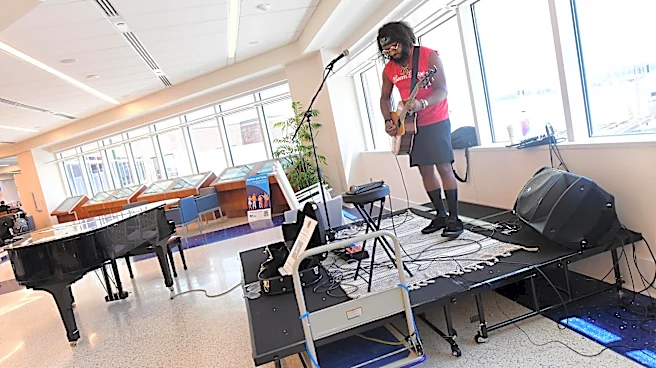

For some people, their first taste of Wilmington culture in 2026 came shortly after arriving at Wilmington International Airport. There, on their way to ground transportation, they heard the deep, rich
voice of Wilmington singer and songwriter Jared Michael Cline.
Every Monday afternoon since January, Cline, whose hippie-adjacent look belies a style that blends folk, country, rock and soul, has performed to passers-by at the airport, part of the "Rhythms & Tunes" series to highlight Wilmington artists.
For Cline, who's been featured in regional showcases of Black country musicians, this is perhaps the most unusual of the two dozen or more gigs he plays every month, both solo and with his band, Bacon Grease. Appearing everywhere from bars and restaurants to breweries and wedding venues, he travels as far north as New Bern and as far south as Myrtle Beach, South Carolina, and makes annual treks to play Florida and the North Carolina mountains.

Most of Cline's gigs, however, are in the Wilmington area, making him one of a handful of working musicians in the Port City with a full-time job playing tunes.
Ever since he was a kid, Cline said, "I wanted to be able to show up with my guitar case to work just like other guys show up with their briefcase."
For nearly 10 years now, he's done just that. And while the gigging lifestyle has its perks, being a full-time contributor to the musical soundtrack of Wilmington comes with challenges as well.
For this story, I checked in on and hung out with Wilmington artists who make their livings solely or mainly playing live music. During interviews, I heard about everything from magical moments and horror stories to pragmatic business concerns and lofty artistic dreams.
In the process, a snapshot of what it means to be a working musician in Wilmington in 2026 came into focus.
Musical lives
By some estimates, several dozen people make their livings as working musicians in the Wilmington area, perhaps more than 100. It's a number that's grown in recent years as the Port City has added population and its entertainment options have expanded.
One of the elder statesmen of the working musician cohort is blues singer and songwriter Randy McQuay, who for more than a quarter-century has been a steady presence on the Wilmington scene with his gritty guitar riffs, groovy harmonica playing and warm, gruff vocals.
"The number of places to play has really grown," McQuay said. "Half the musicians here now would've starved to death in the early 2000s."

McQuay and others also noted that while the number of outlets for solo artists has increased, the number of places for full bands hasn't kept pace.
"I feel bad for bands trying to make it in this town," McQuay said, adding that living as a working musician in Wilmington primarily means playing lots of solo and duo gigs.
Which makes a kind of economic sense, both for artists who don't have to split a payday multiple ways, and for venues whose live-music aspirations are served by one person with a guitar.
"The solo stuff definitely helps musicians take it full-time," said Wilmington singer Delia Stanley. "That said, there are drummers and bassists playing in four bands."
Stanley, who often performs around town with her partner, Shawn Pugh, is like the den mother of the Wilmington music scene, filling social media with a running list of area open mics and posting various resources for artists online.
"People come to me for advice on how to take things to a full-time level," Stanley said. "I tell them, 'It's not a job. It's eight jobs in a trench coat.'"

Independent artists have to not only sing and play, she said, but also serve as their own booker, publicist, social media manager, sound person and roadie.
Cline said he's got an agent who books some gigs for him, but he books Bacon Grease on his own. McQuay said he works off a "sure thing" calendar and fills in dates throughout the year.
"You have to think three to six months ahead of the game," Stanley said. "I've been booked for my year since April. You definitely have to be proactive."
Adding to the complexity is a shifting landscape where venues change from year to year, if not month to month.
McQuay said that of the Wilmington places he started playing in the early 2000s, aside from The Rusty Nail on North Fifth Avenue, "They're mostly all gone."
Musical dreams
For McQuay, the dream of playing music for a living started as a teenager.
"Playing music got me through college," he said. "I had a business card. They might've had perforated edges, but I was already approaching it as a business."
McQuay, who won the prestigious International Blues Challenge's solo/duo division in Memphis in 2015, played close to 300 shows a year in his younger days. He now plays less often, but gets paid more for each gig.
What hasn't changed, he said, is "the passion. I thoroughly enjoy what I do. Even if I have a show that doesn't go the way I like, they're few and far between. I always planned for a life in music, the ups and the downs."

For Cline, it was "never about chasing the fame or the money or anything like that," he said. "I just always wanted to be (doing) the one thing I could never get sick of doing."
Jesse Stockton has been playing in the Wilmington area ever since he scored his first gig at Lagerheads in Wrightsville Beach in 2006 — enough time for him to have paid off two cars with his musical earnings, he said with a boyish grin.
Stockton played acclaimed North Carolina roots music gathering MerleFest in 2014 with his old band, Moonlight Co., and he's a regular at such venues as the Wilmington Distillery, Whiskey Tango Foxtrot and Goat & Compass.

He compared being an itinerant Wilmington musician to the "ski bums" he used to know in Boone.
"There's five people living in this apartment that's meant for two people, and it's just like, 'Man, you guys care about skiing this much?'" Stockton said. "Of course, I care about music that much."
That's because, Stockton said, there's no feeling like the one when he's on stage in a flow state where "my body is allowed to connect with itself and I'm still remembering all the lyrics, and I know what chord is coming."
Musical realities
The life of a working musician might seem like a pretty sweet gig. Your workday's just two or three hours long spent playing tunes you love, right?
"I've heard it often: 'Well, at least what you do is fun.' And it's like, 'No, you see the part that looks fun,'" Cline said on a summer afternoon that marked his first day off after 17 straight days filled with gigs. "A lot of people only see you play that three-hour set. They don't know you've got to travel, make sure your equipment's working. You got to load in your own stuff, tear it down. … There are moments that are really fun, but you don't see what goes in before and after."
Stockton said he's had gigs where he's had to buck up and play when "I don't even want to be (there). They put me right in the sunshine. It's hot as (heck) out here. I'm getting eaten by mosquitoes. I'm not even getting paid my full rate. That's a lot of energy drained" that could be going into his performance.
Bad weather can lead to last-minute cancellations, costing musicians a payday.
On the other hand, Cline said, "I'm my own boss. … I go to work when everybody's not at work, and I'm off when everybody's at work. I can disc golf every morning if I want to."
"A lot of (musicians) are like, 'I don't think I could go back to a 9 to 5,'" Stanley said, but, with a child to support, she did take a part-time job recently to help make ends meet.
"This year has been a tough one," she added, with inflation and rising costs, and rates that haven't budged much since before Covid.
Also, musicians don't generally get sick days. So, when McQuay lost his voice for a little while earlier this year, "I got to a dark place," he said. "Every day that went by was a day of lost income, and a day of uncertainty about the future."
Having a daughter to support got him doing some soul-searching: "Am I going to consider something else?"
He never got a diagnosis, McQuay said, but as of August of this year, his voice was mostly back and he was gigging again.
'I wouldn't trade one second'
Most of Wilmington's working musicians know each other, but "we don't really see each other until we see each other because we're all playing at the same time," Cline said.
But they do check in on each other.
Earlier this year, after McQuay lost his voice, Cline called him and they ended up having an hour-long conversation.
"I've had a lot to think about lately because I just turned 40 and I got nothing to show for it. And it's just like, well, to what end? What's next? I don't think I can do it at this frequency much longer," Cline said. "At the same account, I don't really see myself doing anything else because I don't really have any other skill set. It's pretty much the only thing I know how to do."

Similar thoughts run through Stockton's mind.
"Sometimes I think, 'Have I placed myself on a road to nowhere? And do I care?'" Stockton said.
But when he doubts himself or his direction, Stockton said he always asks himself another question: "Do I have enough faith? I wouldn't trade one second, even on my worst day."
John Staton is the arts and culture reporter for the StarNews. You can reach him at jstaton@usatodayco.com.
This article originally appeared on Wilmington StarNews: For Wilmington's working musicians, paying bills with a labor of love